Tag: GovCon

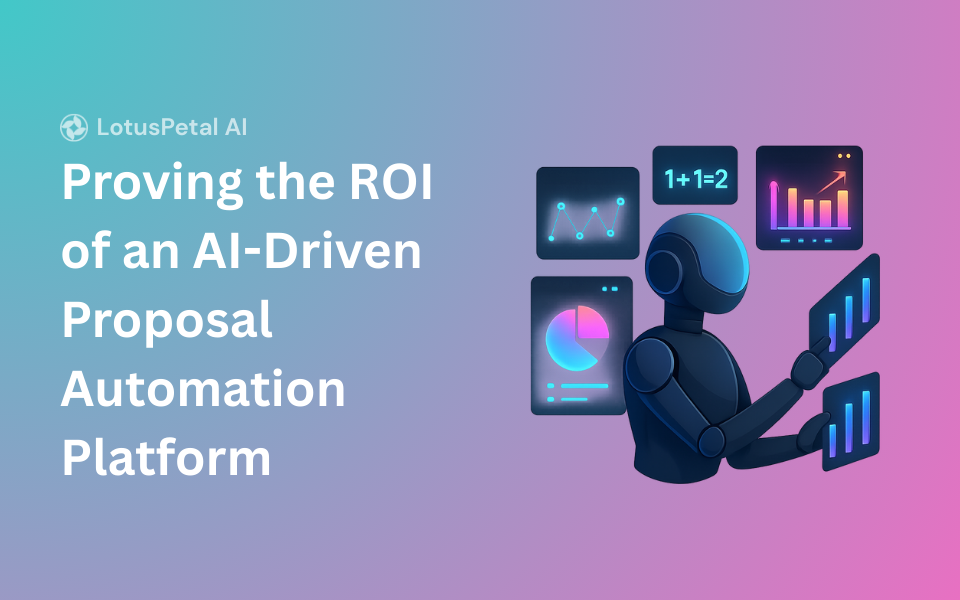
  • Proving the ROI of an AI-Driven Proposal Automation Platform

    Proving the ROI of an AI-Driven Proposal Automation Platform


    Table of Contents


    How much is slow, manual proposal development really costing you? The number is bigger than your team’s budget. 

    As the volume and complexity of RFPs continue to rise, proposal teams are under tremendous pressure to deliver accurate, compliant, and high quality responses at speed. Company leaders aren’t looking for “shiny new tools”, they’re looking for measurable business impact. 

    ROI, Return of Investment, is no longer a buzzword. It’s the benchmark that determines whether an AI-powered proposal automation platform is a strategic investment or another line item.  

    LotusPetal.AI delivers tangible ROI by reducing inefficiencies, eliminating rework, and reclaiming opportunity cost, making financial impact visible within weeks, not months. For a broader understanding of how these systems work, see our guide on AI Proposal Software: The Complete Guide to AI Powered Proposal Automation.


    The Hidden Costs of Manual Proposal Development

    Before quantifying ROI, it’s important to understand the baseline: the cost of sticking with manual, fragmented proposal workflows. 

    Inefficiency That Slows Revenue

    • Hours spent formatting, rewriting, validating compliance, and hunting for content. 
    • Heavy reliance on SMEs, subject matter experts, to recreate information they’re provided dozens of times.
    • A cascading “domino effect” of delays that slows down pipeline velocity and reduces time spent on revenue-generating work. 

    Underestimated Opportunity Cost

    • Bottlenecks that limit your submission capacity.
    • Rushed or incomplete responses reduce competitiveness.
    • SMEs are routinely pulled from strategic initiatives to support repetitive proposal tasks. 

    Team Fatigue and Burnout

    • Repetitive manual work drives cognitive fatigue and decreased focus.
    • Review cycles multiple, introducing more stress and longer turnaround times.
    • Knowledge fragmentation slows onboarding and increases training cost. 

    These aren’t just operational challenges, they are direct hits to your bottom line. 


    How AI-Driven Proposal Automation Drives ROI

    LotusPetal.AI redefines proposal development by shifting teams from manual execution to strategic impact. 

    Speed That Compounds Across Proposal Lifecycle

    This speed doesn’t just save hours, it increases proposal capacity and accelerates pipeline movement. These efficiency gains are also explored in 5 Ways AI Automation Improves RFP Response Times.

    Accuracy & Compliance That Reduces Rework

    • Intent parsing: Advanced NLP distinguishes compliance requirements, strategic asks, and fact based questions. 
    • RAG powered synthesis: Using retrieval-augmented generation (RAG), the responses are grounded in verified internal content eliminating hallucinations and inconsistencies.
    • Automated compliance checks: Instant validation against RFP requirements reduces late-stage revisions.  

    Fewer review cycles translate directly into measurable cost savings. This aligns closely with AI RFP automation, where automation improves both speed and accuracy. For deeper insight, see Improving Proposal Accuracy and Compliance through AI.

    A Smarter Content Engine That Protects SME Time

    • Reusable, version controlled content reduces repetitive SME drafting. 
    • Intelligent recommendations ensure on-brand and accurate responses every time.

    How to Quantify the ROI of an AI Proposal Automation Platform

    A compelling business case starts with translating these benefits into measurable financial outcomes. 

    Core Metrics to Track

    • Time saved per proposal 
    • Increase in monthly or quarterly submission volume
    • Reduction in review cycles
    • Improvement in win rate
    • SME hours returned to high impact work

    The LotusPetal AI ROI Formula: 

    ROI = (Hours Saved * Hourly Cost of Team) + (Incremental Revenue from More Wins – Platform Cost) 

    Quantifying Recovered Opportunity Cost

    • Increased submission volume through faster drafting and validation. 
    • Higher quality submissions due to improved accuracy and compliance
    • Reduced SME Dependency, shifting experts to strategy rather than drafting. 
    • Higher win rates driven by narrative consistency and evaluator-ready responses. 

    Hard Vs. Soft Savings 

    • Hard Savings: Lower labor hours, reduced outsourcing, increased capacity.
    • Soft Savings: Consistency, morale improvements, reduced burnout, predictable quality. 

    Financial Impact with LotusPetal.AI

    Based on early platform data, LotusPetal.AI consistently delivers measurable improvements: 

    Typical Efficiency Outcomes

    • 90% faster first-draft generation
    • 30-40% fewer review cycles due to higher accuracy and automated compliance
    • Turnaround time reductions from weeks to days, even for complex RFPs
    Image 1: Estimated efficiency outcomes with LotusPetal AI.

    Revenue & Pipeline Impact

    • Higher submission capacity drives a stronger pipeline.
    • Improved compliance leads to stronger scoring and higher win probability. 
    • Consistency across teams reduces risk and strengthens brand credibility. 

    Internal Team Impact

    • SMEs reclaim hours for strategy, innovation, and client-facing work. 
    • Proposal managers handle higher volumes with less stress. 
    • Teams experience less burnout and more predictable delivery cycles.

    What Makes LotusPetal.AI Unique in Delivering ROI

    Built for Accuracy-First Teams

    LotusPetal.AI goes beyond drafting, it analyzes intent, validates compliance, and produces structured, evaluator-ready responses grounded in verified knowledge. 

    Purpose-Built Proposal Automation 

    • Native RFP parsing
    • Auto-generated compliance matrices
    • Knowledge hub driven content generation tailored to each client

    This three-pillar architecture, Dynamic Knowledge Hub, Advanced NLP, and a Synthesis Engine, is the core foundation of LotusPetal.AI’s engine. 

    Scalable for Enterprise Growth

    Image 2: LotusPetal AI’s successful VAPT assessment certification.

    Proposal Automation as a Profit Multiplier

    AI-powered proposal automation is no longer a future-state capability, it’s a competitive advantage today. By transforming the proposal lifecycle from manual, fragmented work into an intelligent, automated workflow, LotusPetal AI creates a direct and measurable financial impact. 

    Speed increases capacity.

    Accuracy improves win rates. 

    Automation reduces costs. 

    Strategic focus elevates team performance. 

    For organizations navigating high-stakes, high-volume RFP environments, LotusPetal.AI is more than a productivity tool, it’s an ROI engine that compounds value across your entire proposal function. 

    If you’re ready to quantify the financial impact AI can bring to your proposal function, estimate your projected ROI with LotusPetal.AI’s ROI calculator and see how we can help transform your proposal operation.


    Common Questions on Cost Savings, Efficiency, and Business Impact

    How do you measure ROI in proposal automation?

    ROI is measured through time savings, increased proposal volume, improved win rates, and reduced manual effort.


    What are the biggest ROI drivers in AI proposal tools?

    Speed, accuracy, reduced rework, and increased submission capacity are the primary drivers.


    How does AI reduce proposal costs?

    AI reduces costs by minimizing manual labor, reducing review cycles, and improving efficiency.


    Can AI improve proposal win rates?

    Yes. AI improves win rates by increasing quality, ensuring compliance, and enabling faster responses.


    What is a compliance matrix in proposals?

    A compliance matrix tracks all RFP requirements and ensures they are fully addressed in the proposal.


    How quickly can organizations see ROI?

    Many organizations see measurable ROI within weeks through time savings and improved efficiency.


    Related Sources

  • Improving Proposal Accuracy and Compliance through AI

    Improving Proposal Accuracy and Compliance through AI


    Table of Contents


    The Rising Cost of Proposal Errors 

    Even the most promising proposal can fail, not because of weak ideas, but because of preventable mistakes. 

    Teams navigating competitive RFPs must interpret detailed instructions, compliance rules, and rigid formatting requirements. Missing even one of these items can lead to costly rework or outright rejection. 

    Manual review makes this harder: 

    • Contributors use different writing styles
    • Requirements shifts or get overlooked
    • Information becomes inconsistent across sections
    • Version control breaks under pressure

    Time that should go toward strategy and storytelling is instead spent cross-checking details, verifying requirements, and hunting for inconsistencies. 

    LotusPetal.AI changes this dynamic. Through structured workflows and automated compliance checks, it reduces human error, accelerates accuracy, and helps teams deliver clear, compliant, evaluator ready proposals. Learn how AI improves proposal accuracy and compliance.


    The Challenge of Maintaining Proposal Compliance at Scale

    As proposal complexity grows, human reviewers struggle to track every instruction and requirement:

    • Missing certifications
    • Conflicting data versions
    • Misaligned sections after revisions
    • Misinterpreted clauses
    • Incorrect or inconsistent formatting

    Even small oversights such as a mislabeled appendix, outdated table, or missing form can determine whether a bid wins or loses.

    Under tight deadlines, these risks multiply. Manual review alone is no longer enough to match the competitiveness of modern RFPs, especially in government and enterprise procurement. Using a structured compliance matrix becomes critical at scale.


    How LotusPetal.AI Improves Proposal Accuracy and Compliance

    LotusPetal.AI is designed to bring structure, precision, and predictability to the proposal process. 

    Automated compliance validation

    The platform reviews every proposal section against RFP requirements:

    • Mandatory sections
    • Required terminology
    • Formatting rules
    • Structural alignment
    • Missing forms or attachments

    Gaps are flagged early, long before final submission.

    Consistency across all proposal sections

    LotusPetal.AI cross-references content to ensure:

    • Technical, management, and pricing volumes stay aligned
    • No conflicting numbers or outdated references remain
    • Version control holds across large teams

    Teams no longer need to manually track every change. The system does it in the background. 

    Language clarity and evaluator readiness

    Beyond compliance, LotusPetal.AI evaluates: 

    • Tone and readability
    • Structural clarity
    • Professional formatting
    • Customer-focused messaging

    It helps teams create polished, evaluator friendly proposals that reflect a unified voice. 


    From Rework to Readiness: The Measurable Impact of AI 

    Before AI driven validation, teams could spend days:

    • Building compliance matrices
    • Conducting manual redline reviews
    • Verifying files and appendices
    • Fixing formatting inconsistencies

    And even after multiple reviews, errors still slipped through.

    With LotusPetal.AI:

    • Compliance checks take minutes, not days
    • Review cycles become faster and more predictable
    • Teams experience fewer disqualifications
    • First round approval rates increase
    • The entire submission becomes more consistent and professional

    Every proposal reflects the same structured, compliant, high quality standard. This strengthens evaluator trust over time. See how proposal automation boosts efficiency and response time.


    Beyond Compliance: Secure and Confident Collaboration

    Accuracy and compliance matter, but without strong security they are not enough.

    Every proposal contains sensitive materials:

    • Pricing
    • Technical architecture
    • Customer data
    • Proprietary methodologies
    • Partner information

    LotusPetal.AI operates within a Vulnerability Assessment and Penetration Testing (VAPT) certified environment, validated by an independent accredited security firm.

    This certification ensures the platform meets rigorous enterprise and government grade security standards.

    For organizations responding to government, defense, healthcare, or large enterprise RFPs, security is not optional. It is mandatory.

    With LotusPetal.AI, teams collaborate freely while every draft, edit, and exchange remains protected.

    Image 1: LotusPetal AI’s successful VAPT assessment certification.

    A platform built for accuracy, compliance, and trust

    Winning proposals demand more than creativity. They require:

    • Accuracy
    • Structure
    • Consistency
    • Security
    • Trust

    LotusPetal.AI, brings all of these together through:

    • Intelligent automation
    • Real time compliance validation
    • Consistent writing and structure
    • Secure collaboration within a VAPT certified environment

    Teams can focus on strategy and storytelling while the platform ensures every submission meets the highest standards. Learn more about AI proposal software and automation.

    LotusPetal.AI transforms the proposal process from manual and reactive to intelligent and proactive.


    Start Building Accurate, Compliant, and Secure Proposals Today

    Explore how LotusPetal.AI can help your teams eliminate errors, maintain compliance, and protect sensitive data with an end to end secure workflow.

    Request a personalized demo to begin delivering accurate, compliant, and confidently secure proposals.


    Top Questions Proposal Teams Ask About Compliance and AI

    What causes proposal errors in RFP responses?

    Errors often come from manual review gaps, inconsistent content, and missed requirements in an RFP.


    How does AI improve proposal compliance?

    AI automates validation using structured checks and tools like a compliance matrix to ensure all requirements are met.


    What is the role of AI in reducing rework?

    AI identifies issues early, reducing manual revisions and improving efficiency, as explained in proposal automation efficiency.


    Is AI proposal software secure for enterprise use?

    Yes. Platforms like LotusPetal.AI operate in secure environments with encryption and certifications like VAPT for data protection.


    Can AI replace proposal teams?

    No. AI enhances teams by improving speed and consistency while humans focus on strategy and storytelling alongside subject matter experts.


    Why is compliance critical in proposal management?

    Compliance ensures proposals meet all requirements, preventing disqualification and improving win rates, especially when supported by capture management.


    Related Sources

  • The Practical Guide to Implementing AI in Proposal Management at Scale

    The Practical Guide to Implementing AI in Proposal Management at Scale


    Table of Contents


    For large enterprises, proposal management often feels like a balancing act, juggling RFP volumes, compliance demands, and tight deadlines while striving to maintain quality and consistency.

    AI is redefining how proposal teams operate. It helps identify the right opportunities, generate accurate responses faster, and maintain compliance at speed and scale. But successful implementation isn’t just about adopting an AI tool; it’s about transforming workflows, protecting data, and driving adoption across multiple teams.

    This guide explores how to implement AI in proposal management, from laying the foundation to scaling securely across the organization. Learn more about implementing AI in proposal management.


    Why Enterprises Are Turning to AI for Proposal Management 

    Enterprise proposal teams face growing pressure: more RFPs, shorter timelines, and higher expectations for personalization. Traditional workflows built on manual searches, email threads, and copy-paste reuse simply can’t keep up.  

    AI changes that by enabling teams to qualify opportunities faster, auto generate fully compliant responses, and maintain consistent messaging across teams.

    For enterprises, that means faster turnarounds, better accuracy, and stronger win rates, all without adding resources. See how teams increase win rates using AI.


    Laying the Groundwork for AI-Driven Proposal Success 

    Assess Readiness

    Start by understanding your current process. How many proposals do you handle each quarter? Where do bottlenecks occur? Knowing your baseline helps identify how and where AI can deliver the biggest impact. 

    Start with Focused Use Cases

    Start small, with measurable outcomes such as faster completion time, fewer revisions, or improved compliance rates. Common early AI applications include opportunity qualification, content suggestion, compliance checks, and formatting automation.

    Centralize and Clean Content

    AI thrives on organized and centralized data. Consolidate past responses, brand assets, and reference materials into a unified knowledge hub to ensure accurate, compliant, and brand-specific responses.


    Integrating AI into Complex Enterprise Workflows

    Start with a Pilot

    Launch within one business region. Set clear success metrics, such as reducing response times by 40 percent or improving win rates, to validate ROI before expanding enterprise wide. 

    Aligning with Existing Systems

    Rather than replacing tools your teams rely on, connect AI to your existing knowledge hub and messaging systems. This reduces friction and speeds up team-wide adoption.

    Empower, Don’t Replace

    AI should enhance proposal teams, not replace them. Maintaining human oversight for review and compliance builds confidence that AI enhances expertise rather than erasing it. Collaborating with subject matter experts remains essential.


    Challenges in Scaling AI Across Enterprise Proposal Workflows

    Implementing AI at scale isn’t about technology; it’s about trust. Enterprises handle sensitive data, confidential RFP details, and often regulated content, making security and compliance central to every deployment.  

    Here’s how leading organizations, and LotusPetal.AI, address common challenges: 

    Scattered Data

    Challenge: Proposal data is often stored across multiple repositories and departments. 

    Solution: Gradually unify data into a centralized knowledge hub so AI can generate reliable and relevant responses. 

    Data Security and Privacy Concerns

    Challenge: Concerns over data exposure or model training on proprietary content. 

    Solution: With LotusPetal.AI, your data remains completely yours. No customer data is ever stored or used for model training. All interactions run in a secure, isolated environment, and end-to-end encryption protects data in transit and at rest. An independent 100/100 VAPT assessment validates enterprise-grade resilience.

    Team Adoption and Change Management

    Challenge: Teams may resist AI if the value isn’t clear. 

    Solution: Start with quick-win pilots and position AI as an assistant that enhances productivity.

    Process Complexity: 

    Challenge: Enterprises often have diverse workflow processes, approval chains, and compliance requirements.

    Solution: LotusPetal.AI adapts seamlessly through configurable workflows for different business units, localized intelligence for regional compliance, brand-aligned content generation, and role-based permissions for governance and control.

    Even with the right setup, leadership teams need visible ROI. From the pilot phase, track metrics such as turnaround time, win rate, and content reuse; these early wins build the case for enterprise-wide adoption.


    KPIs and ROI of AI-Powered RFP Automation

    Long-term success depends on continuous measurement and iteration. Leading enterprises track a combination of performance, quality, and business impact metrics. 

    Performance metrics include average turnaround time per proposal, and the number of proposals completed each month.

    Quality metrics include response accuracy, compliance rates, and reduction in last-minute edits.

    Business impact metrics include win rate improvements, faster decision cycles, and cost efficiency through content reuse. To communicate ROI effectively to leadership, summarize the results into executive dashboards that highlight both operational efficiency and strategic gains, translating technical success into business outcomes. Learn more about the ROI of AI driven proposal platforms.

    Estimate your ROI with LotusPetal.AI’s ROI calculator.


    The Future of Enterprise Proposal AI

    Proposal management is entering a new era, powered by predictive analytics to prioritize high-probability RFPs, generative AI for hyper-personalized responses, and intelligent compliance automation and content governance.

    LotusPetal.AI is leading this transformation by combining secure data practices with scalable intelligence designed for enterprises. 


    Get Started with AI-Powered Proposals

    AI is redefining what’s possible in proposal management, turning slow and manual workflows into intelligent, secure, and scalable operations.

    With LotusPetal.AI, enterprises gain more than automation; they gain a trusted partner that helps teams respond faster, stay compliant, and win more deals, all while keeping their data completely secure. 

    Experience the future of RFP proposals: secure, intelligent, and at scale. 

    See how AI can accelerate your proposal success. Book a personalized demo at LotusPetal.AI today.


    Key Questions on Enterprise AI Proposal Workflows and Adoption

    How do enterprises start implementing AI in proposal management?

    Start with a pilot and defined use cases. The guide on implementing AI in proposal management explains step by step rollout strategies.


    How does AI help with compliance in proposals?

    AI ensures structured validation using tools like a compliance matrix and automated checks to reduce errors.


    Will AI replace proposal teams?

    No. AI supports subject matter experts by improving speed and consistency while humans handle strategy.


    What metrics should be tracked for AI proposal success?

    Track turnaround time, win rate, and content reuse. These KPIs align with insights from the ROI of AI proposal platforms.


    How do you scale AI securely across enterprise teams?

    Use secure environments, role based access, and compliance first systems. See how compliance automation works in enterprise settings.


    Is AI proposal automation worth it for large enterprises?

    Yes. It improves efficiency, reduces costs, and increases win rates, especially when combined with structured capture management.


    Related Sources

  • 5 Ways AI Automation Improves RFP Response Times

    5 Ways AI Automation Improves RFP Response Times


    Table of Contents


    Request for Proposals (RFPs), responding to them is like running a marathon with no finish line in sight. They are long, complex, and come with impossible deadlines, and often require hours of reading, coordination, and rewriting. As bid volumes increase and deadlines shrink, even the best proposal teams find themselves buried under documents, juggling inputs from multiple SMEs, and racing the clock to get every single detail right. 

    That’s where AI-powered proposal automation transforms how organizations respond to RFPs. By streamlining intake, drafting, collaboration, and submission, AI doesn’t just make the RFP process faster; it makes it smarter. 

    In this blog, we’ll explore five tangible ways AI automation drives proposal efficiency, improves quality, and helps teams focus on what matters. For deeper context, see how AI RFP automation transforms proposal workflows.


    AI-powered Parsing and RFP Intake: The First Step Towards Faster Proposal Creation

    Every RFP starts the same way: a dense PDF, dozens of pages of requirements, and hours spent trying to make sense of it all.  

    AI automation changes that. Instead of teams manually dissecting documents, AI-powered RFP software can:

    • Instantly read and structure RFPs
    • Identify key questions, requirements, and compliance clauses automatically 

    What used to take hours of manual work now happens in minutes giving proposal teams a running start on their responses and freeing up time for strategy, not sorting. This is where RFP response time improvements truly begin. Learn more about how AI powered proposals work.


    AI-Driven Content Suggestions & First-Draft Generation for Proposal Efficiency

    All RFP response teams have been there-scrolling through old proposals, searching for that one perfect paragraph to reuse. It’s slow and draining. 

    AI removes that bottleneck. Using Natural Language Processing, AI RFP software can:

    • Recommend relevant, pre-approved content from your content library
    • Auto-generate first drafts that match your brand tone
    • Learn from your team’s edits to improve over time

    Teams no longer start from scratch they start with a complete first draft saving time, reducing burnout, and ensuring every proposal sounds consistent and on brand. This is how AI driven proposal automation efficiency turns days of work into hours. See how AI powered proposal generators improve efficiency.


    AI Workflow Orchestration: Keeping Teams in Sync for Faster Proposal Delivery

    Even with great proposal content, RFPs often stall because of poor coordination chasing after SMEs for input, tracking reviews, or digging through email threads.

    AI-powered workflow orchestration keeps everything moving with: 

    • Real-time task dashboards and progress tracking
    • Automated reminders for pending actions
    • Centralized collaboration and version control

    With AI managing the process, no more chasing updates and no more last minute chaos. Everyone stays aligned, and proposals move smoothly from draft to delivery improving RFP response times and overall proposal efficiency. Explore capture management best practices and understand how a structured capture management approach supports coordination.


    Automated Review, Compliance & Quality Checks: The Key to Consistent Proposal Efficiency

    Manual reviews are time-consuming, and rushing them leads to mistakes. AI takes on the heavy lifting by automatically checking for: 

    • Compliance gaps and missing details
    • Off-brand or unclear language
    • Tone, structure, and formatting inconsistencies 

    This process ensures every proposal leaves your desk polished, compliant, and ready for submission, without the 2am scramble. Using a structured compliance matrix ensures every requirement is addressed. RFP proposal teams see measurable gains in both quality and proposal automation efficiency. Understand more about compliance automation in GovCon.


    Automated Submission & Tracking for Faster, Stress-Free RFP Responses

    Deadlines are stressful enough without worrying about missing attachments or formatting errors. AI helps teams close confidently by:

    • Merging and formatting documents automatically
    • Verifying all attachments and compliance items
    • Sending deadline reminders and tracking performance metrics 

    It’s the safety net every proposal team needs ensuring smoother submissions and fewer last minute surprises. This final automation step cuts RFP response times while improving accuracy and confidence. See how AI improves response times in proposals.


    A Real-World Example: How AI Helped Acme Corp Respond Faster

    Acme Corp, a mid sized real estate firm, wanted to respond to a 150 page City of Houston RFP for a downtown housing project. The opportunity was high value but the RFP was packed with complex compliance sections, design requirements, and appendices. Coordinating architects, finance leads, sustainability experts, and legal reviewers under a 10 day deadline seemed impossible.

    Traditionally, just extracting the key requirements and assigning them to SMEs would take days. With AI-driven RFP automation, Acme was able to: 

    • Automatically parse the RFP and extract key requirements
    • Generate 70% completed first drafts using their internal knowledge base
    • Use workflow automation to assign tasks and track progress
    • Run automated compliance checks to meet Houston’s submission guidelines

    The result? Acme Corp delivered a polished, compliant proposal three days early, cutting their response time by nearly 40% – and made the shortlist. 

    This example highlights how AI in proposal management transforms a high stress sprint into a structured and efficient process. Learn how teams increase win rates using AI.


    The Big Picture: AI-Powered Proposal Efficiency at Scale

    AI-powered automation isn’t just about saving time; it’s about giving teams their time back. When the repetitive work disappears, people can focus on strategy, creativity, and storytelling, the things that actually win deals. 

    At the end of the day, proposal efficiency isn’t just about doing more; it’s about doing better. Discover how AI proposal automation can help your team work faster, smarter, and with less stress, book a personalized demo with LotusPetal.AI.


    Frequently Asked Questions About AI RFP Response Time and Automation

    What is an RFP in simple terms?

    An RFP is a formal document organizations use to request proposals from vendors for a specific project or service.


    How does AI improve RFP response time?

    AI automates intake, drafting, and review. Tools explained in AI RFP automation show how teams cut response time significantly.


    What is a compliance matrix and why is it important?

    A compliance matrix ensures every requirement in an RFP is addressed, reducing risk of disqualification.


    Can AI replace subject matter experts?

    No. AI supports subject matter experts by generating drafts and insights, but human expertise remains critical for strategy and accuracy.


    What is capture management in proposals?

    capture management is the process of identifying opportunities and preparing win strategies before the RFP is released.


    Is AI proposal automation worth the investment?

    Yes. As shown in the ROI of AI driven proposal platforms, teams save time, reduce costs, and increase win rates.


    Related Sources

  • What is AI RFP Automation and How Does It Work?

    What is AI RFP Automation and How Does It Work?


    Table of Contents


    If you’ve ever worked on responding to a Request for Proposal, you know the routine: long nights, endless copy and paste, and the countless hours of searching for answers from old proposals before the deadline hits. It is not only time consuming, but it also pulls teams away from strategic thinking and creativity.

    That is where AI RFP Automation comes in. It is about using artificial intelligence to take care of the transactional, repetitive parts of the proposal generation process organizing past and current content, suggesting responses, and keeping everything compliant. With AI RFP Automation, teams can spend less time chasing after documents and more time on winning strategies. For teams evaluating the broader category, this shift is also covered in AI proposal software: the complete guide.


    Defining AI RFP Automation 

    AI RFP automation uses AI to simplify and speed up the way organizations respond to Requests for Proposals. Contrary to manual RFP process, AI-powered automation software: 

    • Maintains an organized library of past and current data 
    • Uses natural language processing (NLP) to interpret RFP enquiries and suggest best fit answers 
    • Flags compliance gaps or inconsistencies for early corrections 
    • Generates structured proposal drafts within minutes 

    The AI RFP generation process is not about replacing people, it is about enhancing people’s capabilities and reducing the workload so teams can focus on strategies and content that make their proposals stand out. Teams exploring the value of this approach often also look at what is AI RFP automation and AI powered proposal generators.


    How It Works

    A typical AI RFP Automation follows these key steps:  

    • Knowledge Hub: AI RFP software starts with a central library that contains all the organization’s proposals, approved solutions, and reference materials. This ensures responses are consistent and up to date. 
    • Natural Language Processing (NLP) Matching: NLP algorithms analyze all the enquiries, interpret their intent, and identify the best-fit responses based on content library, also known as Knowledge Hub.  
    • Machine Learning Optimization: Over time, the system, with your help, gets smarter, learning which responses are most successful. 
    • Human touch and member reviews: While AI auto generates the proposals, team members or subject matter experts review and personalize the drafts, check compliance, and make sure the response reflects the client’s needs.

    In other words, AI handles the first draft while your team adds creativity and nuance. This human plus AI workflow is similar to what many teams are implementing in how AI powered proposals works and implementing AI in proposal management.


    Key Benefits of AI RFP Automation 

    The biggest benefit of AI RFP Automation is time. Automating repetitive tasks means teams can spend fewer hours formatting documents and more hours engaging with clients.  

    McKinsey research shows that companies adopting sales automation see an “efficiency improvement of 10-15%” across their sales operation. By automating tasks like “document preparation and proposal drafting”, the sales team can spend “15-20%” more time engaging directly with customers, which not only improves relationships with clients but also drives revenue growth. Some companies even streamlined their bid process from weeks to hours through automation. 

     In fact, organizations that integrate AI RFP Automation effectively reported “revenue boosts by another 10%” alongside meaningful reductions in the cost of sales. McKinsey’s research estimates generative AI and related technologies could add “$2.6 to $4.4 trillion annually” to the global economy, with a significant share coming directly from marketing and sales functions.  

    AI RFP Automation isn’t just about working faster, it’s about competing smarter, winning more deals, and freeing talent to focus on strategy over paperwork. For teams measuring impact, related reading includes proposal automation boosts efficiency and cuts response time, 5 ways AI automation improves RFP response times, and ROI of an AI driven proposal platform.


    Common Use Cases 

    AI RFP Automation is already transforming how proposal teams manage their workflows with automated drafting, content libraries, and response recommendations.  

    AI-RFP generators can pull the most relevant content based on past proposals, saving hours of research and rewriting. Machine Learning models also analyze RFP questions to suggest the best-fitting responses, while collaboration features like discussion or message boards help multiple team members contribute seamlessly without duplicating effort. Automation tools not only draft proposals but can also flag inconsistencies and align responses with brand and legal standards.  

    These use cases become even more valuable in environments where speed, consistency, and collaboration matter most, as discussed in proposal teams adapt to faster and more demanding RFP environments and turning past proposals into an always on self improving content brain.


    AI Proposal Software vs. Traditional Methods 

    AI RFP Automation vs. Manual RFP Proposal 

    FactorAI RFP Automation Manual RFP Proposal  
    Time to First DraftGenerated in minutes after request submissionRequires days to weeks of manual drafting
    Response Accuracy & ComplianceStructured outputs aligned to requirements and compliance criteriaHigher risk of missed requirements and inconsistent responses
    Scalability Supports multiple concurrent RFPs without additional headcountLimited by team capacity and availability
    Consistency of MessagingStandardized language across proposals and teamsVariability across contributors and responses
    Team UtilizationShifts effort toward strategy, review, and win themesHeavy time spent on repetitive drafting and coordination
    Turnaround PressureReduces last-minute workload and deadline compressionFrequent late cycles and high-pressure deadlines

    In short, AI RFP Automation is not just about speeding things up, it is about changing the nature of the work and letting teams focus on the next level of business strategy. For a broader platform comparison, teams often review best RFP proposal software of 2026 and the guide to government contracting software.


    Challenges & Consideration 

    AI RFP Automation is not simply a plug-and-play solution where everything is done for you. A successful AI proposal depends on: 

    • Data Quality: AI generators rely on accurate, well-organized data 
    • Adoption Curve: Teams need time and training to trust AI recommendations 
    • Human Oversight: While AI drafts content, human reviews ensure personalization and compliance 
    • Customization: Tools must be tailored to brand priorities to avoid sounding generic proposals 

    Acknowledging these challenges upfront ensures smoother adoption and stronger results. Teams planning rollout and stakeholder buy-in may also benefit from how to sell AI proposal automation internally and designing an intuitive AI driven RFP experience.


    Final Thoughts

    The future of RFPs is becoming increasingly proactive, data driven, and intelligent, transforming the proposal process from labor intensive to a more insight driven and highly efficient process.

    AI RFP Automation isn’t about replacing people it is about making the proposal process faster, smarter, and less stressful. By reducing manual effort, improving accuracy, and enabling scalability, organizations can respond more quickly, win more business, and focus their energy where it matters the most.

    As AI capabilities expand with generative and predictive technologies, the gap between traditional proposal methods and AI powered software will continue to widen. Organizations that adopt early will benefit from improved team performance and win rates. This trend is especially visible in how GovCon is using AI to accelerate proposals, how top proposal teams increase win rates using AI, and win more government contracts.

    For a deep dive into advanced strategies, explore the Ultimate Guide to AI RFP Automation from LotusPetal.AI.


    AI Proposal Automation FAQs: Workflow, Benefits, and Scalability

    What is AI RFP automation?

    AI RFP automation uses artificial intelligence to analyze, draft, and optimize responses to RFPs, reducing manual effort and improving accuracy.


    How does AI improve proposal efficiency?

    It automates repetitive work like drafting and formatting, allowing teams to focus on strategy and client engagement. Many teams see this in practice through proposal automation boosts efficiency and cuts response time.


    What role do SMEs play in AI proposals?

    SMEs review and refine AI generated drafts to ensure accuracy, personalization, and compliance.


    Is AI RFP automation scalable?

    Yes, it allows teams to handle multiple RFPs simultaneously without increasing headcount.


    What should companies consider before adopting AI tools?

    Focus on data quality, training, and selecting tools that align with your workflow and compliance requirements. A useful starting point is implementing AI in proposal management.


    Related Sources

  • AI for RFPs: How Proposal Automation Boosts Efficiency and Cuts Response Time

    AI for RFPs: How Proposal Automation Boosts Efficiency and Cuts Response Time


    Table of contents


    The Request for Proposal (RFP) remains a cornerstone of B2B success; however, it can also be a significant resource drain. Traditional methods consume hundreds and hundreds of hours and tens of thousands of dollars at a minimum, often with very low win rates. 

    At LotusPetal.AI we’ve reimagined RFP automation from a reactive compliance task into a proactive strategic advantage, similar to approaches discussed in what is AI RFP automation and the broader evolution outlined in the definitive guide to AI RFP automation. Powered by a three pillar architecture Dynamic Knowledge Hub, Advanced NLP, and Synthesis Engine, LotusPetal.AI reduces response times by over 90% while crafting persuasive and evidence based proposals.

    This guide explores how AI RFP automation works, its benefits, and how to effectively implement it to elevate your win rates. 


    What is AI RFP Automation

    AI RFP automation leverages artificial intelligence to streamline the RFP response process, from parsing complex documents to generating tailored responses, as explained in detail in AI proposal software the complete guide.

    Unlike traditional tools that rely on static libraries, AI driven systems like LotusPetal.AI utilize machine learning, natural language processing (NLP), and retrieval augmented generation (RAG) to dynamically construct responses in real time. This process augments human expertise, freeing teams to focus on strategy, innovation, and client specific customization, aligning with trends highlighted in how GovCon is using AI to accelerate proposals.

    Key components include: 

    • Dynamic Knowledge Hub: Accesses a continuously updated knowledge hub
    • Contextual Analysis: Understands the intent of the client beyond simple keywords
    • Intelligent Synthesis: Crafts verifiable, client-aligned narratives 

    The Flaws of Traditional RFP Processes

    Traditional RFP responses are labor-intensive and inefficient, often failing to deliver new business and revenue. 

    • High Costs: Involves multiple departments and costs thousands per submission 
    • Low Win Rates: Generic, unsolicited responses rarely exceed 20% of win rates, a challenge also discussed in proposal automation boosts efficiency and cuts response time
    • Inconsistent Quality: Manual inputs lead to errors and outdated information
    • Static Tools: Keyword searches rely on obsolete and static libraries

    AI RFP automation addresses these by prioritizing dynamic and contextual intelligence. 


    Why AI RFP Automation is Essential in 2025

    In a competitive B2B landscape, AI RFP automation is a strategic necessity. It transforms RFPs from a financial burden into an asset by delivering:

    • Efficiency: Reduces first-draft time by over 90%, reallocating effort to business strategy
    • Quality & Consistency: Accurate, evidence-based responses aligned with client needs and a strong compliance matrix
    • Scalability: Handles rising RFP volumes without an increase in resources 
    • Competitive Edge: Match opportunities proactively, boosting win rates,  supported by insights from how top proposal teams increase win rates using AI

    As RFP volumes rise and compliance demands intensify, AI is the key to staying ahead of the competition.


    How AI RFP Automation Works: LotusPetal.AI’s Three-Pillar Approach

    LotusPetal.AI’s engine is built on three innovative pillars, which build on the core weaknesses of traditional RFP response management tools and deliver more intelligent responses, similar to platforms compared in best RFP proposal software of 2026.

    Pillar 1: Dynamic Knowledge Hub – Beyond Static Libraries

    Unlike static content libraries, LotusPetal.AI’s Knowledge Hub is a semantic network that continuously evolves. 

    • Continuous Ingestion: Automatically indexes product documentation, past proposals, case studies, regulations, and competitor news. 
    • Semantic Relationships: Uses Named Entity Recognition (NER) to connect concepts
    • Real-Time Updates: Ensures responses reflect the latest data

    Pillar 2: Advanced NLP for RFP Deconstruction

    Understanding the RFP is critical. LotusPetal.AI’s multi-stage NLP pipeline ensures precise analysis.

    • Question Segmentation: Parses complex RFPs into questions and sub-questions, handling varied formats
    • Intent Classification: Uses transformer models to identify compliance and strategic intents 
    • Sentiment and Priority Scoring: Detects tone and prioritizes high-stakes inquiries

    This ensures responses are tailored to the questions’ true intent, not just keywords.

    Pillar 3: Synthesis Engine – Crafting Persuasive Narratives

    The Synthesis Engine transforms raw data into compelling phrases using retrieval-augmented generation (RAG).

    • Extractive and Abstractive Summarization: Waves key facts into fluent and client-specific narratives
    • Hallucination Prevention: RAG ensures that every response output is sourced from verified data hub
    • Customization: Adapts terminology to match the client’s language and needs

    This approach creates responses that are not only accurate but strategically persuasive, aligning with systems described in how we built an AI engine.


    Benefits of AI RFP Automation

    LotusPetal.AI’s AI delivers measurable results:

    • 90% Time Savings: First drafts take hours, even minutes, instead of days, freeing teams for strategic work.
    • Enhanced Consistency: Responses draw from current, centralized data, reducing errors
    • Improved Win Rates: Contextual, persuasive narratives boost win rates significantly
    • Cost Efficiency: Reduces per-proposal expenses by minimizing manual labor, reinforcing ROI insights from ROI of an AI driven proposal platform
    • Scalability: Handles high-volume RFPs effortlessly

    With these benefits, RFPs shift from a burden to a strategic asset.


    Best Practices for AI RFP Automation

    Maximize your investments with LotusPetal.AI’s functions, like:

    • Centralize Knowledge: Consolidate into one Dynamic Knowledge Hub
    • Augment Human Expertise: Use AI for drafts and humans for narrative refinement
    • Prioritize Context: Train systems to match intent, not just keywords
    • Track Performance: Tracks draft time, win rates, and quality metrics

    Overcoming Challenges in AI RFP Automation

    • Scattered knowledge: Solve with continuous ingestion into one knowledge hub
    • Team resistance: Emphasize augmentation, not replacement, through training on strategic roles

    Addressing these two issues ensures seamless adoption and maximum output, similar to adoption strategies covered in implementing AI in proposal management.


    Get Started with LotusPetal.AI

    Transform your RFP process with LotusPetal.AI’s cutting-edge AI RFP automation. Our Dynamic Knowledge Hub, Advanced NLP, and Synthesis Engine deliver unparalleled efficiency and precision. 

    Sign up for a personalized demo to experience the future of RFP proposals.


    Common Questions on Efficiency, Win Rates, and Proposal Workflow

    What problems does AI RFP automation solve in proposal management?

    AI RFP automation eliminates manual inefficiencies like scattered content, repetitive drafting, and compliance gaps. It centralizes knowledge, ensures consistency, and helps teams respond faster with higher-quality proposals.


    How does AI improve proposal win rates?

    By generating contextual, tailored responses aligned with evaluation criteria and strong capture management, supported by insights from how top proposal teams increase win rates using AI.


    Is AI replacing proposal teams?

    No, AI augments SMEs by handling repetitive drafting while humans focus on strategy.


    How fast can AI generate proposals?

    AI can reduce drafting time by over 90%, as explored in proposal automation boosts efficiency and cuts response time.


    What should teams do before adopting AI RFP tools?

    They should centralize knowledge, align workflows with capture management, and follow best practices outlined in the guide to government contracting software.


    Related Sources

  • The Strategic Pivot: How We Built an AI Engine That Transforms RFP Responses from a Cost Center into a Competitive Weapon

    The Strategic Pivot: How We Built an AI Engine That Transforms RFP Responses from a Cost Center into a Competitive Weapon


    Book a Personalized Demo with LotusPetal.AI Today


    For decades, the Request for Proposal (RFP) process has been a necessary evil of the B2B world. It’s a monumental effort that typically involves dozens of employees from sales, product, legal, and finance, sifting through hundreds of pages of questions, often under crushing deadlines. The result? A generic, often inconsistent document that is expensive to produce, rarely wins on its own merit, and drains organizational energy. Our research indicates that win rates for unsolicited RFPs languishes below 20%, despite spending tens of thousands of dollars (if not more) and dozens of man hours (if not more) on each proposal.

    Most organizations treat this as an unavoidable cost of doing business. We saw it as one of the greatest untapped opportunities for strategic advantage. The problem wasn’t the RFP itself; it was the antiquated, human-powered process of responding to it. It was a data-rich problem begging for an AI-powered solution, as explained in what is AI RFP automation and expanded in AI proposal software: the complete guide.

    This is the story of how we built LotusPetal.AI, an AI engine designed not just to automate, but to intelligently augment the proposal process, turning a reactive compliance task into a proactive strategic one. The journey offers a blueprint for any leader looking to apply AI to complex, knowledge-intensive workflows.


    The Fatal Flaw of Traditional Solutions: They Automate the Wrong Thing

    When we began, most “automated” RFP tools were little more than glorified document assemblers. They relied on a static, pre-populated content library (a “knowledge base”). A salesperson would receive an RFP, manually search this library for keywords, and copy-paste the best-matching answers into a template. This approach has two critical failures:

    1. The Keyword Conundrum: It fails to understand context. A question asking about “cloud security” might pull an answer about physical data center security if the word “security” is prominent, completely missing the mark.
    2. The Static Knowledge Problem: The content library is only as good as its last update. Product features, case studies, and compliance certifications change constantly. A static library is obsolete the moment it’s built, leading to proposals that are often inaccurate.

    We realized that to build a truly intelligent system, we had to solve for dynamic knowledge discovery and contextual understanding. The goal wasn’t to find a pre-written answer; it was to construct the best possible answer in real-time from the entire corpus of the company’s ever-changing information.


    Book a Personalized Demo with LotusPetal.AI Today


    Architecting LotusPetal.AI: A Three-Pillar Approach to Intelligent Generation

    We architected LotusPetal.AI around three core pillars, each addressing a fundamental weakness of the old model.

    1. The Dynamic Knowledge Hub: Beyond the Static Library

    Instead of a flat content library, we built a living, breathing Knowledge Hub. This isn’t a simple database; it’s a semantic network that understands the relationships between entities.

    • How it works: Our system continuously ingests and indexes information from dozens of structured and unstructured sources: our product documentation, marketing whitepapers, past winning proposals, client case studies, industry regulations (like ISO certifications or GDPR guidelines), and competitor news. While Large Language Models (LLMs) are good at many tasks, they struggle at tasks with limited training data, and Named Entity Recognition (NER) using our knowledge hub helps overcome these deficiencies.
    • The Strategic Advantage: When LotusPetal.AI encounters a question about “redundancy in the European Union,” it doesn’t just search for the word “redundancy.” It understands the connection between “redundancy,” “GDPR,” “data sovereignty,” “our Frankfurt data center,” and “Client X’s case study on uptime.” It can then dynamically assemble a response that is not only accurate but richly evidenced and perfectly compliant.

    2. Advanced NLP for Deconstruction and Intent-Matching

    The quality of the output is dictated by the system’s understanding of the input. We deployed a multi-stage Natural Language Processing (NLP) pipeline to deconstruct the RFP itself.

    • Question Segmentation and Classification: First, the engine breaks the RFP document into its constituent questions and sub-questions—a non-trivial task given the complex formatting of most RFPs.
    • Intent and Context Detection: Using transformer-based models (like BERT and its successors), LotusPetal.AI analyzes each question to determine its true intent. Is it a factual question about product specs? A compliance question? A strategic question about implementation methodology? This intent-classification is crucial for routing the question to the correct part of the Knowledge Hub.
    • Sentiment and Priority Scoring: The model can even assess the tone and priority of a question. A question laden with legalistic language from the general counsel’s office is treated with a different rigor than a high-level question from a potential executive sponsor.

    3. The Synthesis Engine: From Data to Persuasive Narrative

    This is the core differentiator. Once the relevant evidence is retrieved from the Knowledge Hub, LotusPetal.AI doesn’t just concatenate text snippets. It synthesizes a new, coherent, and compelling answer.

    • The Process: The engine uses a combination of extractive and abstractive summarization. It identifies the most relevant facts, data points, and evidence (extractive) and then weaves them into a fluent, human-sounding paragraph (abstractive) tailored to the client’s specific terminology and the question’s intent.
    • Guarding Against Hallucination: A critical challenge with generative AI is its tendency to “hallucinate” or confabulate facts. We mitigated this through appropriate use of Retrieval-Augmented Generation (RAG). Essentially, the AI is constrained to only use the information it has retrieved from our trusted, internal Knowledge Hub as the source material for its generation. This ensures every claim is verifiable and sourced, making the output trustworthy.

    Book a Personalized Demo with LotusPetal.AI Today


    From Technical Achievement to Business Transformation

    The impact of moving from a reactive, manual process to a proactive, AI-augmented one has been transformative, affecting strategy, culture, and the bottom line.

    • Productivity: The time to produce a first draft of a complex proposal has been reduced by over 90%. This doesn’t eliminate human involvement; it reallocates it from frantic searching and writing to strategic editing, customizing, and strengthening the narrative.
    • Consistency: By ensuring every answer is built from the most current and compelling evidence, proposal quality and consistency have skyrocketed.

    A Leader’s Guide to Augmenting Knowledge Work

    The lesson of LotusPetal.AI extends far beyond responding to proposals. It is a case study in applying AI to complex, human-centric knowledge work. The key isn’t to replace people, but to amplify their capabilities by automating the tedious and augmenting the strategic. For leaders looking to embark on a similar journey, start with these questions:

    1. What is your “RFP process”? Identify the high-cost, high-stakes, data-rich workflows that are drowning your best talent in manual labor.
    2. Where is your knowledge trapped? Is it scattered across SharePoint, Google Drive, Salesforce, and employees’ heads? The first step is envisioning a unified, dynamic knowledge source.
    3. How can you augment, not automate? The goal is to free your experts from the mechanics of finding and assembling information so they can focus on judgment, nuance, and persuasion; the things humans do best.

    The future of competitive advantage lies not in owning the most data, but in building the best systems to learn from it, synthesize it, and act on it faster than anyone else. LotusPetal.AI isn’t just an answer engine; it’s a force multiplier for strategy itself.

    Co-authored by Rohit  Anabheri and LotusPetal.AI.


    Book a Personalized Demo with LotusPetal.AI Today


    Related Sources

  • How AI-powered proposals increase your team’s win rates & profitability

    How AI-powered proposals increase your team’s win rates & profitability

    1. Improved Quality

    2. Faster Proposal Turnaround

    3. Higher Win Rate


    Common Questions on Win Rates, Speed, and Proposal Quality Improvement

    1. How does AI improve RFP response quality?

    AI aligns responses with requirements, improves consistency, and supports compliance using structured tools like a compliance matrix.


    2. Can AI really reduce proposal time?

    Yes. It automates repetitive drafting, search, and formatting, significantly improving turnaround time.


    3. Does AI replace proposal teams?

    No. It supports teams by removing manual work so they can focus on strategy and differentiation.


    4. How does AI increase win rates?

    By improving quality, speed, and positioning, helping teams respond to more opportunities effectively as explained in AI powered proposal strategies.


    5. Is AI useful for small teams?

    Yes. Especially for teams without dedicated proposal resources, AI helps scale output without hiring more staff.


    Related Sources

  • The definitive guide to AI RFP automation: From manual grind to strategic wins

    The definitive guide to AI RFP automation: From manual grind to strategic wins


    Table of Contents


    The high-stakes world of proposal management


    The anatomy of the traditional RFP challenge

    • Labor intensive qualification: Deciding whether to bid on an opportunity is a difficult process. Without proper insights, teams can waste time, effort, and money on proposals with a low probability of winning (PWin).
    • Complex document analysis: RFPs can be voluminous and complicated. Manually analyzing them is tiring and can lead to missed information, resulting in wasted effort or a lost opportunity.
    • The scavenger hunt: A primary pain point is the search for accurate, up to date content. Information is often scattered across siloed documents, shared drives, and old proposal files. This forces teams into a time consuming “scavenger hunt” for answers, which can lead to the use of outdated or irrelevant information.

    AI RFP automation: a major shift in proposal creation


    From manual grind to measurable ROI: the tangible benefits of automation

    Improved quality

    • Match content to specific proposal requirements.
    • Can include industry-specific language.
    • Recommends content from past winning responses.
    • Continuously learns from previous wins and losses to improve suggestions.
    • Gives back more time for your team for more time for brainstorming, research, and creating innovative, client-specific solutions.

    Faster proposal turnaround

    Higher win rate

    Teams that improve both speed and positioning often see stronger outcomes, especially when they combine automation with capture management discipline and a better qualification process.


    A blueprint for success: implementing AI RFP automation


    Winning deals just got easier with AI RFP proposals

    Book a personalized demo with LotusPetal AI and explore how automation, compliance intelligence, and collaborative drafting come together in one platform.


    Common Questions on Proposal Efficiency, Win Rates, and Implementation

    What is AI RFP automation?

    AI RFP automation uses artificial intelligence to analyze, draft, and optimize responses to RFPs, reducing manual effort and improving accuracy.


    How does AI improve proposal win rates?

    It improves quality, speeds up drafting, and supports stronger positioning through better capture management and response quality.


    What is a compliance matrix in proposal work?

    A compliance matrix helps teams track solicitation requirements and confirm that every instruction has been addressed in the final response.


    Does AI replace SMEs and proposal managers?

    No. AI supports SMEs and proposal leaders by reducing repetitive work so they can focus on strategy, differentiation, and client needs.


    How should teams evaluate AI proposal platforms?

    Start with workflow fit, content quality, security, and collaboration features, then compare options using resources like best RFP proposal software of 2026.


    Related Sources