Tag: capture management

  • Federal Set-Asides Explained: 8(a), WOSB, SDVOSB & HUBZone

    Federal Set-Asides Explained: 8(a), WOSB, SDVOSB & HUBZone


    If you run a small business trying to break into government contracting, federal set-asides are where the real opportunity lives. Yet the programs behind them, 8(a), WOSB, SDVOSB and HUBZone, are wrapped in acronyms and fine print that send most newcomers running. This guide clears that up.

    Below, you will find a breakdown of the four major small business set-aside programs: who qualifies for each, how to get certified, how set-asides reshape your bid strategy, and the common pitfalls that quietly cost firms contracts. Skim the comparison table for the big picture, then jump to the program that fits your business.


    Table of Contents


    What Are Federal Set-Asides, and Why Should You Care?

    Federal set-asides are one of the most powerful tools a small business can use to win government work, and one of the most misunderstood. A federal set-aside is a contract, or a portion of one, that a government agency reserves exclusively for a specific category of small business. Instead of competing against every company in America, you compete only against other firms in your certified category. That is the whole point: smaller pools, better odds, and in some cases a direct path to a contract with no competition at all.

    So if you run a small business and you keep hearing “8(a),” “WOSB,” or “HUBZone” thrown around at industry days and walk away feeling lost, you are not alone. The good news: there are only four small business set-aside programs you really need to understand, and this guide breaks all of them down.

    Quick Takeaways

    • Four socioeconomic small business set-aside programs carry statutory contracting goals: 8(a), WOSB (including EDWOSB), SDVOSB and HUBZone.
    • In FY25, the federal government awarded nearly 28% of all prime contract dollars, about $179 billion, to small businesses, beating the 23% statutory goal, according to the SBA’s FY25 scorecard.
    • Self-certification is gone for SDVOSB status. Since the December 22, 2024 deadline, only firms certified through SBA’s VetCert program count toward federal goals.
    • Each federal set-aside program has its own eligibility test, its own paperwork and its own sole-source dollar ceiling. Qualifying for one does not automatically qualify you for another.

    You do not need to master federal acquisition law to use these programs well. You need to know which category actually fits your business, what the certification process requires, and how contracting officers use these tools day to day. The table below gives you the shape of all four small business set-aside programs at a glance before we go section by section.

    The Four Small Business Set-Aside Programs at a Glance

    Table: How the four federal set-asides compare across eligibility, term, goals and benefits.

    For your firm, the practical payoff is straightforward: the right certification changes which solicitations you should even be reading, let alone bidding on.


    The 8(a) Business Development Program (8(a) Set-Aside)

    Of all the federal set-asides, the 8(a) program is the best known. The 8(a) Business Development Program is the SBA’s flagship program for small businesses owned by socially and economically disadvantaged individuals. It is also the only major set-aside program with a built-in expiration date: participation is capped at a nine-year term, after which your firm graduates and loses sole-source eligibility. During those nine years, the program pairs you with a dedicated Business Opportunity Specialist for one-on-one business development support.

    To qualify for this federal set-aside, you will need to clear two separate tests. First, social disadvantage: the SBA applies a rebuttable presumption of social disadvantage to specific ethnic and racial groups, and individuals outside those groups can still qualify by submitting a personal narrative documenting bias or discrimination they have personally experienced. Second, economic disadvantage, which is where most applicants get tripped up. Under the SBA’s 8(a) eligibility rules (13 CFR 124.104), personal net worth is capped at $850,000 (excluding your equity in your primary residence and in the business itself), three-year average adjusted gross income is capped at $400,000, and total assets are capped at $6.5 million. Exceed any single threshold and you are generally disqualified.

    The headline benefit is sole-source authority. The government can award sole-source contracts to 8(a) participants for up to $7 million on acquisitions assigned manufacturing NAICS codes, and $4.5 million for everything else. Push past those numbers and approval gets more involved: contracts exceeding $25 million at most civilian agencies, or $100 million at the Department of Defense, require additional justification. There is also a career ceiling to know about, since individually owned firms lose sole-source eligibility once their combined 8(a) contract value crosses roughly $168.5 million, though this cap does not apply to tribally owned, ANC-owned or NHO-owned participants.

    Here is the strategic reality: the program has tightened considerably in the past two years. In FY25, 8(a) firms received just 3.7% of all prime contracts, or $24.3 billion, the largest year-over-year drop in 8(a) contracting in over a decade, after the administration returned the Small Disadvantaged Business goal from 15% to its statutory 5% floor. If you are leaning heavily on 8(a) sole-source work, start building competitive-bid muscle well before your nine years run out.


    Women-Owned Small Business (WOSB) and EDWOSB Certification

    Among the federal set-asides, WOSB certification is unusual: it exists to correct under-representation in specific industries, not to reward ownership status across the board. That distinction matters for bid strategy. WOSB set-asides only apply in NAICS codes the SBA has designated as underrepresented (13 CFR 127) for women-owned firms, so certification alone does not open every door.

    Eligibility for this federal set-aside centers on direct ownership and control. Your company must be at least 51% unconditionally and directly owned and controlled by one or more women who are U.S. citizens, and the highest-ranking woman owner must work in the business full-time during normal business hours. Unlike 8(a), the WOSB/EDWOSB program has no fixed participation term, so once you are in, you stay in as long as you remain eligible and keep up with recertification.

    If your ownership also clears a second, tighter economic bar, apply for EDWOSB status instead of plain WOSB. EDWOSB set-asides are available in both underrepresented and substantially underrepresented NAICS codes, while WOSB set-asides only cover the substantially underrepresented list, meaning EDWOSB firms simply see more opportunity. The thresholds mirror the 8(a) economic test closely, and you can apply directly through the SBA’s MySBA Certifications portal at no government cost.

    The demand side backs this up. Congress has authorized agencies to set aside contracts, or grant contracting preferences, specifically for WOSBs, and the government-wide WOSB goal sits at 5% of prime contracting dollars. One practical tip: keep your SAM.gov entity registration current and matched to your certification details. Mismatches between the two systems are one of the most common reasons buyers cannot find otherwise-eligible WOSB firms in their search tools.


    Service-Disabled Veteran-Owned Small Business (SDVOSB) Certification

    Of the four federal set-asides, this is the program that changed the most in the last two years, and if you have not kept up, it could be costing you contracts right now. The SDVOSB program is administered by the SBA’s VetCert office, which took over verification duties from the VA’s old Center for Verification and Evaluation on January 1, 2023.

    The single biggest shift: self-certification is dead. SDVOSBs and VOSBs can no longer self-certify their status to qualify for federal contracting opportunities, and self-certified firms no longer count toward agency small business goals or a prime contractor’s subcontracting goals. Under the rule implementing Section 864 of the NDAA for FY2024, every prime and subcontract award counted toward SDVOSB participation goals must go to a VetCert-certified firm. If your firm has not applied for VetCert, an award to you may no longer count as SDVOSB credit for the buying agency at all.

    The payoff for getting certified has grown. The NDAA for FY2024 raised the federal SDVOSB spending goal from 3% to 5% of all prime and subcontract dollars, a 67% increase in targeted opportunity that pushes the annual target above $31 billion. Agencies are already delivering: SDVOSBs received $32.5 billion in prime contracts in FY25, clearing the 5% target. Processing has sped up dramatically, too. After a rough stretch, the SBA cleared its VetCert backlog in November 2025 and cut average processing time to roughly 12 days, down from a peak near 80 days in late 2024.

    The SDVOSB requirements for this federal set-aside are straightforward: your business must be at least 51% owned and unconditionally controlled by one or more service-disabled veterans, and certification is valid for three years before you recertify. Have your DD Form 214 and VA disability letter ready before you start, because mismatched names or incomplete service records are the most common source of delay.


    The HUBZone Program

    The HUBZone program is the odd one out among the four federal set-asides, and understanding why matters for your strategy. Every other program in this guide certifies based on who owns the business. HUBZone certifies based on where the business operates and who it employs. It is geography-based: it rewards businesses that locate operations in, and hire employees from, economically distressed areas.

    To qualify, your firm has to clear four tests at the same time: meet SBA size standards for your primary NAICS code; be at least 51% owned and controlled by U.S. citizens (or a qualifying CDC, agricultural cooperative, tribe or Native corporation); locate your principal office, with actual office space rather than a virtual address, inside a designated HUBZone; and keep at least 35% of your employees living in a HUBZone. That last requirement trips up the most firms over time, because it has to be maintained continuously, not just at the moment of certification.

    The upside is a benefit no other program offers. In full and open competition, a HUBZone firm’s bid can be up to 10% higher than a non-HUBZone competitor’s and still be treated as the lowest bid, on top of eligibility for HUBZone set-asides and sole-source awards. The government’s goal is to award 3% of all prime and subcontracting dollars to HUBZone firms each year, a target it has fallen short of for years running, which makes HUBZone the one small business goal the government most consistently misses. The program has also gotten less administratively demanding lately: recertification now happens every three years instead of annually, and the employee-residency review window dropped from 180 days to 90 days. If you have never checked whether your office address qualifies, it is worth five minutes on the SBA’s HUBZone map, because a lot of firms are surprised to find they already meet the geographic test.


    How Set-Asides Shape Your Bid Strategy

    Federal set-asides do not win contracts by themselves. What they do is change the shape of the competition you are walking into, and that should directly inform your bid/no-bid decision on every opportunity you review.

    Start with the Rule of Two, the mechanism underneath most set-aside decisions. Under FAR 19.502-2, a contracting officer must set an acquisition aside for small business unless there is no reasonable expectation of receiving offers from two or more responsible, competitively priced small businesses. Above the $350,000 simplified acquisition threshold, the officer must first consider the socioeconomic programs (WOSB, HUBZone, SDVOSB) before defaulting to a general small business set-aside. In practice, this means contracting officers are actively looking for certified firms in your category before they ever open a requirement to full competition. If you hold a relevant certification and you are not showing up in their market research, you are leaving opportunity on the table before a solicitation even drops.

    That is exactly where capture discipline earns its keep. Much of the raw data is public: award history on USAspending.gov and active solicitations on SAM.gov. Tracking which agencies are hitting or missing their socioeconomic goals, and positioning ahead of a Rule of Two determination rather than reacting to a posted solicitation, is the difference between chasing RFPs and shaping them. If your team has not formalized that process yet, our comprehensive guide to capture management software walks through how to build that muscle. And once you have identified the right opportunities, LotusPetal.AI helps proposal teams turn certified-category targeting into faster, more compliant responses.

    Holding multiple federal set-aside certifications compounds the advantage. A firm that is both SDVOSB- and HUBZone-certified, for instance, gives contracting officers more than one way to count the award toward their goals, and gives you more solicitations worth tracking in the first place. For more on where to focus that tracking, see our breakdown on how to win more government contracts.


    Common Set-Aside Pitfalls (and How to Avoid Them)

    Certification is a gate, not a guarantee, and most firms do not lose federal set-aside opportunities to competitors. They lose them to their own paperwork. A few patterns show up again and again.

    Letting SAM.gov and your certification data drift apart

    Your System for Award Management entity registration and your SBA certification profile have to match, including business name, UEI and ownership details. When they do not, contracting officers’ market research tools cannot reliably find you, even if your certification is fully active. Renew SAM.gov well before expiration, because a lapsed registration can stall a set-aside award mid-process.

    Underestimating a status protest

    Any interested party can challenge your eligibility for a specific set-aside award, and a size protest or status challenge can delay or unwind an award you have already won if your documentation does not hold up. Keep ownership records, financial statements and control documentation current and consistent, so they are accurate today and not just on the day you applied.

    Treating certification as a one-time task

    8(a) requires annual reviews. HUBZone requires maintaining 35% employee residency continuously. SDVOSB and WOSB both require recertification on a fixed cycle. Firms that certify and then forget about it are routinely surprised by decertification right when a federal set-aside opportunity appears.

    Chasing every set-aside category regardless of fit

    Certification takes real staff time to earn and maintain. If a category does not map to NAICS codes your firm can actually perform, or to agencies actually buying in that category, the certification becomes overhead without upside. For a broader look at avoiding this kind of misallocated effort, our compliance automation for GovCon guide covers how teams keep documentation, and by extension eligibility, audit-ready without burning cycles on categories that do not pay off.

    The bottom line

    Used well, federal set-asides are the fastest way for a qualified small business to move from “lost in the crowd” to “short list.” Pick the one or two small business set-aside programs that genuinely match how your firm is owned, operated and staffed, get certified through the SBA, keep your records current, and let those certifications steer which solicitations you chase. That focus, not chasing every category, is what turns a certification into contracts.


    Federal Set-Asides: Frequently Asked Questions

    What is a federal set-aside?

    A federal set-aside is a contract, or a portion of one, that a government agency restricts to a specific category of small business, such as 8(a), WOSB, SDVOSB or HUBZone firms, rather than opening it to full and open competition. The four main federal set-asides give small firms a smaller, more winnable pool of competitors.


    Can my business qualify for more than one set-aside program at once?

    Yes. The ownership-based programs (8(a), WOSB, SDVOSB) and the geography-based HUBZone program are not mutually exclusive. A firm that qualifies for several federal set-asides can be a stronger fit for more solicitations, since agencies can count the same award toward multiple socioeconomic goals.


    Do I need to hire a consultant to apply for these certifications?

    No. Every one of these small business set-aside programs runs through the SBA’s official certification portal at no government cost, and requires an active Unique Entity Identifier from your SAM.gov registration. A consultant can help you prepare documentation, but the SBA is the only body that can actually certify your status.


    What is the real difference between WOSB and EDWOSB?

    WOSB certification opens set-asides only in NAICS codes designated as substantially underrepresented for women-owned firms. EDWOSB adds an economic-disadvantage test on top of the ownership requirement and, in exchange, opens set-asides in a broader list of underrepresented NAICS codes.


    How long does SDVOSB certification take in 2026?

    Processing improved significantly after a backlog in 2024 and early 2025. Current SBA VetCert processing runs close to 12 days on average, though incomplete documentation, especially DD Form 214s and VA disability letters, can extend that timeline.


    Turn Set-Aside Contracts into Winning Proposals with LotusPetal.AI

    We built LotusPetal.AI for exactly this moment. Winning federal set-aside work is really two jobs: first you earn the certification, then you have to turn every relevant solicitation into a compliant, persuasive proposal before the deadline, usually with a lean team and very little runway. We take on that second job with you.

    Here is how we help small businesses working the set-aside programs:

    • We help you target the right opportunities. We focus your pipeline on the solicitations that actually match your certified categories and NAICS codes, so you stop spending capture hours on work you were never positioned to win.
    • We shred RFPs in minutes. We pull every requirement out of the solicitation and build a compliance matrix mapped to Sections L and M automatically, so nothing slips through the cracks before submission.
    • We help you draft compliant responses faster. We generate first-draft answers from your own past proposals and reusable content, so your team spends its time sharpening win themes instead of staring at a blank page.
    • We keep everything audit-ready. We keep your certifications, ownership records, and proposal content consistent and traceable, which is exactly what protects you if a size or status protest lands.

    The payoff is simple: your team scrambles less every time a set-aside notice hits SAM.gov, and spends more of its time on the strategy that actually wins awards.

    See it on your next set-aside

    Bring your certifications and a live solicitation, and we will show you how LotusPetal.AI shreds the RFP, builds your compliance matrix, and drafts a first response in a single working session, so you can see the time savings on real work before you commit.

    Book a personalized demo today.


    Related Resources

    Agency Contract Guides:

    Our agency contract guides break down how each agency buys from small businesses: VA, DHS, DOD, DOE, DOJ, DOS, GSA, HHS, Treasury, and USDA.

    City Contracting Guides:

    Pursuing state and local dollars too? See our city contract guides for Houston, Dallas, San Francisco, New York, Los Angeles, and Washington, D.C.

    Government data sources:

  • How to Build a Compliance Matrix for Federal Proposals (Section L & Section M)

    How to Build a Compliance Matrix for Federal Proposals (Section L & Section M)


    A compliance matrix for proposals is a single table that maps every requirement in a solicitation to the place your proposal answers it and to the evaluation factor the government will use to score it. You build it by extracting each instruction from Section L, linking it to the matching Section M factor, then tracking the owner, location, and status of the response as the draft evolves. Done well, it is the backbone of a compliant, competitive bid. Done as a one-time spreadsheet at kickoff, it quietly goes stale and lets requirements slip through.

    This guide walks through how to build a compliance matrix step by step: the exact columns to use, a worked Section L to Section M mapping on a sample solicitation, the reason matrices drift out of sync with the draft, and where automation removes the pre-submission scramble. It is written for proposal managers, capture leads, and writers who live in federal RFPs, though the same discipline applies to commercial bids.


    Key Takeaways

    • A compliance matrix maps Section L instructions to Section M evaluation factors so nothing is missed and every response is scored the way you intend.
    • Mapping Section L alone produces a compliant proposal. Mapping Section L to Section M produces a competitive one.
    • The strongest matrices use granular, one-requirement-per-row entries with columns for owner, proposal location, evaluation factor, status, and validation.
    • Matrices fail less from missing requirements and more from losing sync as the draft changes. Sections move, content is rewritten, and the matrix stays frozen at kickoff.
    • Treating compliance as a continuous process, not a Red Team afterthought, is what separates teams that win more contracts from teams that scramble before submission.
    • Proposal-specific compliance automation keeps the matrix synced to the live draft, so gaps surface during writing instead of hours before upload.

    Table of Contents


    What Is a Compliance Matrix for Proposals?

    A compliance matrix is a structured table that tracks every requirement in a solicitation and connects it to the specific part of your proposal that responds to it. Its job is simple: make sure every requirement is addressed, traceable, and aligned with how evaluators will actually score the bid.

    At minimum, a working matrix tracks each requirement, where it lives in the solicitation, the proposal location that answers it, the responsible author, the review status, and the matching evaluation factor. The difference between an average matrix and a great one comes down to one habit: the great ones connect Section L and Section M instead of treating them as two separate documents.

    In short, the matrix is what connects the solicitation to your finished proposal. It shows that everything required in Section L is answered somewhere in your volumes, and that each answer is written to score well against Section M.


    What Are Sections L and M?

    Sections L and M are two parts of a federal solicitation that work as a pair. Under the Uniform Contract Format (FAR 15.204-1), both sit in Part IV: Section L holds the instructions for preparing your proposal, and Section M holds the factors the government will use to evaluate it. Read only one of them and you are working with half the picture.

    What Is Section L?

    Section L is the set of proposal preparation instructions. It answers a simple question: what must the offeror submit, and in what form? Typical Section L content includes:

    • Proposal volumes, structure, and page limits
    • Formatting, file formats, and submission instructions
    • Technical and management approach instructions
    • Staffing plans with labor categories and level of effort
    • Transition-in plans and a quality control approach
    • Past performance submissions, required attachments, and certifications

    What Is Section M?

    Section M is the set of evaluation factors. It answers a different question: how will evaluators score what we submit? Typical Section M factors include:

    • Technical capability and understanding
    • Management approach and staffing realism
    • Transition risk and operational continuity
    • Key personnel qualifications
    • Past performance confidence
    • Best-value tradeoff and price or cost realism

    Strong proposals map cleanly to both sections, and to the Statement of Work or Performance Work Statement that sits behind them.


    Why Map Section L to Section M (Not Just Section L)?

    Many teams build the matrix from Section L alone. That gets you compliance. It does not get you a competitive proposal. Section L tells you what to submit. Section M tells you how it will be judged. A response can satisfy every Section L instruction and still lose on Section M, because it never emphasized the strengths and discriminators evaluators were told to reward.

    This matters because of how evaluation actually works. Under FAR 15.305, the government assesses proposals solely on the factors and subfactors stated in the solicitation, and those factors live in Section M. When each Section L instruction is wired to its matching Section M factor, your writers stop answering in a vacuum. They write on the scorecard.

    Teams sometimes call this a Section L Section M compliance matrix, and the name captures the point: the mapping between the two is what turns a checklist into a competitive response.


    What Columns Should a Compliance Matrix Have?

    A strong compliance matrix for proposals uses one row per requirement and the following columns. Resist the urge to collapse several instructions into a single row, because granularity is what makes the matrix trustworthy at final review.

    How to read this: the recommended column set for a compliance matrix. Adapt the labels to your team’s workflow.

    These columns create complete traceability: from the solicitation, to the response, to the score.


    How Do You Build a Compliance Matrix, Step by Step?

    Building a compliance matrix for proposals comes down to six repeatable steps, from shredding Section L to validating coverage as the draft changes.

    Step 1: Shred Section L Into Individual Requirements

    Read Section L line by line and turn every instruction that demands a response into its own row. “Shredding” is the discipline of breaking compound instructions into atomic requirements, because a single sentence often hides three. The more granular the matrix, the easier compliance becomes later.

    Example only: a Section L shred from a sample solicitation.

    Step 2: Map Each Requirement to Its Section M Factor

    Next to each requirement, record how the government plans to evaluate it against the matching Section M factor. This is the step most teams skip, and it is the step that turns a checklist into an evaluation strategy.

    Example only: how sample requirements map to Section M factors.

    Step 3: Build the Matrix Structure

    Stand up the columns from the section above. Keep Requirement Text verbatim so reviewers can audit against the source, and keep the Section M Factor visible in the same row so writers never lose sight of the scorecard.

    Step 4: Assign Every Requirement to a Named Owner

    The biggest ownership mistake is assigning a requirement to a team. Teams do not write. People do. Every row gets one accountable owner.

    Example only: illustrative owners for common requirement types.

    Step 5: Link Each Requirement to Proposal Content

    As content develops, populate the proposal location for every row. This creates an auditable trail from solicitation to submission and makes the final compliance check a confirmation rather than a search.

    Example only: sample requirement-to-location links.

    Step 6: Validate Continuously, Not Just at the End

    Check coverage at every milestone, not only at Pink and Red Team. A requirement-level review during drafting catches gaps while they are cheap to fix. This is the practical core of compliance automation for GovCon: compliance as a continuous discipline, not a pre-submission event.


    Compliance Matrix Example: Section L to Section M on a Sample Solicitation

    Consider a federal IT services opportunity. Here is how one instruction flows from solicitation language to a strong matrix entry.

    Section L instruction. “Describe the offeror’s approach for onboarding cleared personnel within 30 days after contract award, including any subcontractor personnel.”

    Section M evaluation language. “The Government will evaluate the offeror’s ability to transition personnel rapidly while minimizing operational disruption and schedule risk.”

    A weak matrix entry just records that the requirement was “addressed.” A strong entry carries the Section M factor into the row, so the writer knows they must prove speed and continuity, not merely list onboarding steps:

    Example only: one requirement carried from solicitation language to a matrix row.

    Notice the difference. The Section L instruction asks you to describe an approach. Section M tells you that describing is not enough. Evaluators are scoring speed and minimized disruption. The matrix is what keeps that scoring lens in front of the writer the entire time.


    RFP Compliance Matrix Template

    Most teams start in a spreadsheet, and that is a fine place to begin. Here is a starter row layout you can copy directly into Excel or Google Sheets:

    Example only: a starter layout you can copy into Excel or Google Sheets.

    The template is easy. Keeping it accurate for three weeks while the draft moves underneath it is the hard part, which is the focus of the next section.


    Why Do Compliance Matrices Drift Out of Sync With the Draft?

    This is the part proposal teams rarely talk about. The matrix is almost always accurate on Day 1. It is almost always wrong by Day 20. Not because requirements were missing, but because the proposal kept moving and the matrix did not.

    Picture a typical 30-day response:

    1. Day 1. The matrix is built at kickoff. Every Section L requirement is captured, owned, and mapped to Section M. It is perfect.
    2. Day 8. Pink Team feedback reorganizes Volume I. Section 4.1 becomes 4.3. The matrix still points to 4.1.
    3. Day 15. A graphic replaces three paragraphs of text. The requirement those paragraphs answered is now unaddressed, and no one updates the row.
    4. Day 20. An amendment adds two requirements and changes a page limit. The matrix is now missing rows and citing a stale limit.
    5. Day 28. The team spends the final 48 hours manually reconciling hundreds of rows against a draft that no longer matches. That is the scramble.

    The common failure points behind that drift are predictable:

    • The matrix stops updating. It is created once and never revisited as content changes.
    • Requirements have no owner. Everyone assumes someone else has it; no one does.
    • Section L is tracked without Section M. Writers answer instructions but never emphasize what evaluators reward.
    • Compliance is a final-review activity. Gaps surface at Red Team, when fixing them is expensive and stressful.

    How Do Leading GovCon Teams Keep Compliance in Sync?

    The best proposal shops treat compliance as an ongoing process rather than a gate at the end. In practice, that means they:

    • Validate compliance throughout drafting, not just before submission.
    • Run requirement-level reviews at every color-team milestone.
    • Track ownership continuously, so accountability never goes fuzzy.
    • Monitor Section L-to-Section M alignment as content changes, not after.
    • Re-baseline the matrix the moment an amendment drops.

    This is the same operational discipline we describe in AI in proposal management. The proposals that struggle usually struggle for process reasons, not writing ones.


    Where Does Automation Remove the Last-Minute Scramble?

    Maintaining a large matrix by hand is slow, and every revision is a fresh chance for content and requirements to disconnect. This is where proposal-specific automation earns its place. Modern platforms can:

    • Extract solicitation requirements automatically and shred Section L into discrete rows.
    • Surface Section M evaluation factors and suggest the Section L to Section M mapping.
    • Generate the compliance matrix and keep requirement IDs stable.
    • Track coverage and flag requirements with no response or no owner.
    • Re-baseline automatically when an amendment changes scope, page limits, or factors.
    • Maintain traceability as the draft is reorganized, so the matrix follows the content instead of falling behind it.

    The point is not to replace the proposal manager’s judgment. It is to remove the manual reconciliation that creates the Day 28 scramble. For a fuller picture of how this fits the broader tool landscape, see our guide to AI proposal software for GovCon. And if you are weighing generic chatbots against purpose-built tools, generic AI for federal proposals explains why content generation alone does not solve compliance.


    How LotusPetal.AI Keeps the Compliance Matrix in Sync

    LotusPetal.AI was built as a proposal operations platform, not a standalone writing assistant. Instead of treating the matrix as a kickoff artifact, it keeps requirements, ownership, and Section L-to-Section M alignment connected to the live draft across the full proposal lifecycle.

    The platform extracts requirements from the solicitation, generates and maintains the compliance matrix, tracks coverage and ownership, and flags gaps as the proposal changes, so issues surface during drafting instead of the night before upload. It also helps teams reuse validated, compliant content from prior bids, which cuts rework while keeping messaging consistent.

    If you want the business case, our breakdown of the ROI of an AI proposal platform walks through where the time savings actually come from.

    See it on your own solicitation: book a personalized demo with LotusPetal.AI.


    Compliance Matrix FAQs (Section L, Section M & Automation)

    What is a compliance matrix for proposals?

    A compliance matrix is a table that tracks every solicitation requirement and maps it to the proposal response location, the responsible owner, and the matching Section M evaluation factor. It is what proves your bid answers everything the government asked for.


    What is the difference between Section L and Section M?

    Section L is the set of instructions telling offerors what to submit and how to format it. Section M is the set of evaluation factors telling evaluators how to score it. Section L is about compliance; Section M is about competitiveness.


    How do you map Section L to Section M in a compliance matrix?

    Place the Section M evaluation factor in the same row as each Section L requirement. For every instruction, ask which factor or subfactor the government will use to score that response, and record it. This keeps writers answering to the scorecard, not just to the instruction.


    What columns should a federal proposal compliance matrix include?

    At minimum: requirement ID, RFP reference, verbatim requirement text, Section M factor, proposal volume and section, owner, status, reviewer notes, and a final validation status.


    Is there a compliance matrix template I can use?

    Yes. Start with a spreadsheet using the column set above, one requirement per row. The template is the easy part. Keeping it synced to a moving draft is where teams need either tight discipline or automation.


    Why do compliance matrices drift out of sync with the proposal?

    Because proposals change constantly: sections move, graphics replace text, reviewers rewrite content, and amendments add requirements. A static matrix built at kickoff stops reflecting the draft within a couple of weeks unless it is actively maintained.


    Can a proposal be rejected for compliance issues?

    Yes. Missing mandatory requirements, omitted attachments, exceeding page limits, wrong file formats, or ignoring an amendment can lead to rejection or a lower evaluation, regardless of how strong the technical solution is.


    How often should a compliance matrix be reviewed?

    Throughout proposal development, not just before submission. Aim for a review at every color-team milestone and immediately after any amendment.


    Can a compliance matrix be automated?

    Yes. Purpose-built platforms can extract requirements, generate the matrix, track coverage, and maintain traceability as drafts evolve. See compliance automation for GovCon for how that works in practice.


    Ready to Stop Rebuilding Your Matrix by Hand?

    See how LotusPetal.AI generates and maintains your compliance matrix, mapping Section L to Section M, tracking coverage, and surfacing gaps before submission. Book a personalized demo to see compliance stay in sync across the full pursuit lifecycle.


    Keep Reading: Related GovCon & AI Resources

  • Generic AI for Federal Proposals: Risks and Compliance

    Generic AI for Federal Proposals: Risks and Compliance


    A federal proposal can lose before an evaluator reads a single page. 

    Exceed a page limit. Miss a required attachment. Misread a Section L instruction. Submit the wrong file format. These mistakes happen on real bids every year. They happen even at organizations that have already adopted AI to move faster.

    Most generic AI systems were built to generate text, not to manage compliance. In government contracting, compliance is the baseline requirement for staying eligible for award, not a step you can bolt on at the end.

    This article explains the risks of using generic AI for federal proposals: why these tools introduce compliance risk in proposal development, where that risk appears inside Sections L and M of a solicitation, and how proposal-specific AI helps GovCon teams hold compliance together across the full proposal lifecycle. If you respond to commercial RFPs and enterprise procurement as well, the same risks and the same fixes apply.


    Key Takeaways

    • Generic AI tools optimize for content generation, not proposal compliance.
    • Federal proposals can be disqualified for administrative noncompliance before evaluation even begins.
    • AI hallucinations can create legal, contractual, and reputational exposure when claims are not validated.
    • Public AI systems can introduce security concerns when handling sensitive or controlled proposal data.
    • Reliable proposal automation requires more than drafting help. It requires structured proposal operations.
    • The same compliance and coordination risks apply to commercial RFPs, security questionnaires, and enterprise procurement. 

    Table of Contents


    What Is Generic AI in Government Contracting?

    Generic AI refers to artificial intelligence systems built for broad consumer and business use rather than for federal proposal development. Familiar examples include ChatGPT, Claude, Gemini, and Microsoft Copilot. These tools are useful for everyday knowledge work, and they can help proposal teams with the following tasks:

    • Drafting content
    • Summarizing documents
    • Brainstorming ideas and approaches
    • Rewriting and tightening text
    • Answering general questions

    What they were not designed to do is the work that actually keeps a federal bid alive:

    • Interpret federal solicitation structures
    • Track proposal requirements against a compliance matrix
    • Maintain shred and requirements traceability
    • Manage proposal workflows and contributor ownership
    • Monitor proposal readiness in real time
    • Support GovCon-specific operational processes

    For proposal teams, that distinction matters. A tool that writes well is not the same as a tool that keeps you compliant.


    Why Is Generic AI Risky for Federal Proposals?

    Generic AI can accelerate writing, but it cannot independently ensure proposal compliance. Responding to a federal RFP requires teams to do all of the following, in parallel and under deadline: 

    Generic AI tools were not built to own those responsibilities, so the burden falls back on people to catch compliance issues by hand. That work usually happens late, under pressure, and with little room for error.


    Understanding Sections L and M

    Before you can evaluate AI risk, you need to understand how a federal solicitation is built. Under FAR 15.204, Sections L and M establish the framework that governs how a proposal is prepared and how it is scored. They are the two sections that decide whether your bid is even readable, let alone competitive.

    What Is Section L?

    Section L contains the proposal preparation instructions. It typically defines:

    • Proposal volumes and structure
    • Formatting requirements
    • Page limitations
    • Submission instructions
    • Required attachments
    • File naming conventions
    • Accessibility requirements
    • Compliance matrix expectations

    Section L tells offerors how to build the proposal. If you fail to follow these instructions, you can be eliminated from the competition no matter how strong your solution is.

    What Is Section M?

    Section M contains the evaluation criteria. It explains:

    Section M tells evaluators how proposals will be scored. The strongest proposals map cleanly to both Sections L and M, as well as to the Statement of Work or Performance Work Statement that sits behind them.


    Four Ways Generic AI Creates Risk in GovCon Proposal Development

    1. Generic AI Does Not Understand Proposal Architecture

    Most AI systems treat a solicitation as a wall of plain text. Federal solicitations are highly structured. They contain interconnected instructions spanning Section L, Section M, the Statement of Work, the Performance Work Statement, amendments, attachments, security clauses, and submission requirements. Generic AI tends to summarize rather than validate, so a critical requirement buried in an attachment can be missed.

    2. Compliance Is Binary

    Proposal compliance is not a matter of taste. A proposal either complies with the instructions or it does not. Common reasons for administrative rejection include:

    • Exceeding page limits
    • Missing attachments
    • Incorrect formatting
    • Improper volume organization
    • Missing signatures
    • Incorrect file formats
    • Failure to follow amendment instructions

    A technically excellent proposal can still be thrown out if a single binary compliance requirement is not met. That is why compliance automation treats compliance as a continuous discipline, not a last-minute checklist.

    3. AI Hallucinations Can Create Serious Risk

    An AI hallucination occurs when a model generates inaccurate or fabricated information and presents it as fact. In a federal proposal, hallucinations can show up in the most dangerous places: 

    • Certifications
    • Past performance references
    • Technical capabilities
    • Staffing and key personnel information
    • Contract statistics
    • Compliance claims

    Every AI-generated statement should be validated before submission. Speed never removes accountability. In GovCon, a fabricated reference or certification is a contractual and reputational problem, not just an editing one. We cover this further in our guide to AI proposal accuracy and compliance

    4. Public AI Systems May Create Security Concerns

    Many proposals contain information that demands careful handling, including: 

    Organizations have to weigh AI usage against the requirements that actually apply to them, including:

    Before using any AI platform, teams should know where proposal information is stored, processed, and retained, and whether the vendor can demonstrate controls like SOC 2. With a public, consumer-grade model, those answers are often unclear.


    Common Proposal Compliance Mistakes

    Even seasoned proposal teams run into the same recurring compliance problems. The most common include:

    • Misinterpreting Section L instructions
    • Missing proposal requirements entirely
    • Overlooking solicitation amendments
    • Inconsistent responses across volumes
    • Missing required attachments
    • Failing to align with evaluation criteria
    • Poor version control
    • Limited visibility into proposal status

    Most of these stem from process and coordination breakdowns, not weak writing. That is why better drafting alone rarely fixes them, and why AI in proposal management has to address the workflow, not just the words.


    Does This Also Apply to Commercial Contracting?

    Yes. The setting changes, but the failure modes do not. Commercial RFPs, enterprise procurement, and vendor security reviews reward the same discipline that federal bids do. The vocabulary shifts more than the substance, and most of the federal concepts in this article have a direct commercial equivalent.

    Commercial compliance is just as binary. A bid can be set aside for submitting after the portal deadline, missing a mandatory “must” or “shall” requirement, omitting a required attachment, using the wrong file format, or exceeding a character limit in a portal field. None of those are content problems, and faster drafting does not prevent them.

    The coordination problem is identical too. A commercial response still pulls in sales, solutions engineers, legal, security, and finance, and it still benefits from compliance automation and structured AI in proposal management. Whether you respond to a federal solicitation or a commercial RFP, the proposal that wins is the one that pairs strong content with reliable compliance and coordination.


    Generic AI vs. Proposal-Specific AI

    The clearest way to see the gap is side by side. The difference is not drafting speed. It is operational support.

    If you are comparing tools, our roundups of AI proposal software for GovCon and the best RFP and proposal software of 2026 break this down vendor by vendor.


    The Operational Problem Most AI Tools Cannot Solve

    The biggest proposal challenge is rarely writing. It is coordination. As an organization pursues more opportunities, complexity climbs fast. A single proposal can require alignment across:

    Most organizations still run all of this through spreadsheets, email threads, shared drives, and disconnected systems. That approach gets harder with every additional pursuit, which is exactly why how proposal teams are run is changing so quickly.

    Proposals that struggle usually struggle for operational reasons, not creative ones:

    • Unclear ownership
    • Conflicting interpretations of requirements
    • Late amendments
    • Review bottlenecks
    • Inconsistent content across volumes

    Faster drafting does not touch any of that. The same holds whether you pursue federal awards or state and local opportunities in markets like Houston, Dallas, New York, Los Angeles, San Francisco, and Washington, DC. The coordination problem looks the same everywhere.


    How LotusPetal.AI Supports Proposal Operations

    LotusPetal.AI was designed as a proposal operations platform, not a standalone writing assistant. Instead of treating compliance as a final review step, it gives teams visibility across the full proposal lifecycle. The platform helps organizations find best-fit opportunities, manage requirements, ownership, workflows, institutional knowledge, review processes, and proposal readiness in one place, which reduces coordination overhead while improving consistency across pursuits. For the business case, see our breakdown of the ROI of an AI proposal platform.

    Institutional Knowledge Management

    Proposal teams accumulate real value over time, but it tends to scatter across prior proposals, past performance libraries, technical content repositories, capture documentation, reviewer feedback, and approved boilerplate. LotusPetal.AI helps teams locate and reuse validated content, which cuts rework while keeping messaging consistent. That is the idea behind turning past proposals into a content brain.

    Coordinating Distributed Proposal Teams

    Modern proposal teams are spread across locations, time zones, and partner organizations. LotusPetal.AI provides visibility into ownership, status, dependencies, and workflow progression, so issues surface early instead of the night before a deadline. This is part of a broader shift in how AI is reshaping proposal teams and the skills they hire for.


    The Future of AI in GovCon Proposals

    The future of proposal AI is not about generating more content, faster. Draft generation is becoming a commodity. The organizations that gain durable advantages will be the ones that improve:

    • Compliance management
    • Workflow coordination
    • Institutional knowledge utilization
    • Review efficiency
    • Submission readiness
    • Proposal governance

    Winning proposals demand operational discipline as much as strong writing. As federal procurement keeps getting more complex, teams will rely more on systems that support execution across the entire lifecycle, from capture through submission. If your goal is to win more government contracts, that operational layer is where the next round of advantage is won.


    Frequently Asked Questions About AI in Proposal Development

    Can ChatGPT write a federal proposal?

    ChatGPT can assist with drafting and summarization, but proposal teams remain responsible for compliance, accuracy, validation, and submission readiness. It is an assistant, not a compliance system. 


    Is AI allowed in government contracting proposals?

    In most cases, yes. But organizations should evaluate security, compliance, and data-handling requirements, such as CMMC and NIST 800-171, before using any AI tool in proposal development.


    What is proposal compliance automation?

    Proposal compliance automation uses software and AI to help organizations identify, track, and manage solicitation requirements throughout proposal development, rather than checking compliance once at the end.


    Can AI read Sections L and M?

    Many AI tools can read and summarize Section L and Section M. But summarizing instructions and maintaining compliance against them are different tasks, and human review remains essential.


    What is an AI hallucination in proposal writing?

    A hallucination is when an AI system generates inaccurate or fabricated information and presents it as fact. Because the stakes are high, teams should validate all AI-generated content before submission. See our guide to AI proposal accuracy and compliance.


    Does this apply to commercial RFPs, not just federal proposals?

    Yes. Commercial RFPs, enterprise procurement, and vendor security reviews carry the same compliance and coordination risks. Submission instructions stand in for Section L, scoring rubrics stand in for Section M, and SOC 2 or ISO 27001 questionnaires stand in for federal security clauses.


    How does LotusPetal.AI differ from generic AI tools?

    Generic AI focuses on content generation. LotusPetal.AI supports proposal operations across the full lifecycle, including requirements management, workflow coordination, compliance visibility, and knowledge management.


    Ready to Improve Proposal Execution?

    Book a personalized demo with LotusPetal.AI to see how AI-powered proposal operations can improve compliance visibility, team coordination, and proposal readiness across the entire pursuit lifecycle.


    Keep Reading: Related GovCon & AI Resources

  • Best AI-Powered GovCon Proposal Software in 2026

    Best AI-Powered GovCon Proposal Software in 2026


    Disclosure about how we wrote this comparison: This comparison was authored and published by the LotusPetal.AI team. Each platform was evaluated using the same research framework based on publicly available product documentation, vendor materials, and our team’s direct familiarity with how GovCon proposal organizations operate in practice. 

    We intentionally did not rely heavily on aggregated review platforms for this analysis. GovCon proposal software remains an emerging category where review volume often reflects market visibility more than operational capability. Federal proposal performance is fundamentally a workflow, compliance, and collaboration challenge, not simply a popularity metric. 

    All competitor capabilities described here are based on publicly available information at the time of writing. We encourage buyers to independently evaluate each platform to determine the best fit for their organization’s requirements.


    Table of Contents


    Summary Table: AI GovCon Proposal Software Compared

    The most useful question is not which platform has the most features. It is which platform fits the way your team actually finds opportunities, writes proposals, reviews content, manages compliance, and submits with confidence.

    Disclaimer note: Feature descriptions are based on publicly available product positioning and documented platform focus areas.

    Book a personalized demo to see how LotusPetal.AI handles your actual proposal workflow.


    What Makes AI Proposal Software Different From Generic RFP Tools

    GovCon proposal software is built around the specific workflow of responding to government solicitations: RFP review, compliance, drafting, internal review, and submission. Almost every vendor in this space now talks about AI drafting, automation, and content reuse. The capabilities can be useful. They can also be misleading if a buyer evaluates them without thinking about the federal acquisition environment.

    Generic RFP tools solve a narrower problem. They store approved answers, help teams reuse past content, assign questions to contributors, and track deadlines. That works well for commercial sales questionnaires where the questions are repetitive and the evaluation criteria are predictable. Federal proposals are not that shape. A solicitation may include multiple attachments, amendments, page-count rules, Section L instructions, Section M evaluation factors, past performance requirements, pricing inputs, and a review schedule involving capture, compliance, technical, pricing, and executive sign-offs. The work is not a longer questionnaire. It is a different workflow entirely.

    The other gap is context. Capture management intelligence built before the RFP drops (win themes, competitive positioning, customer priorities) rarely makes it into the proposal in tools that start at the response phase. By the time the draft begins, that context has either been recorded in a separate system or lost.

    The strongest AI proposal software helps teams interpret the solicitation, structure the response, retrieve trusted content, draft from real strategy, coordinate reviewers, and move toward a proposal that is both compliant and competitive. That is a different bar than generic RFP tools were built to meet.


    The 5 Features That Matter Most for Government Contractors

    1. Capture Management Context That Survives Into the Draft

    Capture management is where federal pursuits are won or lost. Understanding the customer, shaping requirements, identifying teaming partners, and making a confident bid/no-bid decision all happen before the proposal is written. A platform with strong GovCon fit preserves that context into drafting. Without it, teams rebuild context every time work moves between stages. Our Comprehensive Guide to Capture Management Software covers why this stage determines win rates more than the proposal itself.

    2. Compliance Matrix Automation, Not Just Compliance Review

    Compliance failures are one of the most common reasons technically strong proposals are scored down. The compliance matrix slips out of sync with the evolving draft. Section L instructions are not mapped to Section M evaluation factors. A serious GovCon platform should extract requirements automatically, map them to response sections, and track gaps continuously, not leave compliance as the final scramble before submission. See Compliance Automation for GovCon for a deeper read.

    3. Context-Aware AI, Not Library Retrieval

    There are two architectures behind the AI in this market. The first retrieves and suggests content from an existing library; output quality is capped by the library itself. The second generates from capture data, evaluation criteria, and compliance requirements tied to the current opportunity. For predictable, repeatable commercial RFPs, library-based AI can be enough. For competitive federal pursuits where each proposal needs to make the right arguments for the right evaluators, context-aware generation is structurally different work. AI Proposal Software for GovCon (2026) covers the architectural distinction in more detail.

    4. Federal-Grade Security Architecture

    Security is not a checkbox in GovCon. It is a material factor in vendor selection, especially for teams handling CUI, pursuing CMMC certifications, or operating in defense or intelligence-adjacent programs. The relevant questions: is the platform aligned to FedRAMP standards? Is the platform SOC 2 certified with continuous monitoring? Has it been through third-party penetration testing with verifiable results? Commercial-grade security baselines are not always sufficient for the workloads federal contractors are actually handling. See LotusPetal.AI’s security posture and the perfect VAPT score announcement article for the specifics.

    5. Visibility, Control, and Review Readiness

    Proposal software should make the work easier to govern, not just easier to write. Generating more content is not always helpful. Teams need control over what is being generated, where it came from, who reviewed it, and whether it has been validated against the requirements. For multi-volume proposals with technical, management, past performance, and pricing reviewers, visibility across the lifecycle is what makes the difference between a controlled submission and a chaotic one.


    Head-to-Head AI RFP Proposal Platform Comparisons

    LotusPetal.AI vs. Loopio

    Quick answer: Loopio is built for response management at high volume. LotusPetal.AI is built for the full GovCon proposal lifecycle. Both have a legitimate place. The right choice depends on whether the bottleneck is response throughput or proposal intelligence.

    Loopio has earned its position in RFP response management. Its content library is mature, its workflow orchestration handles distributed teams, and its October 2025 AI release added genuine drafting from approved sources with citation tracking. For commercial teams running hundreds of similar RFPs per year, Loopio delivers real value.

    The architectural distinction is what the AI is built on. Loopio’s AI accelerates retrieval from the existing library. It cannot generate from capture context, because that context does not exist in the system. There is no native capture management, no SAM.gov monitoring, no NAICS qualification, and no compliance automation for federal proposal requirements. For teams operating under FAR and DFARS, these are structural gaps rather than missing features.

    Who should choose LotusPetal.AI: GovCon teams that want AI proposal automation built around structured federal procurement workflows, with compliance matrix automation and capture management intelligence carried into the draft.

    Who should choose Loopio: Commercial teams with mature content libraries and predictable, high-volume RFP cycles where response speed and answer consistency are the primary bottlenecks. For a deeper comparison, see LotusPetal.AI vs. Loopio (2026).

    LotusPetal.AI vs. Responsive (formerly RFPIO)

    Quick answer: Responsive is built for enterprise response orchestration at scale. LotusPetal.AI is built for the depth of the proposal intelligence layer. For large commercial organizations managing many response types, Responsive is a serious platform. For GovCon teams whose constraint is what happens inside the proposal itself, LotusPetal.AI is built differently.

    Responsive rebranded from RFPIO in 2022. Its AI capabilities are genuine: the Writing Agent generates drafts from prior answers, the Analysis Agent extracts RFP requirements, and the TRACE Score evaluates traceability, relevance, accuracy, completeness, and evidence. Agent Studio lets enterprise teams build custom AI workflows. For organizations handling 100+ commercial RFPs per year with distributed review across legal, security, and executive stakeholders, this is real infrastructure.

    Pricing is named-user licensing across four tiers (Lite, Emerging, Growth, Enterprise). Every reviewer, approver, and SME requires a paid seat, which adds up quickly for distributed reviews. Compliance is AI-assisted but human-gated: Responsive’s own documentation requires human approval of AI-recommended content at each stage. There is no GovCon capture management pipeline, no source selection terminology, and no FAR/DFARS-aligned compliance built into the platform.

    Who should choose LotusPetal.AI: GovCon teams that need automated compliance, AI grounded in capture strategy, and a security posture engineered for federal work, not adapted from a commercial baseline.

    Who should choose Responsive: Enterprise organizations managing high-volume commercial RFPs, security questionnaires, and DDQs across many departments, where workflow control at scale is the primary requirement. For a deeper comparison, see LotusPetal.AI vs. Responsive (RFPIO) (2026).

    LotusPetal.AI vs. GovDash

    Quick answer: Both are GovCon-native, which makes this the most direct comparison in the set. GovDash is broader: a BD-to-delivery operating system with contracts and pricing modules. LotusPetal.AI is deeper: a focused proposal intelligence platform with FedRAMP High alignment and automated compliance. The right choice depends on whether your bottleneck is breadth or depth.

    GovDash covers meaningful ground: Discover pulls from SAM.gov, PIEE, and 50+ procurement portals; Capture is a purpose-built CRM; Proposal uses AI trained on public federal data; Contract handles post-award obligations; Expensive support tools cost workflows. A self-hosted deployment is available for teams with strict data residency needs.

    The architectural distinction sits in two places. First, compliance: GovDash provides oversight and annotated outline generation; LotusPetal.AI automates the full compliance matrix pipeline from extraction through gap detection. Second, security: GovDash aligns to FedRAMP Moderate; LotusPetal.AI is built to FedRAMP High with a perfect VAPT score and continuous SOC 2 monitoring. For prime contractors assessing CMMC vendor compliance or teams handling sensitive defense workloads, the gap between Moderate and High alignment is worth evaluating directly.

    Who should choose LotusPetal.AI: GovCon teams where proposal intelligence depth, automated compliance, and federal-grade security are the constraints that decide whether you win or lose.

    Who should choose GovDash: GovCon firms that need a unified BD-to-delivery platform spanning discovery, capture management, proposals, contracts, and pricing in one system. For a deeper comparison, see LotusPetal.AI vs. GovDash (2026)


    How to Evaluate and Select the Right Platform

    The best demo is not the one with the longest feature list. It is the one that shows how the software handles your actual proposal reality. Use the five-step process below.

    Step 1: Define Your Real Bottleneck

    Before evaluating tools, name the stage where work actually breaks. Is it opportunity qualification (too many low-fit pursuits in the pipeline)? Capture management (strategy never makes it into the draft)? Drafting speed (the first usable version takes too long)? Compliance (matrix work is improvised at submission)? Review (versioning chaos across volumes)? The right platform is the one built around your bottleneck, not the one with the most features in the demo.

    Step 2: Map Must-Have Features to GovCon Workflows

    Use the 5 features above (capture management context, compliance automation, context-aware AI, federal-grade security, lifecycle visibility) as your evaluation rubric. For each, write down what “good enough” looks like for your team. A platform that scores well on commercial RFP throughput but poorly on Section L and Section M mapping is not a fit, no matter how polished the demo is. For a broader strategic framework, see How to Win More Government Contracts.

    Step 3: Run a Real Solicitation Through the Demo

    Bring an actual RFP, or one you recently lost. Ask the vendor to ingest it, extract requirements, generate an outline, and produce a first-pass draft. Watch how it handles amendments, whether it maps Section L to Section M, whether the AI’s output reflects capture management context, and whether compliance gaps surface continuously or only at the end. A canned demo with a sample RFP tells you very little.

    Step 4: Audit Security and Compliance Architecture

    Ask the vendor directly: are you FedRAMP aligned? Are you SOC 2 certified with continuous monitoring? Have you been through third-party VAPT testing, and what were the findings? Where does customer data live, and what isolation guarantees exist for CUI workloads? For teams pursuing CMMC compliance or handling sensitive defense data, this audit is not optional. Document what each vendor says in writing.

    Step 5: Model Total Lifecycle ROI, Not Seat Cost

    Seat-cost comparison is the wrong frame. The right comparison is total cost of adoption (licensing plus implementation, content migration, training, integration, and the context-switching tax of every additional tool in the stack) against win-rate impact. A platform that improves win rate by even a few percentage points on a federal pursuit portfolio generates returns that dwarf any licensing difference. Model the next 12 months of pursuits and run the math on both axes before signing anything. Use the ROI calculator or our deeper analysis on the ROI of an AI proposal platform to build that model.


    Questions GovCon Buyers Ask About Proposal Software

    What is the best AI proposal software for government contractors?

    It depends on the bottleneck. For GovCon-specific proposal intelligence with automated compliance and federal-grade security, LotusPetal.AI is the focused option. For broader BD-to-delivery breadth including post-award contracts, GovDash covers more lifecycle stages. For commercial-style response management at high volume, Loopio and Responsive are mature platforms. Match the platform to the constraint your team is actually trying to solve.


    Is generic RFP software enough for federal proposals?

    Sometimes, for teams with predictable workflows and mature content libraries. But federal proposals usually require structured support for Section L instructions, Section M evaluation criteria, compliance matrix tracking, capture management context, past performance management, and teaming coordination. Generic RFP tools rarely cover those layers natively, and the workaround is usually two or three additional tools.


    How is GovCon proposal software different from standard proposal software?

    GovCon proposal software is built around the realities of federal procurement: structured solicitations, compliance precision, capture management strategy, past performance, set-aside eligibility, teaming up, and formal review processes. Standard proposal software is usually built around commercial RFP response, where questions are repetitive and evaluation criteria are predictable.


    Can AI help write government proposals?

    Yes, but the architecture matters. Library-based AI accelerates retrieval of existing answers; the output ceiling is what the library already contains. Context-aware AI generates from current opportunity data, capture management strategy, and compliance requirements, producing first drafts that already make the right arguments for the right evaluators. Human review remains essential for compliance accuracy and strategic positioning regardless of architecture.


    What features matter most in GovCon proposal tools?

    Capture management context that survives into the draft, compliance matrix automation, context-aware AI generation, federal-grade security architecture, and lifecycle visibility across capture, drafting, and review. Volume features (content libraries, questionnaire automation) matter less in federal work than they do in commercial RFPs.


    Is Loopio good for government contractors?

    Loopio is a strong fit for commercial teams running high-volume RFPs with mature content libraries. It is not the right fit for most GovCon teams: there is no native capture management, no SAM.gov monitoring, no NAICS qualification, and no automated compliance matrix. GovCon teams using Loopio typically end up running two or three additional tools to cover these gaps.


    Is Responsive good for GovCon teams?

    Responsive is a strong fit for larger commercial enterprise organizations that need Strategic Response Management across many teams and response types. It offers GovCloud hosting and questionnaire templates for FISMA, FedRAMP, CMMC, and ITAR, which are useful for government-adjacent work. It was not designed for federal acquisition workflows specifically: no FAR/DFARS-aligned compliance, no source selection terminology, no pre-RFP capture management support.


    How is GovDash different from generic RFP tools?

    GovDash is GovCon-native and covers more than proposal response. The platform includes opportunity discovery from SAM.gov and other procurement portals, capture management, AI-assisted proposal drafting, contract management, and pricing workflows. It is broader than a typical RFP tool, which makes it useful for teams that want to consolidate fragmented tooling into a single BD-to-delivery system.


    How is LotusPetal.AI different from traditional RFP software?

    LotusPetal.AI is built for the depth of the proposal intelligence layer in structured federal procurement: automated compliance matrix mapping, AI generation grounded in capture management strategy, FedRAMP High-aligned infrastructure, and CUI workloads engineered from day one. It is positioned for GovCon teams whose constraint is what happens inside the proposal itself, not response throughput.


    Do small GovCon firms need dedicated proposal software?

    Not always, but most reach a point where shared drives, spreadsheets, and manual coordination limit growth. Consider dedicated software when missing deadlines, struggling with compliance, losing context between capture management and drafting, or unable to scale pursuits without burning out the team. AI-assisted platforms often benefit small teams the most because they are the most resource-constrained.


    Can AI proposal software handle compliance-heavy proposals?

    It can, when the compliance layer is automated end-to-end rather than treated as a review step. Look for platforms that extract requirements from the solicitation, map them to response sections, track gaps continuously, and confirm coverage before submission. AI should support compliance discipline, not replace it. Human review remains the final check.


    What should I ask during a proposal software demo?

    Ask vendors to ingest a real solicitation, generate an outline against Section L and Section M, retrieve relevant prior content with visible sources, demonstrate compliance matrix gap detection on the live draft, show how a solicitation amendment ripples through the existing work, and walk through how capture management context carries into the proposal. A canned demo with a sample RFP tells you almost nothing about real workflow fit.


    What is the biggest mistake buyers make when choosing proposal software?

    Buying for feature breadth instead of workflow fit. A platform can have impressive AI demos, broad integrations, and clean UI and still fail if it does not match how your team actually manages federal opportunities, proposal reviews, and compliance matrices. The second-biggest mistake is comparing seat cost instead of total cost of adoption and win-rate impact.


    What is the best Loopio alternative for federal contractors?

    For federal contractors specifically, the most relevant Loopio alternatives are LotusPetal.AI and GovDash. Loopio is strong for general response management. Contractors that need capture management, compliance automation, and GovCon-specific workflows generally need a platform built for federal acquisition rather than commercial RFP volume.


    How does LotusPetal.AI compare to GovDash?

    Both are GovCon-native. GovDash is built for breadth across BD, capture management, proposals, and post-award contracts. LotusPetal.AI is built for depth in the proposal intelligence layer: automated compliance matrix, context-aware AI from capture strategy, and FedRAMP High-aligned security. Teams that need a full lifecycle operating system lean toward GovDash. Teams whose constraint is proposal quality and compliance precision lean toward LotusPetal.AI.


    Does LotusPetal.AI require a pre-existing content library?

    No. LotusPetal.AI generates context-aware proposals dynamically from opportunity data and capture management intelligence. A content library can be imported and improves output over time, but it is not a prerequisite. Teams can produce compliant, strategy-aligned drafts from day one.


    Is LotusPetal.AI secure enough for federal work?

    Yes. LotusPetal.AI is built to FedRAMP High alignment from day one, with a perfect VAPT score (zero critical findings), SOC 2 with continuous monitoring rather than point-in-time audits, and infrastructure engineered for CUI workloads. For teams pursuing CMMC certifications or operating in defense and intelligence-adjacent programs, that architecture is a material factor in vendor selection.


    Which Platform Is Right for Your Team?

    AI-powered proposal software is no longer just a productivity tool. For government contractors, it is part of how teams manage capacity, preserve institutional knowledge, and compete under pressure. The question is not which vendor uses the most AI language. It is which platform helps your team make better pursuit decisions, draft stronger proposals, and maintain compliance control.

    Loopio is the right call for commercial response management at volume. Responsive is the right call for enterprise-scale response orchestration across many departments. GovDash is the right call for GovCon teams that want a broader BD-to-delivery system including post-award contracts. LotusPetal.AI is the right call for federal contractors and competitive commercial teams whose constraint is the depth of the proposal intelligence layer: automated compliance, context-aware AI, and federal-grade security built in from day one.

    If your bottleneck is the proposal itself, see LotusPetal.AI in action. Book a personalized demo or calculate your ROI impact.


    Related Resources

    Platform Comparisons

    GovCon Strategy and Proposal Operations

  • LotusPetal.AI vs. GovEagle (2026): For GovCon Proposal Teams

    LotusPetal.AI vs. GovEagle (2026): For GovCon Proposal Teams


    Disclosure: This comparison was written by the LotusPetal.AI team. We have represented GovEagle’s capabilities using publicly available information from their website (goveagle.com), product pages, and published materials. We encourage teams to evaluate both platforms directly against their operational requirements.


    Quick answer: GovEagle is a Y Combinator-backed GovCon proposal automation platform focused on helping contractors produce compliant drafts faster using proposal libraries, bid/no-bid decision analysis, compliance shredding, and AI drafting from organizational knowledge. LotusPetal.AI is a full lifecycle proposal intelligence platform built around a different principle: the proposal should be generated from the strategy of the specific pursuit, not from accumulated historical content.

    Both platforms automate GovCon proposal software workflows. Both reduce manual effort. The difference is where the AI gets its intelligence.

    Book a personalized demo of LotusPetal.AI


    Table of Contents:


    What Is the Difference Between LotusPetal.AI and GovEagle?

    Quick answer: GovEagle focuses on helping GovCon teams generate compliant RFP drafts faster using AI grounded in organizational proposal content and past performance repositories. LotusPetal.AI focuses on connecting the full pursuit lifecycle, from opportunity discovery and capture strategy through proposal generation and compliance validation, into one continuous intelligence system.

    GovEagle’s positioning is centered around proposal acceleration: compliance shredding, compliance matrix generation, capability matrices, annotated outlines, AI-generated drafts, proposal reviews, and native Word, Excel, PowerPoint, and SharePoint integration. That operational focus is real and valuable for proposal teams trying to reduce drafting time. GovEagle publicly highlights outcomes including 80% less SME time on early-stage proposals, 30 to 40% savings on RFI workflows, and the ability to respond to an average of two more RFPs per month.

    But in 2026, proposal speed is only one part of the GovCon problem.

    The larger issue many contractors face is continuity: the capture intelligence built during the pursuit often gets fragmented across BD, capture, proposal, review, and compliance workflows. By the time the proposal is submitted, much of the strategic differentiation that originally shaped the pursuit has been diluted.

    That is the architectural problem LotusPetal.AI was built to solve. Rather than treating the proposal as a separate drafting event, LotusPetal.AI treats the proposal as the output of the entire pursuit lifecycle: opportunity qualification, capture management, competitive positioning, evaluator alignment, win themes, compliance tracking, proposal generation, and submission readiness. That difference shapes almost every other distinction in the LotusPetal.AI vs. GovEagle comparison.

    Best RFP & Proposal Software of 2026 makes a point that resonates across competitive federal programs in 2026: the most significant gap is not drafting speed. It is whether the intelligence built during capture actually survives into the final submission.


    LotusPetal.AI vs. GovEagle: Side-by-Side Feature Comparison (2026)


    What Is GovEagle Good For? Strengths and Limitations

    Quick answer: GovEagle is strongest as a GovCon proposal acceleration platform for contractors who already maintain substantial proposal libraries and want to reduce the operational burden of compliance shredding, drafting, and proposal preparation.

    GovEagle is a Y Combinator-backed GovCon proposal software platform founded by engineers with backgrounds at Meta, Stripe, Lyft, and Amazon. It is purpose-built for government contracting workflows and integrates natively into the Microsoft ecosystem used by most proposal teams: Word, Excel, PowerPoint, and SharePoint. Customer organizations report meaningful productivity improvements across proposal operations.

    GovEagle’s core workflow covers:

    • Compliance matrix generation from solicitation shredding
    • Capability matrices that match past performance to task area objectives
    • Annotated outlines built from Section L instructions and Section M evaluation criteria
    • AI-generated drafts in the organization’s own voice and style
    • Knowledge management for documents, snippets, and graphics retrieval
    • Solutioning workflows for brainstorming responses to requirements and SOW objectives
    • Bid/no-bid decision analysis that surfaces gaps in past performance and capabilities

    Where GovEagle has room to develop: the platform’s AI is grounded in organizational memory. Proposal quality becomes dependent on what already exists in those repositories. When a pursuit requires different competitive positioning, a unique evaluator narrative, or a strategy that diverges from historical approaches, library-grounded AI cannot fully bridge that gap on its own.

    In highly competitive best-value tradeoff procurements, the challenge is often not producing a compliant response quickly. The challenge is producing a response that reflects the specific evaluator priorities, competitive dynamics, and capture plan of this pursuit. That is a fundamentally different problem from drafting speed.


    What Makes LotusPetal.AI Different from GovEagle?

    Quick answer: LotusPetal.AI was built around the principle that proposal intelligence should persist continuously across the entire pursuit lifecycle, not reset between teams and systems when the drafting phase begins.

    We started building LotusPetal.AI after watching the same pattern across GovCon proposal operations: capture teams develop strong win themes, BD teams build customer intelligence, competitive positioning becomes clear, evaluator priorities are mapped, compliance matrix risks are identified. Then the proposal process begins, and much of that context disappears into disconnected workflows, templates, and document libraries.

    The final proposal may still be compliant. It may still be well-written. But it no longer reflects the full strategic intelligence of the pursuit. LotusPetal.AI was designed to prevent that reset.

    The platform connects:

    • Opportunity discovery for federal and commercial markets with high-win qualification scoring
    • Capture management where win themes, competitive positioning, and customer intelligence are structured and carried forward
    • AI that generates from this pursuit’s capture plan data, not from historical proposal libraries
    • Compliance matrix built and tracked continuously from solicitation ingestion through submission
    • Section L instructions mapped to Section M evaluation criteria from the first outline
    • Generates dynamically from opportunity context and past performance; content library or knowledge hub optional and improves output further over time, but not required for a strong initial draft
    • Serves both GovCon and commercial teams across manufacturing, consulting, construction, and healthcare

    How to Win More Government Contracts is direct on this point: the most impactful improvements in federal win rates come not from drafting faster, but from ensuring capture intelligence reaches the evaluator in the proposal.

    See how LotusPetal.AI connects capture strategy to proposal execution


    How Does GovEagle Handle Proposal Automation?

    Quick answer: GovEagle provides a capable GovCon proposal automation workflow centered around accelerating compliant proposal creation from existing organizational knowledge and proposal repositories.

    GovEagle’s RFP automation suite is designed to take a team from solicitation to pink team in significantly less time than traditional processes. The core workflow generates compliance matrices from shredding all RFP documents, builds capability matrices that automatically match task area objectives to past performance evidence, produces annotated outlines that marry proposal instructions with Section L and Section M criteria, and generates compliant narrative drafts in the organization’s established voice and style.

    GovEagle also highlights hallucination protection through citations and grounding, an agentic infrastructure using multiple steps and tools, and off-the-shelf models hosted in FedRAMP High cloud infrastructure for security-sensitive environments.

    This architecture is especially effective for teams with mature proposal libraries, repeat contract vehicles, standardized proposal environments, and high proposal throughput operations. The platform’s pitch is direct: respond faster without changing how your team works.

    LotusPetal.AI approaches proposal automation from a different angle. Rather than asking what was written before, the system asks what specifically will make evaluators choose this team for this pursuit. That reframe changes how the AI structures win themes, competitive positioning, risk mitigation, mission alignment, staffing narratives, and compliance prioritization. The proposal becomes grounded in the strategy of the pursuit, not only in the organization’s historical content.


    How Does GovEagle’s AI Compare to LotusPetal.AI’s?

    Quick answer: Both platforms use AI for GovCon proposal generation. The core difference is the intelligence source behind the generation process.

    In the LotusPetal.AI vs. GovEagle comparison, this is the most consequential technical distinction for proposal quality on competitive best-value tradeoff acquisitions.

    GovEagle’s AI: Organizational Knowledge Grounded

    GovEagle’s AI generates content from the organization’s own proposal library and past performance repository. The system drafts in the company’s voice using its accumulated content base, applies relevant past performance narratives, and structures responses according to historical proposal patterns. This approach improves drafting speed, content consistency, formatting, and proposal throughput, and it meaningfully reduces the blank-page problem for proposal teams.

    The strategic limitation is the ceiling: the AI can only produce content as strong as the library behind it. For a pursuit where competitive positioning against a specific incumbent differs fundamentally from historical approaches, or where a unique evaluator narrative is required, library-grounded AI alone cannot fully solve that problem.

    LotusPetal.AI’s AI: Capture-Strategy Grounded

    LotusPetal.AI‘s AI generates proposals from the intelligence built during this specific pursuit:

    • Win themes developed for this opportunity and these evaluators
    • Competitive positioning against the specific incumbent or competitors in this competition
    • Customer context and unstated priorities captured during pre-RFP engagement
    • Performance work statement requirements and Section M evaluation criteria as the organizing framework
    • Past performance narratives matched to this evaluation’s specific scoring factors 

    The result is not simply a faster proposal. It is a proposal designed around why evaluators should choose this team in this competition specifically. As AI Proposal Software: The Complete Guide explains, this shift from library-fed to context-fed AI generation is the defining evolution in GovCon proposal software in 2026. How GovCon Is Using AI to Accelerate Proposals documents how the most competitive teams are building this capability.


    How Does Each Platform Handle Capture Management?

    Quick answer: GovEagle provides bid/no-bid decision gap analysis that surfaces misalignments between an opportunity and the organization’s past performance. LotusPetal.AI extends capture management across the full pursuit lifecycle, ensuring win themes, competitive positioning, and evaluator priorities carry directly into AI proposal generation without context loss.

    GovEagle Capture and Bid/No-Bid

    GovEagle’s capture-adjacent capability is its Bid/No-Bid module, which allows teams to quickly identify gaps in past performance and organizational capabilities relative to an opportunity. This helps BD teams make faster bid/no-bid decisions and understand where they may need teaming or additional capability evidence.

    However, GovEagle does not appear to include a structured capture pipeline, win-theme development workflows, competitive positioning tools, or a mechanism to carry capture plan intelligence directly into the AI drafting process. The proposal phase begins from the document library, not from the capture strategy.

    LotusPetal.AI Capture Management and Continuity

    LotusPetal.AI’s capture management extends into the strategic content of the pursuit: win themes, competitive positioning, teaming agreement structures, and evaluator-priority mapping. That content is then directly fed into the AI proposal generation workflow, so the proposal draft opens with the specific arguments built during capture, not with generic content pulled from a document library. The operational case is detailed in Comprehensive Guide to Capture Management Software: the most consistent driver of win rate improvement on competitive federal pursuits is not proposal speed, but the unbroken thread between what capture discovered and what the proposal argues.


    Which Platform Has Better Compliance Automation?

    Quick answer: Both platforms automate compliance workflows, but they address different points in the proposal lifecycle.

    GovEagle is strongest at initial solicitation shredding, compliance matrix extraction, annotated outline generation, and requirement organization. That significantly reduces manual administrative effort at the beginning of the proposal lifecycle and is one of the platform’s clearest strengths.

    LotusPetal.AI extends compliance automation across the full drafting lifecycle: continuous tracking, real-time gap detection, Section L and Section M continuity, requirement coverage validation, and submission-readiness verification. That distinction matters because many compliance failures do not happen at initial shredding. They happen later, after revisions, reviews, rewrites, and red-team cycles alter the document.

    LotusPetal.AI was designed to continuously validate compliance as the proposal evolves, not only at proposal initiation. For CMMC and FedRAMP programs where compliance is both a technical and contractual requirement, continuous tracking is operationally significant. Learn more in What Is Compliance Automation for Government Contractors?.


    How Does Each Platform Approach Security for Federal Work?

    Quick answer: Both platforms publish strong security postures for GovCon environments. GovEagle emphasizes FedRAMP Moderate Equivalent compliance and NIST 800-171 handling for CUI. LotusPetal.AI holds FedRAMP High Alignment, a perfect VAPT score, SOC 2 certification with continuous monitoring, and FISMA and ITAR alignment.

    GovEagle Security Posture

    GovEagle describes itself as FedRAMP Moderate Equivalent and NIST 800-171 compliant, with zero data retention policies across AI providers and US-based staff with all employees being US citizens. The platform’s off-the-shelf AI models are hosted in FedRAMP High cloud infrastructure. GovEagle also emphasizes that it uses its own customers’ content to ground its responses, with no data used to improve shared models.

    For contractors who need to store, process, and handle CUI in their proposal workflows, GovEagle’s NIST 800-171 compliance and zero-retention architecture address baseline federal data handling requirements.

    LotusPetal.AI Security Posture

    We engineered LotusPetal.AI‘s security posture for the federal contracting environment from day one:

    • FedRAMP High Alignment built into the platform architecture
    • Perfect VAPT score with zero critical findings from independent penetration testing
    • SOC 2 certification with continuous monitoring rather than point-in-time audits
    • FISMA and ITAR alignment for regulated workloads
    • CUI infrastructure with data isolated per organization and no cross-customer exposure
    • AES-256 encryption at rest; TLS in transit; AI never trains on customer data

    Teams evaluating both platforms should assess their specific program security requirements directly. LotusPetal.AI‘s architecture was engineered for the most sensitive federal contractor workloads with FedRAMP High Alignment, continuous monitoring, and verified penetration testing. Teams with specific CUI or CMMC requirements should verify their contractual security needs with each vendor.


    How Does GovEagle Pricing Compare to LotusPetal.AI?

    Quick answer: Both platforms use contact-based, demo-first pricing with no publicly listed rates. The more important comparison is operational ROI measured against your team’s primary constraint.

    GovEagle does not publish pricing on its website. Teams access pricing through a demo request. GovEagle highlights transparent pricing as a differentiator in customer testimonials.

    LotusPetal.AI offers tiered plans built around your workflow and opportunity volume. A quick demo is the fastest way to see which tier maps to your team and what the ROI looks like. For teams currently managing procurement intelligence, capture, proposals, and compliance across multiple disconnected tools, consolidating onto a single lifecycle platform often produces favorable economics before factoring in win rate improvement.

    The ROI of an AI-Driven Proposal Platform offers the most useful framing here: the question is not per-seat cost, but ROI per contract won. A platform that meaningfully improves win rate on even a few pursuits generates returns that dwarf the licensing cost difference.

    Calculate your ROI impact


    Which Platform Is Better for Federal Contractors?

    Quick answer: GovEagle is stronger for teams where proposal production speed and drafting throughput are the primary constraint. LotusPetal.AI is stronger for teams where the gap between what capture built and what the proposal argues is what is costing them wins.

    GovEagle is likely the better fit when:

    • Your team already has strong proposal repositories and past performance libraries
    • Your operational challenge is primarily drafting efficiency and throughput
    • Your workflows are heavily Word, Excel, PowerPoint, and SharePoint based
    • Your proposal operation is GovCon-only without commercial proposal needs
    • Your primary goal is responding to more opportunities in less time

    LotusPetal.AI is likely the better fit when:

    • Capture intelligence gets lost before submission and win themes fail to survive into final drafts
    • You need opportunity discovery for federal and commercial markets that connects into capture without rebuilding context
    • Compliance matrix tracking breaks across revisions and red-team cycles
    • Section M alignment is inconsistent between what capture identified and what the proposal argues
    • Your organization competes in both GovCon and commercial markets and needs one platform for both
    • You do not yet have a mature proposal library and need strong AI output from day one

    Two of the most comprehensive resources on GovCon win rate improvement, The Complete GovCon Playbook and How to Win More Government Contracts, converge on the same finding: the highest-leverage improvement is not how fast you write, but how much of your capture intelligence survives into the final document.


    Who Should Use GovEagle?

    Quick answer: GovEagle is a strong fit for federal contractors who need to produce compliant, well-structured proposal drafts faster using existing organizational knowledge, proposal libraries, and past performance content.

    GovEagle works best for:

    • Proposal teams with substantial, well-maintained past performance repositories and proposal libraries who need to accelerate drafting throughput
    • Teams running high volumes of RFIs and RFPs in repeat contract vehicle environments where historical content is highly relevant
    • Organizations deeply embedded in the Microsoft ecosystem where native Word, Excel, PowerPoint, and SharePoint integration reduces workflow friction
    • Lean defense and federal IT teams where SME availability is limited and faster automated outlines and drafts are operationally essential
    • Contractors who primarily need faster proposal throughput rather than capture-to-proposal strategy continuity

    GovEagle is not the right fit if your primary constraint is that win themes, competitive positioning, and evaluator priorities need to carry directly from capture into the proposal draft, or if your team operates in commercial markets beyond GovCon.


    Who Should Use LotusPetal.AI?

    Quick answer: LotusPetal.AI was built for teams where winning is the measure of success, not just submitting. It serves federal contractors and commercial organizations where the proposal must carry the specific intelligence of the pursuit, not simply reformat what has already been written.

    We built LotusPetal.AI for teams where winning is the metric. LotusPetal.AI works best for:

    • Teams who need built-in opportunity discovery for federal and commercial markets that connects directly into capture without rebuilding context
    • Federal contractors where win themes, competitive positioning, and evaluator priorities built during capture consistently fail to reach the final proposal with enough specificity to win best-value tradeoff awards
    • Proposal teams receiving debriefings that reveal compliance gaps or failure to address unstated evaluation priorities that should have been caught during capture management
    • Organizations pursuing IDIQ and task order competitions where vehicle-level capture context must carry into each individual submission
    • Teams competing across both GovCon and commercial markets who need one platform for both
    • Teams without a mature proposal library who need strong AI output from day one without building a content repository first

    If your team has received a debriefing where evaluators flagged lack of strategic differentiation or compliance gaps, How AI Turns Debriefs and Evaluator Feedback into a Competitive Edge covers exactly how to build structural advantage from that feedback.


    Is LotusPetal.AI the Best GovEagle Alternative?

    Quick answer: For teams where capture-to-proposal continuity, commercial market coverage, and AI grounded in pursuit-specific strategy are the primary requirements, yes. LotusPetal.AI is the strongest GovEagle alternative for GovCon and commercial organizations where the bottleneck is strategic precision, not drafting speed.

    Most GovEagle alternatives in the market, including platforms like Loopio, Responsive (RFPIO), and similar RFP automation tools, compete on the same axis as GovEagle: faster drafting from accumulated content. LotusPetal.AI is a GovEagle alternative built for a different operational constraint: ensuring the intelligence your team built during capture actually changes what gets submitted.

    For a complete view of the GovCon proposal software landscape, see The Ultimate Guide to Government Contracting Software. For parallel comparisons, see LotusPetal.AI vs. GovSignals (2026), LotusPetal.AI vs. GovDash (2026), Loopio vs. LotusPetal.AI (2026), and Responsive vs. LotusPetal.AI (2026).

    Book a personalized demo of LotusPetal.AI


    LotusPetal.AI vs. GovEagle: Your Top Questions Answered

    What is GovEagle?

    GovEagle is a Y Combinator-backed GovCon proposal automation platform designed to help federal contractors produce compliant proposal drafts faster. The platform provides compliance shredding, compliance matrix generation, capability matrices, annotated outlines, AI-generated drafts, and knowledge management tools. It integrates natively with Word, Excel, PowerPoint, and SharePoint and is grounded in the organization’s own proposal libraries and past performance content.


    What is the main difference between LotusPetal.AI and GovEagle?

    GovEagle accelerates proposal drafting using AI grounded in the organization’s existing proposal libraries and past performance content. LotusPetal.AI generates proposals from the specific capture plan, win themes, and evaluation criteria of the current pursuit, and serves both GovCon and commercial markets through one connected lifecycle platform.


    Does GovEagle support capture management?

    GovEagle includes a Bid/No-Bid analysis module that surfaces gaps between an opportunity and the organization’s past performance and capabilities. It does not appear to include a full capture management pipeline with win theme development, competitive positioning workflows, or a mechanism to carry capture plan intelligence directly into the AI drafting process.


    How does GovEagle’s AI differ from LotusPetal.AI’s AI?

    GovEagle’s AI generates proposal content from the organization’s proposal library and past performance repository, producing consistent drafts grounded in accumulated organizational knowledge. LotusPetal.AI’s AI generates from the current pursuit’s capture plan, win themes, and Section M evaluation criteria. One produces faster drafts from historical content. The other produces more strategically differentiated proposals from pursuit-specific intelligence.


    Does GovEagle track compliance continuously through the proposal lifecycle?

    GovEagle generates compliance matrices at the initiation stage and produces annotated outlines from Section L and Section M. LotusPetal.AI adds continuous compliance tracking throughout the draft lifecycle, with real-time gap detection that validates coverage as the proposal evolves through revisions, reviews, and red-team cycles, not only at the beginning.


    Which platform is better for GovCon win rates?

    GovEagle improves win rates by enabling teams to respond to more opportunities faster. LotusPetal.AI improves win rates by ensuring capture intelligence, win themes, and Section M alignment survive all the way into the final submission without losing context. Which improvement matters more depends on where your team’s current bottleneck sits.


    Does LotusPetal.AI require a content library to get started?

    No. LotusPetal.AI generates context-aware proposals from opportunity data and capture plan intelligence dynamically. A content library can be imported and will improve output over time, but teams can produce compliant, strategy-aligned drafts from day one without building a proposal repository first. This is a meaningful advantage for newer contractors and organizations entering new markets.


    Which platform is better for CUI workloads?

    Both platforms support CUI handling. GovEagle is NIST 800-171 compliant with zero data retention across AI providers. LotusPetal.AI is built to FedRAMP High standards with data isolated per organization, no cross-customer exposure, AES-256 encryption, and AI that never trains on customer data. Teams should verify their specific program CUI requirements directly with each vendor.


    Can LotusPetal.AI serve commercial organizations as well as GovCon?

    Yes. LotusPetal.AI serves both GovCon and commercial organizations including manufacturing, consulting, construction, and healthcare teams. GovEagle is focused exclusively on government contracting. For organizations competing across both markets, LotusPetal.AI provides one connected lifecycle platform for both.


    Does GovEagle support opportunity discovery?

    GovEagle’s Bid/No-Bid module helps teams assess fit between their capabilities and a known opportunity. It does not appear to include built-in opportunity discovery across SAM.gov or other sources sought portals. LotusPetal.AI includes built-in opportunity discovery for federal and commercial markets with high-win qualification scoring that connects directly into the capture workflow.


    What is the best GovEagle alternative for federal contractors?

    For federal contractors where capture intelligence continuity, lifecycle-integrated AI, and commercial market coverage are the primary constraints, LotusPetal.AI is the strongest GovEagle alternative. For teams focused primarily on proposal drafting speed from existing organizational content, other proposal acceleration platforms may also be relevant. Teams should evaluate based on where their operational bottleneck actually sits.


    Can LotusPetal.AI help with teaming and subcontracting workflows?

    Teaming agreement management and subcontractor contribution planning are built into LotusPetal.AI‘s capture workflow. Teams can structure teaming arrangements early and carry that structure directly into the proposal’s management approach and past performance sections.


    Which Is Better: LotusPetal.AI or GovEagle in 2026?

    Quick answer: GovEagle is the stronger platform for teams whose primary bottleneck is proposal production speed from existing organizational knowledge. LotusPetal.AI is the stronger platform for teams where the bottleneck is transforming capture intelligence into proposals that win, not just proposals that comply.

    GovEagle is a capable GovCon proposal automation platform with genuine strengths: compliance shredding, library-driven AI drafting, Microsoft ecosystem integration, and measurable improvements in proposal throughput. For teams trying to produce more compliant proposals in less time using existing organizational content, it is a credible solution.

    But the GovCon market in 2026 is increasingly shifting beyond drafting speed alone. The contractors improving win rates are not simply generating proposals faster. They are preserving strategic intelligence across the full pursuit lifecycle: evaluator priorities, capture plan strategy, competitive positioning, compliance precision, Section M alignment, customer intelligence, and win themes.

    LotusPetal.AI is built for the full pursuit lifecycle as one connected system: opportunity discovery across federal and commercial markets, capture management where win strategy carries forward without resetting, AI proposal generation grounded in this specific pursuit’s capture intelligence rather than historical content, fully automated compliance matrix tracking from solicitation ingestion through submission, and a security posture built for the most demanding federal workloads. LotusPetal.AI does not hand off context between stages. It carries it.

    In 2026, the difference between faster drafts and better proposals is becoming the difference between participating in more bids and actually winning more of them.

    Book a personalized demo of LotusPetal.AI


    Related Resources

  • LotusPetal.AI vs. GovSignals (2026): For Federal Contractors

    LotusPetal.AI vs. GovSignals (2026): For Federal Contractors


    Disclosure: This comparison was written by the LotusPetal.AI team. We have represented GovSignals’ capabilities based on publicly available product information from their website (govsignals.ai) and published press materials. We encourage teams to evaluate both platforms directly.


    Quick answer: GovSignals is an AI-powered GovCon proposal platform covering procurement intelligence, capture, and proposal automation, founded in 2023 and serving 400+ organizations with FedRAMP High Authorization across federal and SLED markets. LotusPetal.AI is a full lifecycle proposal intelligence platform built for GovCon proposal teams and commercial proposal teams where AI grounded in a specific pursuit’s capture strategy, not a document library, produces the strategic differentiation that wins contracts.

    Book a personalized demo of LotusPetal.AI


    Table of Contents:


    What Is the Difference Between LotusPetal.AI and GovSignals?

    Quick answer: Both platforms connect procurement intelligence to proposal execution. GovSignals is known for the breadth of its federal intelligence layer: 100,000+ sources, pre-solicitation signals, congressional budget data, and proposal automation from a company document library. LotusPetal.AI maintains its own robust procurement intelligence layer covering federal and commercial opportunities, with high-win qualification scoring that matches each pursuit to team capabilities. The distinction that shapes outcomes is what feeds the AI: GovSignals generates from accumulated organizational content; LotusPetal.AI‘s AI generates from this specific pursuit’s capture plan, win themes, and evaluation criteria.

    The short version: GovSignals excels at federal market intelligence breadth. LotusPetal.AI connects procurement intelligence, whether from its own opportunity finder or any source, through capture strategy into proposals that reflect the specific reasons evaluators should choose your team.

    That distinction matters depending on where your team’s operational bottleneck actually sits. For BD organizations managing large pipelines, GovSignals’ intelligence breadth is genuinely differentiated. For proposal teams where capture strategy never makes it into the final draft, LotusPetal.AI’s architecture solves a different, often more costly problem.

    This LotusPetal.AI vs. GovSignals comparison in 2026 is between two serious GovCon AI platforms, not between a specialist and a general tool. Both automate compliance matrices, generate proposal drafts, and manage capture pipelines. The question is what the AI builds on.

    GovSignals’ AI generates proposals drawing from the company’s own document library and historical content. It applies that content faster and more accurately than manual processes. LotusPetal.AI’s AI generates from the specific opportunity in front of you: the capture plan, competitive positioning, evaluator priorities, and win themes developed for this pursuit. The output is not just faster, it is strategically grounded in the reasons this evaluator should choose your team.

    As explored in Best RFP & Proposal Software of 2026, the LotusPetal.AI vs. GovSignals decision ultimately comes down to this: the teams gaining the largest competitive advantages in 2026 are not the ones finding more opportunities or generating faster drafts. They are the teams whose proposal intelligence carries the full context of the pursuit through every stage without resetting.


    LotusPetal.AI vs GovSignals: Side-by-Side Feature Comparison (2026)


    What Is GovSignals Good For? Strengths and Limitations

    Quick answer: GovSignals is a strong fit for federal contractors who need broad procurement intelligence across 100,000+ sources, pre-solicitation signals, agency budget and buying behavior data, and a unified system covering BD, capture, and proposal automation in one platform.

    GovSignals, founded in September 2023, has grown quickly. The platform covers all three stages of the pre-award lifecycle: business development (Signals module), capture (pipeline CRM, go/no-go automation), and proposals (compliance matrix generation, AI drafting, evaluation scoring). Customers report $2B+ in contracts won and the company serves 400+ organizations including defense primes, professional services firms, health IT contractors, and AEC companies.

    The intelligence layer is genuinely differentiated. GovSignals processes 100,000+ government data sources including SAM.gov, PIEE, congressional J-books, budget documents, agency memorandums, and proprietary data feeds. Pre-solicitation signals surface opportunities before formal RFP release, giving BD teams earlier decision windows. The platform delivers 10,000+ daily opportunity recommendations calibrated to each team’s strategy.

    On proposals, GovSignals generates compliance matrices with claims greater than 95% accuracy in under five minutes, produces Section L and Section M aligned outlines, and scores proposal sections with specific gap recommendations. The AI drafts using the company’s own secure document library, keeping content organization-specific and compliant with data handling requirements.

    GovSignals also holds FedRAMP High Authorization and DoD Impact Level 5 Authorization, making it one of the most security-certified AI platforms in the GovCon market.

    Where GovSignals has room to develop: the AI generates proposals from the company’s accumulated content library. This produces consistent, well-structured drafts, but the output quality is bounded by what is already in the library. The system does not generate from this specific pursuit’s capture plan, competitive positioning developed for this opportunity, or the specific win themes your team built during capture. Additionally, GovSignals is focused exclusively on GovCon and does not serve commercial organizations.


    What Makes LotusPetal.AI Different from GovSignals?

    Quick answer: LotusPetal.AI is built around a different architectural principle: the proposal is the output of a connected pursuit lifecycle, not a document produced from a content library. Every stage from opportunity discovery through compliance submission is connected, and the AI generates from the intelligence built in this specific pursuit.

    We started building LotusPetal.AI because we kept watching teams lose proposals they should have won. Not because they lacked procurement intelligence or drafted slowly. Because the capture strategy built during the pursuit never made it into the final proposal with the specificity and evaluator alignment that wins best-value tradeoff contracts.

    We built the platform around lifecycle continuity:

    • Opportunity discovery for both federal and commercial markets with high-win qualification scoring
    • Capture management where win themes, competitive positioning, and customer intelligence are structured, not just noted
    • AI that generates proposals from this pursuit’s capture plan data, not from a historical document library
    • Compliance matrix built and tracked continuously from solicitation ingestion through submission
    • Section L instructions mapped to Section M evaluation criteria from the first outline
    • No content library required: AI generates dynamically from this opportunity’s context and past performance
    • Serves both GovCon and commercial teams across manufacturing, consulting, construction, and healthcare

    As documented in How to Win More Government Contracts, the most impactful improvements in federal win rates come not from identifying more opportunities or drafting faster, but from ensuring capture intelligence actually reaches the evaluator in the proposal. That is the operational problem LotusPetal.AI was built to solve.

    See how LotusPetal.AI connects capture strategy to proposal execution


    How Does GovSignals’ Opportunity Intelligence Compare to LotusPetal.AI’s?

    Quick answer: GovSignals processes a particularly deep volume of federal intelligence: 100,000+ sources including pre-solicitation signals, congressional budget documents, J-books, and agency buying behavior data. This federal intelligence depth is one of GovSignals’ genuine strengths for BD teams needing earlier market visibility. LotusPetal.AI focuses on matching federal and commercial opportunities to team capabilities with high-win qualification scoring, then ensuring that intelligence carries directly into capture and proposal execution without resetting. 

    GovSignals: Federal Market Breadth

    GovSignals’ Signals module is genuinely differentiated in the breadth and depth of federal market intelligence. Processing data from SAM.gov, PIEE, Seaport, GSA eBuy, congressional J-books, agency budget justifications, and over 100 proprietary sources, the platform surfaces pre-solicitation signals before RFP release. For business development teams managing large federal pipelines, this earlier visibility is a genuine competitive advantage.

    LotusPetal.AI: Intelligence Continuity Into the Proposal

    LotusPetal.AI brings its own procurement intelligence layer for federal and commercial markets, surfacing opportunities matched to team capabilities with high-win qualification scoring across multiple sources. What differentiates LotusPetal.AI‘s approach is not just identifying opportunities but ensuring that intelligence carries through capture into the proposal without resetting. That discovery intelligence connects directly to the capture plan workflow so nothing is lost in the handoff.

    For organizations that find opportunities but consistently struggle to translate capture intelligence into differentiated proposals, the continuity architecture of LotusPetal.AI addresses the constraint that comes after discovery: ensuring that intelligence shapes the proposal. Both capabilities matter. Both platforms deliver them. The question is where your team’s primary gap actually exists. How GovCon Is Using AI to Accelerate Proposals documents how the most competitive teams are building both.


    How Does Each Platform Handle Capture Management?

    Quick answer: GovSignals provides a capable capture CRM with go/no-bid automation, pipeline kanban, and team collaboration. LotusPetal.AI extends capture management into win strategy continuity, ensuring win themes, competitive positioning, and evaluator priorities developed during capture carry directly into AI proposal generation without team handoffs resetting that context.

    GovSignals Capture Management

    GovSignals’ capture module provides pipeline management through a kanban board, bid/no-bid decision automation that extracts risks and program terms from solicitation documents, team collaboration with assignments and comments, and coverage across federal, state/local, and SLED markets. For capture managers processing high volumes of pursuits, the automated go/no-go analysis reduces manual effort meaningfully.

    LotusPetal.AI Capture Management and Strategy Continuity

    LotusPetal.AI’s capture management extends beyond pipeline tracking into the strategic content of the pursuit: win themes, competitive positioning, teaming agreement structures, and evaluator-priority mapping. This content is then directly fed into the AI proposal generation workflow, so the proposal draft opens with the specific arguments built during capture, not with generic content pulled from a document library. Comprehensive Guide to Capture Management Software covers why this continuity between capture intelligence and proposal execution is the primary driver of win rate improvement for competitive federal pursuits.


    How Does GovSignals’ AI Compare to LotusPetal.AI’s AI?

    Quick answer: Both platforms use AI to generate proposal content. The difference is the foundation. GovSignals’ AI draws from the company’s own document library, producing consistent drafts grounded in accumulated organizational knowledge. LotusPetal.AI’s AI draws from the specific pursuit’s capture strategy, producing drafts grounded in the strategic realities of this opportunity.

    In the LotusPetal.AI vs. GovSignals comparison, the AI distinction is the most consequential for proposal quality on competitive best-value acquisitions.

    GovSignals’s AI: Document-Library Grounded

    GovSignals’ proposal AI generates content using the company’s own secure document library as its primary source. The system drafts in the company’s voice, applies past performance narratives, and structures responses according to the company’s accumulated knowledge base. GovSignals claims 90% faster first drafts and explicitly describes the system as not a basic wrapper on public AI models.

    The strength of this approach is consistency and brand voice. The limitation is the ceiling: the AI can only produce content as strong as the library behind it. For a pursuit where your competitive positioning against this specific set of competitors is fundamentally different from your historical approach, document-library AI has no mechanism to reflect that.

    LotusPetal.AI’s AI: Capture-Strategy Grounded

    LotusPetal.AI’s AI generates proposals from the intelligence built during this specific pursuit:

    • Win themes developed for this opportunity and these evaluators
    • Competitive positioning against the specific incumbent or competitors in this pursuit
    • Customer context and unstated priorities captured during pre-RFP engagement
    • Performance work statement requirements and Section M evaluation criteria as the organizing framework
    • Past performance narratives matched to this evaluation’s specific scoring factors

    The result is a first draft that does not just fill in the required sections. It builds arguments that speak to the specific evaluation criteria in front of your evaluators. As AI Proposal Software for GovCon 2026: Full Guide explains, this shift from library-fed to context-fed AI generation is the defining evolution in GovCon proposal software in 2026.


    Which Platform Has Better Proposal Automation?

    Quick answer: Both platforms offer genuine, capable proposal automation. GovSignals automates from a broad feature set including compliance matrices, AI drafting, section scoring, and gap analysis. LotusPetal.AI automates the same workflow but can also generate drafts from capture strategy not just from content libraries, and adds continuous compliance tracking throughout the draft lifecycle rather than at generation time only.

    GovSignals Proposal Automation

    GovSignals covers the full proposal automation stack: automated compliance matrix and outline generation from Section L and Section M in under five minutes at a claimed 95% accuracy; AI-assisted section drafting from the document library; a per-section evaluation and scoring tool with gap recommendations; version control with audit history; and native Microsoft Office integration (Word, Excel, PowerPoint, PDF). The platform also supports SF1449, DoD formats, and a wide range of contract types.

    LotusPetal.AI Proposal Automation

    LotusPetal.AI’s proposal automation generates win themes, mission-aligned statements, risk mitigation approaches, compliant staffing plans, Section L/Section M summaries, and full section drafts from the pursuit’s capture context. The compliance matrix is not generated once at outline time, it is tracked continuously throughout the draft lifecycle with real-time gap detection. Coverage confirmation runs before submission, not just at generation. No content library is required to get strong AI output from day one.


    How Does Each Platform Handle Compliance?

    Quick answer: Both platforms automate compliance matrix generation from Section L and Section M. The distinction is when compliance tracking happens: GovSignals generates the matrix at proposal initiation; LotusPetal.AI tracks compliance continuously throughout the draft lifecycle with real-time gap detection from solicitation ingestion through submission.

    Compliance failures remain one of the most common reasons technically strong proposals are scored down or disqualified. GovSignals addresses this at the outline stage with a high-accuracy automated matrix. LotusPetal.AI addresses it as an ongoing workflow, ensuring that as the proposal evolves through drafts, reviews, and revisions, the compliance state is continuously validated rather than assumed from the original outline.

    For highly competitive best-value tradeoff acquisitions, this is one of the clearest differentiators in the LotusPetal.AI vs. GovSignals evaluation: continuous compliance tracking throughout the evolving document is a meaningful operational advantage. Learn more in Compliance Automation for GovCon.


    How Does Each Platform Approach Security for Federal Work?

    Quick answer: Both platforms hold strong security postures for federal work. GovSignals holds FedRAMP High Authorization and DoD IL5 Authorization, among the most stringent authorizations in the market. LotusPetal.AI holdsFedRAMP High Alignment, a perfect VAPT score, SOC 2 certification with continuous monitoring and annual audits, and FISMA and ITAR alignment.

    GovSignals Security Posture

    GovSignals has made security a central competitive claim. The platform achieved FedRAMP High Authorization through AWS GovCloud and DoD Impact Level 5 Authorization through Second Front Systems’ Game Warden platform. GovSignals also holds SOC 2 compliance and aligns with CMMC, DFARS, and NIST 800-171 frameworks. CUI can be uploaded and stored within the authorized boundary; data does not leave the boundary and is not used to train external models.

    For defense contractors and intelligence community primes requiring formal government authorization rather than alignment, GovSignals’ FedRAMP High Authorization and IL5 are significant credentials.

    LotusPetal.AI Security Posture

    We engineered LotusPetal.AI’s security posture for the federal contracting environment:

    • FedRAMP High Alignment built into the architecture from day one
    • Perfect VAPT score with zero critical findings from independent penetration testing
    • SOC 2 certification with continuous monitoring rather than point-in-time audits
    • FISMA and ITAR alignment for regulated workloads
    • CUI infrastructure with data isolated per organization and no cross-customer exposure
    • AES-256 encryption at rest; TLS in transit; no model training on customer data 

    Teams should assess their specific program requirements directly. LotusPetal.AI was engineered to meet the demands of the most sensitive federal workloads from day one, with FedRAMP High Alignment, zero-critical-finding VAPT validation, continuous SOC 2 monitoring, FISMA and ITAR compliance, AES-256 encryption, and CUI handling architecture built specifically for contractor-side federal proposal work. Teams with formal government-issued authorization requirements should verify their program’s specific contractual security needs with each AI platform vendor.


    How Does GovSignals Pricing Compare to LotusPetal.AI?

    Quick answer: Both platforms use contact-based pricing with no publicly listed rates. The more useful comparison is operational ROI measured against your team’s primary constraint: intelligence breadth, proposal throughput, and win rate improvements.

    GovSignals offers three tiers (Small Teams, Business, Enterprise) with annual billing. No dollar figures are published; all tiers use a contact-based inquiry model.

    LotusPetal.AI offers tiered plans built around your workflow and opportunity volume. A quick demo is the fastest way to see which tier maps to your team and what the ROI looks like. For teams currently managing procurement intelligence, capture, proposals, and compliance across multiple disconnected tools, consolidating onto a single lifecycle platform often produces favorable economics before factoring in win rate improvement.

    For federal contractors evaluating both platforms, the more important framing is ROI per contract won. The ROI of an AI-Driven Proposal Platform covers how to model this for your team’s specific opportunity mix.

    Calculate your ROI impact


    Which Platform Is Better for Federal Contractors?

    Quick answer: GovSignals is stronger for teams where procurement intelligence breadth and pre-solicitation visibility are the primary bottleneck. LotusPetal.AI is stronger for teams where a connected lifecycle, from opportunity discovery through capture strategy and compliant proposal generation, is the constraint. Both are serious platforms for federal contractors in 2026.

    GovSignals excels when: your BD team needs broader visibility across 100,000+ federal sources before opportunities are formally released, your capture organization needs automated go/no-bid analysis at scale, or your proposal teams need AI drafting from a well-maintained company document library with strong security authorization credentials.

    LotusPetal.AI excels when: your team needs opportunity discovery across federal and commercial markets with high-win qualification scoring that connects directly into capture strategy, not just a pipeline dashboard. Or when capture intelligence gets lost in the handoff to proposal teams, and your win themes and competitive positioning never fully make it into the final draft. Or when compliance tracking is disconnected from the evolving document. Or when your team competes across both federal and commercial markets and needs one platform, from opportunity discovery through compliant proposal submission, for both.

    GovCon Playbook 2026 and How to Win More Government Contracts both document that the most impactful improvements in federal win rates come from what happens at the intersection of capture intelligence and proposal execution. The LotusPetal.AI vs. GovSignals decision comes down to which side of that intersection your team needs to strengthen most.


    Who Should Use GovSignals?

    Quick answer: GovSignals is a strong fit for federal contractors who need broad procurement intelligence across a wide range of federal sources, early pre-solicitation visibility, and a unified system covering BD, capture, and proposal automation backed by formal FedRAMP High and IL5 security authorization.

    GovSignals works best for:

    • Business development organizations managing large federal pipelines who need pre-solicitation signals and agency buying behavior data before formal RFP release
    • Capture teams who need automated go/no-bid analysis and kanban pipeline management across high volumes of federal, SLED, and defense opportunities
    • Proposal teams who need AI drafting grounded in the company’s accumulated document library with formal FedRAMP High Authorization and IL5 for sensitive federal programs
    • Defense primes and intelligence community contractors requiring formally authorized FedRAMP High and IL5 infrastructure for their proposal platform
    • Organizations in defense, aerospace, health IT, AEC, staffing, and professional services where federal market intelligence drives pipeline strategy

    GovSignals is not the right fit if your primary constraint is that capture-strategy intelligence, win themes, and competitive positioning need to carry directly into AI proposal generation rather than being drawn from a document library, or if your team operates in commercial markets beyond federal and SLED.


    Who Should Use LotusPetal.AI?

    Quick answer: LotusPetal.AI was built for federal contractors and highly competitive commercial organizations where winning requires the proposal to reflect the specific capture strategy developed for this pursuit, not just fast drafting from accumulated content.

    We built LotusPetal.AI for teams where winning is the metric. LotusPetal.AI works best for:

    • Teams who want to discover high-win federal and commercial opportunities matched to capabilities, then connect that intelligence directly into capture without rebuilding context
    • Federal contractors where win themes, competitive positioning, and evaluator priorities built during capture consistently fail to make it into the final proposal with the specificity that wins best-value tradeoff awards
    • Proposal teams receiving debriefings that reveal compliance gaps or failure to address unstated evaluation priorities that should have been caught during capture
    • Organizations pursuing IDIQ and task order competitions where vehicle-level capture context needs to carry into each individual submission
    • Teams operating in both GovCon and commercial markets (consulting, manufacturing, construction, healthcare) who need one platform for both without switching tools
    • Teams without a mature content library who need strong AI proposal output from day one

    If your team has received a debriefing where evaluators flagged a lack of strategic differentiation or compliance precision, How AI Turns Debriefs and Evaluator Feedback into a Competitive Edge covers how to turn that feedback into structural advantage.


    Is LotusPetal.AI the Best GovSignals Alternative?

    Quick answer: For teams where capture-to-proposal continuity, commercial market coverage, and AI grounded in a specific pursuit’s strategy are the primary requirements, yes. LotusPetal.AI is the strongest GovSignals alternative for GovCon and commercial organizations where the bottleneck is what happens inside the proposal itself.

    The LotusPetal.AI vs. GovSignals question comes down to where your team needs to go deeper. GovSignals helps teams know more about the federal market. LotusPetal.AI helps teams turn what they know about a specific pursuit into a proposal that wins it.

    Most GovSignals alternatives in the market, including platforms like Loopio, Responsive (RFPIO), and GovDash, compete on features that overlap heavily with what GovSignals already does well. LotusPetal.AI is a GovSignals alternative built for a different operational need: the connection between capture strategy and proposal execution that determines whether the intelligence your team gathered actually changes the outcome. For a complete view of the GovCon software landscape, see The Ultimate Guide to Government Contracting Software. For parallel comparisons, see LotusPetal.AI vs. GovDash (2026), Loopio vs LotusPetal.AI (2026), and LotusPetal.AI vs. Responsive (2026).

    Book a personalized demo of LotusPetal.AI


    LotusPetal.AI vs GovSignals: What Buyers Need to Know

    What is the main difference between LotusPetal.AI and GovSignals?

    GovSignals provides broad federal procurement intelligence across 100,000+ sources, automated proposal workflows from a company document library, and formal FedRAMP High + IL5 authorization. LotusPetal.AI generates proposals from this specific pursuit’s capture plan, win themes, and evaluation criteria rather than a document library, and serves both GovCon and commercial markets.


    Does GovSignals generate proposals?

    Yes. GovSignals includes automated compliance matrix generation (claimed 95% accuracy in under five minutes), AI-assisted section drafting from the company’s document library, per-section evaluation and scoring with gap recommendations, and native Microsoft Office integration. It is a full proposal automation platform, not only a procurement intelligence tool.


    Does GovSignals automate compliance matrix tracking?

    Yes. GovSignals generates compliance matrices and outlines automatically from Section L and Section M in under five minutes. LotusPetal.AI also automates compliance matrix generation and adds continuous tracking throughout the draft lifecycle with real-time gap detection rather than generating the matrix only at the initiation stage.


    Which platform is better for capture management?

    GovSignals provides pipeline CRM, automated go/no-bid analysis, kanban boards, and team collaboration tools across federal, SLED, and defense pipelines. LotusPetal.AI’s capture management extends into win strategy development, ensuring win themes, competitive positioning, and evaluator priorities carry directly into AI proposal generation. The choice depends on whether your primary capture need is pipeline volume management or strategy continuity into the proposal.


    How does GovSignals’ AI differ from LotusPetal.AI’s AI?

    GovSignals’ AI generates proposal content from the company’s own document library, producing consistent, brand-voice-aligned drafts grounded in accumulated organizational content. LotusPetal.AI’s AI generates from the current pursuit’s capture plan, win themes, and Section M evaluation criteria, producing drafts grounded in the specific strategic context of this opportunity. One is faster. The other is more strategically differentiated.


    Is GovSignals FedRAMP authorized?

    Yes. GovSignals is FedRAMP High Authorized and DoD Impact Level 5 Authorized. It also holds SOC 2 compliance and aligns with CMMC 2.0, DFARS, and NIST 800-171. LotusPetal.AI holds FedRAMP High Alignment with a perfect VAPT score, SOC 2 certification with continuous monitoring, and FISMA and ITAR alignment. Teams with formal authorization requirements should evaluate both platform’s government-issued authorizations against their specific program requirements.


    Which platform is better for CUI workloads?

    Both platforms support CUI handling. GovSignals stores and processes CUI within its FedRAMP High authorized boundary on AWS GovCloud. LotusPetal.AI is built to FedRAMP High standards with data isolated per organization, no cross-customer exposure, AES-256 encryption at rest, TLS in transit, and AI that never trains on customer data. LotusPetal.AI’s CUI infrastructure was designed for federal contractor workloads from day one, backed by a perfect VAPT score and continuous SOC 2 monitoring. Teams should verify their specific program security requirements directly with each vendor.


    Can LotusPetal.AI replace multiple GovCon tools?

    LotusPetal.AI covers opportunity discovery, capture management, AI proposal generation, and compliance automation in one connected system for both GovCon and commercial pursuits. For teams currently running separate tools for each stage, consolidating onto a single lifecycle platform typically produces favorable economics and eliminates the context loss that occurs at every handoff between tools.


    Does LotusPetal.AI require a content library?

    No. LotusPetal.AI generates context-aware proposals dynamically from opportunity data and capture plan intelligence. A content library can be imported and will improve output over time, but teams can begin producing compliant, strategy-aligned drafts from day one without a pre-existing library. This is a meaningful advantage for growing organizations and new market entrants.


    Which platform supports teaming and subcontracting workflows?

    LotusPetal.AI’s teaming agreement management and subcontractor contribution planning are built into the capture workflow, allowing teams to structure arrangements early and carry that structure into the proposal. GovSignals does not appear to offer dedicated teaming or subcontractor management tools.


    Which platform is better for improving GovCon win rates?

    Both platforms claim to improve win rates through different mechanisms. GovSignals improves win rates by identifying more and better-matched opportunities earlier. LotusPetal.AI improves win rates by ensuring the intelligence your team builds during capture, specifically win themes, competitive positioning, and Section M alignment, survives all the way into the final proposal without losing context. The more impactful improvement depends on where your team’s current bottleneck actually sits.


    Which Is Better: LotusPetal.AI or GovSignals in 2026?

    Quick answer: GovSignals is the stronger platform for teams where procurement intelligence breadth and early federal visibility are the primary constraint. LotusPetal.AI is the stronger platform for teams where the quality of what happens inside the proposal, specifically whether capture strategy, evaluator alignment, and compliance precision survive all the way to submission, determines whether you win.

    GovSignals is a well-built, genuinely capable GovCon AI platform. Its intelligence layer is one of the most comprehensive in the market at 100,000+ sources. Its proposal automation is real. Its security credentials, with FedRAMP High Authorization and IL5, are among the strongest in the sector. For federal contractors whose primary operational need is knowing more about the market earlier and automating from accumulated organizational content, GovSignals is a strong choice.

    LotusPetal.AI is built for the full pursuit lifecycle as one connected system: opportunity discovery across federal and commercial markets with high-win qualification scoring, capture management where win themes, competitive positioning, and evaluator priorities are structured and carried forward, AI proposal generation grounded in this specific pursuit’s capture strategy rather than a document library, fully automated compliance matrix tracking from solicitation ingestion through submission, and a security posture built for the most demanding federal workloads. LotusPetal.AI does not hand off context between stages. It carries it.

    In 2026, federal contractors are not competing on who identifies opportunities first or drafts fastest. The teams improving win rates are the ones whose win themes, competitive arguments, and compliance matrix tracking survive every handoff between BD, capture, proposal teams, and reviewers without resetting. That is the operational problem LotusPetal.AI was built to solve.

    Book a personalized demo of LotusPetal.AI 


    Related Resources

  • LotusPetal.AI vs. GovDash for GovCon Teams (2026)

    LotusPetal.AI vs. GovDash for GovCon Teams (2026)


    Disclosure: This comparison was written by the LotusPetal.AI team. We have represented GovDash’s capabilities based on publicly available product information from their website. We encourage you to evaluate both platforms directly.


    LotusPetal.AI is a full lifecycle proposal intelligence platform built for federal contractors and highly competitive commercial organizations where winning proposals require compliance precision, context-aware AI, and lifecycle continuity. GovDash is a GovCon-native AI platform covering business development, capture management, proposals, contract management, and operations, built exclusively for government contractors.

    Quick answer: LotusPetal.AI serves both GovCon teams and highly competitive commercial organizations. GovDash is built exclusively for government contractors. For federal contractors, LotusPetal.AI is the stronger choice where proposal intelligence depth is the constraint: compliance precision, AI grounded in capture strategy, and a security posture built for the most sensitive federal workloads. GovDash is the stronger choice for contractors who need a unified BD-to-delivery system including post-award contract management and pricing workflows.

    Book a personalized demo of LotusPetal.AI


    Table of Contents


    What Is the Difference Between LotusPetal.AI and GovDash?

    Quick answer: GovDash is built around the breadth of the GovCon contractor lifecycle, from opportunity discovery through post-award contract management. LotusPetal.AI is built around the depth of the proposal intelligence layer, with automated compliance matrix mapping, AI generation grounded in capture plan strategy, and a security posture aligned to FedRAMP High requirements.

    This LotusPetal.AI vs GovDash comparison is different from others in this series. Both platforms are built specifically for government contracting in 2026. The question is not whether to use a GovCon-native tool. It is, which one is built for the specific outcome your team needs most.

    LotusPetal.AI takes a depth-first approach: one system where compliance automation, lifecycle-integrated AI, and federal-grade security are built into the proposal intelligence layer from the ground up. GovDash takes a broad platform approach: one system for BD, capture, pricing, proposals, contracts, and operations.

    As documented in Best RFP & Proposal Software of 2026, the teams gaining the largest competitive advantages in 2026 are not the ones with the most tools. They are the ones whose tools carry context, strategy, and compliance intelligence through every stage of the pursuit without dropping it.


    LotusPetal.AI vs GovDash: Side-by-Side Feature Comparison (2026)


    What Is GovDash Good For? Strengths and Limitations

    Quick answer: GovDash is built for government contractors who need a single platform covering the entire BD lifecycle, from opportunity discovery through post-award contract management. It is particularly strong for teams managing high volumes of pursuits across multiple contract vehicles and program offices.

    GovDash covers meaningful ground across the contractor lifecycle. Its Discover module pulls from SAM.gov, PIEE, and 50+ procurement portals, surfacing over 2 million active opportunities and matching them to your team’s capabilities using NAICS codes and PSC codes. The Capture module provides a purpose-built CRM for pipeline management. The Proposal module generates drafts up to 60% faster using AI trained on public federal data. The Contract module handles post-award obligations. The Pricer module supports cost and pricing workflows.

    For teams that have historically run these functions across separate tools, spreadsheets, and SharePoint folders, GovDash offers a consolidation story that is genuinely compelling. Customers report significant productivity gains: 90% reduction in draft turnaround time, 50% faster to pink team reviews, and 80% reduction in RFI response time, based on GovDash’s published customer statistics.

    GovDash also offers a self-hosted deployment option for teams with strict data residency requirements, multi-entity management for ANCs and NHOs, and a US-based team with all employees based in the United States.

    Where GovDash has room to develop: The platform’s compliance handling centers on outlining and oversight tools rather than automated compliance matrix extraction and gap detection. And for teams handling CUI or pursuing CMMC Level 2 compliance in defense programs, the depth of the security architecture matters as much as the feature set.


    What Makes LotusPetal.AI Different from GovDash?

    Quick answer: LotusPetal.AI is engineered around the intelligence layer inside the proposal, not just the workflow around it. Compliance is automated end-to-end. AI generates from the current opportunity’s capture strategy, not from a library of prior responses or generically trained federal data. And the security infrastructure is built to FedRAMP High standards from day one.

    We started building LotusPetal.AI because we kept watching federal contractors lose proposals they should have won. Not because of weak writing or slow turnaround times. Because the intelligence built during capture never made it into the draft. Because compliance gaps were discovered at submission, not at outline. Because context reset at every handoff between tools.

    We built the platform around a different architectural principle: the proposal is the output of a connected system, not a standalone document. That means:

    • Built-in opportunity finder that surfaces federal and commercial opportunities matched to your capabilities, with high-win qualification scoring to prioritize the right pursuits before investing capture resources
    • Opportunity qualification connected directly to capture plan development, so nothing is lost in the handoff from discovery to pursuit
    • Win themes, competitive positioning, and customer intelligence carried into the draft automatically
    • AI that generates from the current opportunity context, not from historical federal documents
    • Compliance matrix built and tracked from the moment the solicitation is ingested
    • Section L instructions mapped to Section M evaluation criteria from the start
    • Security architecture built for FedRAMP High requirements and CUI workloads from day one 

    As detailed in How to Win More Government Contracts, the teams that consistently outperform in competitive federal pursuits are not the ones that respond fastest. They are the ones that build the most compelling, compliant, and strategically differentiated proposals. That is the outcome LotusPetal.AI is designed to produce.

    See how LotusPetal.AI connects your entire proposal lifecycle


    How Does GovDash Handle Proposal Compliance?

    Quick answer: GovDash provides compliance oversight tools including annotated outlines and compliance-focused AI assistance. LotusPetal.AI automates the full compliance matrix pipeline from requirement extraction through gap detection, with continuous tracking throughout the draft lifecycle.

    Compliance failures are among the most costly reasons technically strong proposals are scored down or disqualified, particularly in federal acquisitions where Section L and Section M requirements must be addressed precisely and traceably.

    GovDash: Compliance Oversight and Outline Tools

    GovDash positions compliance oversight as a core capability. The platform generates annotated outlines automatically and applies AI to help teams produce compliant proposals. This is a meaningful starting point, particularly for teams that previously relied entirely on manual compliance reviews.

    However, GovDash’s compliance approach is structured around oversight and annotation. It helps teams organize and structure responses correctly. It does not appear to automate the full pipeline of requirement extraction, section-by-section mapping, and continuous gap detection that eliminates compliance risk at the document level.

    LotusPetal.AI: Fully Automated Compliance Pipeline

    LotusPetal.AI automates the full compliance matrix pipeline:

    • Automated extraction of every requirement from the solicitation document
    • Automatic mapping to corresponding proposal sections against Section L instructions
    • Real-time gap detection throughout the draft lifecycle
    • Coverage confirmation across every stated requirement before submission
    • Section M evaluation criteria tracked and addressed from the first outline

    For CMMC and FedRAMP requirements specifically, automated compliance mapping is not a convenience feature. It is a prerequisite for defensible, auditable submissions. Learn more in What Is Compliance Automation for Government Contractors?.


    How Does GovDash’s AI Compare to LotusPetal.AI’s?

    Quick answer: GovDash uses AI trained on public federal data to accelerate proposal drafting. LotusPetal.AI uses AI that generates from the current opportunity’s capture strategy, evaluation criteria, and compliance requirements. Both accelerate drafting. Only one builds proposals grounded in the specific strategic context of the pursuit.

    In the GovDash vs. LotusPetal.AI comparison, the AI distinction is the most consequential for proposal quality. Both platforms claim to produce proposals faster. The difference is what the AI is reasoning from.

    GovDash AI: Federal-Data Trained

    GovDash’s AI is trained specifically for government contracting, using public, non-sensitive federal data sources. The system generates drafts and provides responses without training on customer data, which is an important security characteristic. The platform claims up to 60% faster drafting and reports that 50% of initial proposal drafts are produced automatically.

    The limitation of this approach is the foundation. Federal-data training makes the AI fluent in government contracting language and structure. But it does not make the AI aware of your specific opportunity, your win themes, your capture plan intelligence, your competitor analysis, or the specific evaluation factors under Section M for this solicitation. The output is technically competent but strategically generic.

    LotusPetal.AI AI: Capture-Context Driven

    LotusPetal.AI’s AI generates from the intelligence built during capture:

    The result is not just a faster first draft. It is a first draft that already makes the right arguments for the right evaluators. As AI Proposal Software: The Complete Guide explains, this shift from speed-oriented to context-oriented AI generation is the defining evolution in GovCon proposal software in 2026. How GovCon Is Using AI to Accelerate Proposals documents how the most competitive teams are already building this capability.


    How Does Each Platform Approach Security for Federal Work?

    Quick answer: GovDash aligns to FedRAMP Moderate security baselines with strong CUI controls and annual third-party auditing. LotusPetal.AI is built to FedRAMP High standards with a perfect VAPT score and continuous SOC 2 monitoring, providing a deeper security posture for teams operating in the most sensitive federal workloads.

    For federal contractors, security is not a checkbox. It is a material factor in vendor selection, particularly for teams handling CUI, pursuing CMMC certifications, or working in defense and intelligence-adjacent programs.

    GovDash Security Posture

    GovDash has made meaningful investments in security. The platform provides CUI protection controls, encrypts data in transit with TLS 1.2+ and at rest with FIPS 140-2 validated modules, enforces multi-factor authentication, and undergoes an annual third-party security audit. The AI system does not train on customer data, and a self-hosted deployment option is available for teams requiring full data isolation.

    GovDash describes its infrastructure as aligned with FedRAMP Moderate baselines. For teams with standard federal security requirements, this provides a solid foundation. For prime contractors assessing vendor compliance under CMMC or operating in defense and intelligence programs, the gap between Moderate and High alignment is worth evaluating directly.

    LotusPetal.AI Security Posture

    We engineered LotusPetal.AI’s security posture specifically for the federal contracting environment, not as an adaptation of a commercial security model:

    • FedRAMP High Alignment built into the architecture from day one
    • Perfect VAPT score with zero critical findings
    • SOC 2 certification with continuous monitoring rather than point-in-time audits
    • CUI infrastructure engineered for FedRAMP High requirements
    • TLS encryption across all data in transit 

    We built LotusPetal.AI to meet the demands of the most sensitive federal environments from day one. That means FedRAMP High Alignment, continuous monitoring, and a perfect VAPT score are not certifications we pursued after the fact. They are architectural commitments that reflect the programs our customers are pursuing and the CUI they are responsible for protecting.

    Achieving a Perfect VAPT Score Is Just the Beginning: How LotusPetal AI Turned Security into Strategic Advantage
    Building Continuous Trust: LotusPetal AI Achieves SOC 2 Certification
    LotusPetal.AI is built on FedRAMP High-aligned infrastructure and engineered for CUI workloads from day one.

    Does GovDash Include Post-Award Contract Management?

    Quick answer: Yes. GovDash includes a dedicated Contract module for post-award obligation management. LotusPetal.AI is focused on the pre-award lifecycle, with the deepest intelligence layer at the proposal and compliance stage.

    This is one area where GovDash has a clear functional advantage for teams that need post-award management in the same platform as proposal development. The Contract module handles post-award obligations, deliverable tracking, and contract performance management in a unified system.

    For teams that currently manage contract performance in separate tools and want to consolidate into one system from pursuit to delivery, this is a meaningful capability. GovDash also includes a pricier module for cost and pricing workflows, which addresses another stage of the pre-award process that is distinct from proposal writing.

    LotusPetal.AI is built around the pre-award lifecycle: from opportunity qualification through capture management, AI proposal generation, and compliance automation. Teams that need post-award contract management in the same platform should factor this into their evaluation.

    That is the core of the LotusPetal.AI vs. GovDash decision. If contract performance management is one of the bottlenecks, GovDash’s broader lifecycle coverage is the right fit. If proposal intelligence, compliance precision, and win rate are the bottlenecks, LotusPetal.AI’s depth in the pre-award layer is where the ROI concentrates.


    How Does GovDash Pricing Compare to LotusPetal.AI?

    The pricing comparison reflects the same depth-versus-breadth distinction that defines the LotusPetal.AI vs. GovDash choice overall. GovDash prices a broader platform. LotusPetal.AI prices a deeper one. The right question is which constraint your team is actually trying to solve.

    Quick answer: Both platforms use custom, quote-based pricing with no published rates. The more useful comparison is total lifecycle ROI against your team’s specific constraint.

    GovDash uses custom, contact-based pricing scoped by team size, annual contract revenue, and the federal versus SLED market focus. No specific pricing tiers or dollar figures are published.

    LotusPetal.AI offers tiered plans built around your workflow and opportunity volume. A quick demo is the fastest way to see which tier maps to your team, and what the ROI looks like. For teams currently running multiple disconnected tools across capture, proposals, and compliance, consolidating onto a single lifecycle platform often produces favorable economics even before factoring in win rate improvement.

    The more important framing for teams evaluating both platforms is not seat cost. It is the ROI per contract won. A platform that improves win rate by even a few percentage points on a federal pursuit portfolio generates returns that dwarf any licensing cost difference. The ROI of an AI-Driven Proposal Platform covers how to model this for your team’s specific opportunity mix.

    Calculate your ROI impact


    Which Platform Is Better for Federal Contractors?

    Quick answer: GovDash is better for contractors who need breadth across the full BD-to-delivery lifecycle. LotusPetal.AI is better for contractors where the proposal intelligence layer is the constraint: compliance automation, context-aware AI, and a security posture that satisfies the most demanding federal requirements.

    In 2026, both platforms serve the federal contracting market. The distinction is not GovCon vs. commercial. It is depth vs. breadth within the GovCon stack.

    GovDash excels when: your team needs a single system from sources sought monitoring through post-award contract management, you operate across multiple entities including ANCs or NHOs, or you need dedicated pricing workflows in the same platform as proposal development.

    LotusPetal.AI excels when: you need intelligent opportunity discovery that surfaces high-win federal and commercial matches before a single proposal dollar is spent; your primary bottleneck is what happens inside the proposal itself, specifically whether compliance is automated end-to-end and whether your AI generates arguments grounded in this pursuit’s capture strategy; or your security posture needs to satisfy FedRAMP High requirements for sensitive federal work.

    For teams pursuing highly competitive federal contracts, particularly in defense, intelligence, or health programs where best-value tradeoff evaluations reward strategic differentiation over compliance-only approaches, the depth of the proposal intelligence layer is what separates winning submissions from compliant but losing ones.

    The Complete GovCon Playbook and How to Win More Government Contracts both document that the most impactful improvements in GovCon win rates come from what happens at the intersection of capture intelligence and proposal execution. That is exactly where LotusPetal.AI is purpose-built to operate.


    Who Should Use GovDash?

    Quick answer: GovDash is a strong fit for federal contractors who need a unified BD-to-delivery platform and whose primary challenge is consolidating fragmented tools across the full contractor lifecycle.

    GovDash works best for:

    • Federal contractors running business development, capture, proposals, and contract management across multiple disconnected tools who need a single system
    • Organizations managing multi-entity structures including ANCs, NHOs, or large primes with complex pipeline management requirements
    • Teams that handle post-award contract obligations and need those linked to the same platform as their proposal development
    • Contractors who need dedicated pricing and cost workflows integrated with their proposal process
    • Teams in defense, civilian, health, and SLED markets who want opportunity discovery from SAM.gov, PIEE, and 50+ portals in one place

    GovDash is not the right fit if your primary constraint is the depth of the compliance automation layer, the security posture required for CUI and CMMC workloads, or the need for AI that generates proposals from the specific strategic context of each pursuit rather than from general federal training data. If GovDash’s profile matches your team’s primary challenge, it is a strong platform for government contracting. If the bottleneck is what happens inside the proposal itself, read on. 


    Who Should Use LotusPetal.AI?

    Quick answer: LotusPetal.AI is built for federal contractors and highly competitive commercial organizations where proposal intelligence, compliance precision, and lifecycle continuity directly determine whether you win.

    We built LotusPetal.AI for teams where winning is the metric, not just responding. As a GovCon proposal software platform, it works equally well for federal contractors and highly competitive commercial organizations:

    • Teams who want to discover high-win federal and commercial opportunities matched to their capabilities before committing capture resources, using built-in qualification scoring to focus only on the right pursuits
    • Federal contractors competing for highly competitive best-value tradeoff pursuits where proposal quality drives outcomes
    • Teams that consistently lose debriefings due to compliance gaps or proposals that failed to address unstated evaluation priorities
    • Organizations handling CUI or operating in defense programs that require FedRAMP High-aligned infrastructure
    • Proposal teams where capture intelligence, win themes, and competitive positioning fail to make it into the final document
    • Government contractors pursuing IDIQ and task order competitions that require vehicle-level context carried into each submission
    • Teams pursuing set-aside contracts under 8(a), SDVOSB, HUBZone, or WOSB programs where proposal precision matters
    • Complex B2B and enterprise organizations managing large-scale commercial RFP responses where compliance alignment and strategic differentiation determine outcomes
    • Organizations competing across both federal and commercial markets who need one platform capable of handling both without switching tools or rebuilding context

    If your team has received a debriefing where evaluators flagged compliance gaps or a failure to address unstated priorities, How AI Turns Debriefs and Evaluator Feedback into a Competitive Edge covers exactly how to build a structural advantage from that feedback on the next pursuit.


    Is LotusPetal.AI the Best GovDash Alternative?

    Quick answer: For teams where proposal intelligence, compliance automation, and federal-grade security are the primary requirements, yes. LotusPetal.AI is the strongest GovDash alternative for federal contractors who need depth in the proposal layer rather than breadth across the contractor lifecycle.

    When teams evaluate GovDash alternatives, they are typically searching for one of two things: a platform that offers more lifecycle breadth (adding contract management, pricing, or multi-entity support), or a platform that goes deeper on the intelligence within the proposal itself.

    Most GovDash alternatives in the first category, including platforms like Loopio, Responsive (RFPIO), or Qvidian, compete on workflow features but are not GovCon-native. They were built for commercial RFP response and adapted for government work.

    LotusPetal.AI is a GovDash alternative built for the second category: deeper proposal intelligence, automated compliance, and a security posture built for the most demanding federal environments. For federal contractors who find that GovDash’s proposal layer is not producing the compliance precision and strategic differentiation they need to win, LotusPetal.AI is the natural next step. For a broader view of the GovCon software landscape, see The Ultimate Guide to Government Contracting Software. For parallel comparisons, see Loopio vs LotusPetal.AI (2026) and Responsive vs LotusPetal.AI (2026).

    Book a personalized demo of LotusPetal.AI


    LotusPetal.AI vs GovDash: What Buyers Need to Know Before Choosing

    What is the main difference between LotusPetal.AI and GovDash?

    LotusPetal.AI is a depth-first proposal intelligence platform where compliance automation, capture-context AI, and FedRAMP High-aligned security are built specifically to improve win rates on competitive federal pursuits. GovDash is a broad GovCon platform covering the full BD-to-delivery lifecycle, including contract management and pricing.


    Does GovDash automate compliance matrix tracking?

    GovDash provides compliance oversight tools and annotated outline generation. It does not appear to automate the full compliance matrix pipeline from requirement extraction through section mapping and gap detection. LotusPetal.AI automates this entire pipeline, with continuous coverage tracking throughout the draft lifecycle.


    How does LotusPetal.AI’s security posture compare to GovDash’s for sensitive federal work?

    GovDash aligns to FedRAMP Moderate security baselines with CUI protection controls, FIPS 140-2 encryption, MFA, and annual third-party auditing. LotusPetal.AI is built to FedRAMP High standards with a perfect VAPT score and continuous SOC 2 monitoring. For teams working in defense programs, classified-adjacent environments, or pursuing CMMC certifications, the difference between Moderate and High alignment is worth a direct evaluation.


    Does GovDash have post-award contract management?

    Yes. GovDash includes a dedicated Contract module for post-award obligation management. This is a meaningful functional advantage for teams that need proposal development and contract performance management in the same system. LotusPetal.AI is focused on the pre-award lifecycle.


    How does GovDash’s AI differ from LotusPetal.AI’s AI?

    GovDash’s AI is trained on public federal data and generates proposals 60% faster. LotusPetal.AI’s AI generates from the specific capture plan strategy, win themes, past performance, and compliance requirements tied to the current opportunity. GovDash AI is fast. LotusPetal.AI’s AI is contextually grounded in this pursuit’s intelligence.


    Which platform is better for CMMC compliance?

    LotusPetal.AI’s FedRAMP High Alignment provides a stronger security posture for teams pursuing CMMC certifications. GovDash is CMMC-focused in its security design but is not FedRAMP high aligned, which may be a factor in prime contractor supply chain assessments.


    Can LotusPetal.AI handle IDIQ and task order competitions?

    Yes. IDIQ and task order competitions require carrying vehicle-level context into individual task order proposals. LotusPetal.AI maintains this context continuity across the contract vehicle, so each task order response reflects the full history of past performance, technical approach, and pricing strategy established at the base contract level.


    Does GovDash support set-aside contract programs?

    GovDash’s opportunity discovery module supports filtering by set-aside programs. LotusPetal.AI supports the full range of small business set-aside programs including 8(a), HUBZone, SDVOSB, and WOSB with eligibility criteria tracked alongside opportunity qualification throughout the pursuit lifecycle.


    Does LotusPetal.AI require a content library?

    No. LotusPetal.AI generates context-aware proposals dynamically from opportunity data and capture plan intelligence. A content library can be imported and improves output over time, but teams can begin producing compliant, strategy-aligned drafts from day one without a pre-existing library.


    How does LotusPetal.AI handle subcontracting and teaming?

    Teaming agreement management and subcontractor contribution planning are built into the capture management workflow. Teams structure arrangements early in the pursuit and carry that structure into the proposal’s management approach and past performance sections.


    What is the best GovDash alternative for federal contractors?

    For teams whose primary constraint is proposal intelligence depth, LotusPetal.AI is the strongest GovDash alternative. It provides deeper compliance matrix automation, AI generated from capture plan strategy rather than generic federal training data, and a FedRAMP High-aligned security posture. For teams whose primary constraint is post-award lifecycle breadth, GovDash’s Contract and Pricer modules address a scope that LotusPetal.AI does not currently cover.


    Which Is Better: LotusPetal.AI or GovDash in 2026?

    Quick answer: LotusPetal.AI is the stronger platform for teams where the depth of proposal intelligence, compliance automation, and federal-grade security are the constraints that determine whether you win or lose. GovDash is the stronger platform for teams that need breadth across the full contractor lifecycle.

    LotusPetal.AI is built for a different constraint: the quality of what happens inside the proposal itself.

    GovDash is a well-built GovCon platform that consolidates meaningful functionality across business development, capture, proposals, contracts, and operations. For contractors who have been running these functions across fragmented tools and spreadsheets, GovDash offers a compelling consolidation story with proven customer results.

    When your win themes need to be woven through every section. When your compliance matrix needs to be tracked and confirmed from outline to submission, not reviewed at the end. When your AI needs to generate arguments grounded in this specific opportunity’s intelligence, not in a library of prior responses. When your security infrastructure needs to satisfy FedRAMP High requirements for the programs your team is actually pursuing. Those are the conditions LotusPetal.AI was engineered for.

    The question is not which platform is objectively better. It is which platform is built for your team’s specific constraint in 2026.

    Book a personalized demo of LotusPetal.AI


    Related Resources

  • LotusPetal AI vs. Responsive RFPIO (2026): Full Comparison

    LotusPetal AI vs. Responsive RFPIO (2026): Full Comparison


    Disclosure: This comparison was written by the LotusPetal.AI team. We have represented Responsive’s capabilities based on publicly available product information. We encourage you to evaluate both platforms directly.


    Quick answer: Responsive (formerly RFPIO) is a leading enterprise RFP response management platform built for workflow orchestration, AI-assisted drafting, and high-volume response teams. LotusPetal.AI is a full lifecycle platform that connects opportunity discovery, capture management, AI proposal generation, and compliance automation into one system, making it the stronger choice for GovCon teams and organizations where winning requires more than efficient workflows.

    Book a personalized demo of LotusPetal.AI

    Responsive (also known as RFPIO) is an enterprise Strategic Response Management platform built for high-volume RFP response workflows. LotusPetal.AI is a full lifecycle proposal intelligence platform purpose-built for GovCon teams that need to win, not just respond.


    Table of Contents


    What Is the Difference Between Responsive and LotusPetal.AI?

    Quick answer: Responsive focuses on managing RFP responses at scale through AI-assisted workflows and structured collaboration. LotusPetal.AI automates the entire proposal lifecycle, including opportunity qualification, capture planning, AI-driven proposal drafting, and compliance mapping, so teams never lose strategic context between stages.

    The short version: Responsive helps teams respond faster. LotusPetal.AI helps teams win more consistently.

    In 2026, most proposal teams don’t lose because of poor writing. They lose because the lifecycle is fragmented. Discovery happens in one system. Capture planning in another. Proposal drafting somewhere else. Compliance is treated as a final checkpoint rather than a continuous thread.

    This disconnect is the real bottleneck. As explored in Best RFP & Proposal Software of 2026, the biggest failure point in modern proposal management is not drafting speed. It is context fragmentation across disconnected stages.


    Responsive vs LotusPetal.AI: Side-by-Side Feature Comparison (2026)


    What Is Responsive Good For? Strengths and Limitations

    Quick answer: Responsive is best for enterprise teams managing high volumes of commercial RFPs that require structured workflows, AI-assisted drafting, and collaboration across large teams.

    Responsive, formerly known as RFPIO and rebranded in 2022 to reflect its broader Strategic Response Management positioning, excels at workflow orchestration. It provides structured processes for assigning sections, managing approvals, coordinating contributors, and maintaining a governed content library at scale.

    Its AI capabilities are genuinely sophisticated. The Writing Agent generates first-draft responses drawn from prior successful answers. The Analysis Agent shreds incoming RFPs to extract requirements and score fit. The TRACE Score evaluates generated content across five dimensions: Traceability, Relevance, Accuracy, Completeness, and Evidence. Agent Studio allows enterprise teams to build custom AI workflows without code.

    For organizations handling hundreds of RFPs per year, this level of workflow control and AI-assisted execution improves throughput significantly.

    However, the platform begins at the response phase. There is no opportunity qualification pipeline, no structured capture planning, and no built-in compliance automation that operates without human review checkpoints at each stage. Teams must manage pre-RFP stages separately. The strategic context that determines win probability, including win themes, competitive positioning, and evaluation criteria alignment, often never makes it into the final proposal.


    What Makes LotusPetal.AI Different from Responsive?

    Quick answer: LotusPetal.AI connects the entire lifecycle so that capture strategy, evaluation criteria, and compliance requirements are built directly into the proposal from the start, not added at the end. And unlike Responsive, it requires no pre-existing content library to deliver strong AI output.

    We built LotusPetal.AI because teams kept losing contracts they should have won. Not because of bad writing, but because their tools broke the workflow into disconnected stages. The intelligence built upstream in capture never made it into the proposal. Compliance was a last-minute scramble. Context reset at every handoff.

    Winning proposals are not written in isolation. They are built across the lifecycle:

    • Opportunity qualification from SAM.gov and other sources
    • Capture strategy, win themes, and competitive positioning
    • Evaluation criteria alignment under Section M
    • Compliance matrix mapping from day one against Section L instructions
    • AI-generated drafting grounded in full opportunity context
    • No content library required: AI generates dynamically from the current opportunity, not recycled past answers 

    By the time drafting begins in LotusPetal.AI, the system already understands the opportunity, the strategy, and the requirements. The AI generates from that context, not from a generic library of prior responses. This is the structural difference that separates proposal management software from lifecycle intelligence.

    As detailed in How to Win More Government Contracts, most wins are determined before the proposal is written. That is exactly what this platform is designed around.

    See how LotusPetal.AI connects your entire RFP lifecycle


    Does Responsive Support Capture Management?

    Quick answer: Not in any meaningful sense for GovCon. Responsive has go/no-bid analysis tools and intake workflows, but no GovCon-style capture management pipeline.

    Capture management is where GovCon opportunities are won or lost, well before a proposal is written. Understanding the customer’s priorities, shaping requirements, identifying the right teaming agreement partners, and making a confident bid/no-bid decision are all pre-proposal activities that directly determine whether a submission can be competitive.

    Responsive does include a Fit Analysis Agent for go/no-bid scoring and an Intake workflow for routing bid decisions. In May 2025, Responsive also acquired Bidhive, an Australian bid lifecycle platform. However, Bidhive’s capabilities have not yet been visibly integrated into Responsive’s core product.

    What Responsive does not have: no opportunity tracking from SAM.gov, no structured win strategy development, no color team review support, no NAICS-based qualification, and no carry-through of capture intelligence into the proposal draft. By the time a team opens Responsive, all of that upstream context has either been captured in a separate tool or lost entirely.

    LotusPetal.AI integrates capture management natively. Comprehensive Guide to Capture Management Software covers why this integration matters: teams that carry capture intelligence into drafting produce proposals that speak directly to unstated evaluation priorities, not just the stated requirements in the solicitation.

    For IDIQ vehicles and task order competitions especially, where the evaluation panel knows your firm from previous awards, this contextual intelligence is the difference between a compliant proposal and a winning one.


    How Does Responsive’s AI Compare to LotusPetal.AI’s?

    Quick answer: Responsive uses AI to accelerate and improve RFP responses. LotusPetal.AI uses AI to generate proposals grounded in the full opportunity context. Both are serious AI platforms. What they are built on is fundamentally different.

    In the Responsive vs LotusPetal.AI comparison, this is the most meaningful technical difference, and it has a direct bearing on proposal quality in 2026.

    Responsive’s AI: Response-Execution Focused

    Responsive’s Writing Agent generates draft responses from a governed content library of prior answers. The Analysis Agent extracts requirements and surfaces relevant content. The TRACE Score validates generated content across Traceability, Relevance, Accuracy, Completeness, and Evidence before submission. Agent Studio allows teams to build custom AI agents for their specific workflows.

    These are genuine capabilities. The limitation is the foundation: Responsive’s AI draws from past responses. It optimizes for consistency and speed against what the team has already written. If the content library contains weak answers, the AI produces better-formatted weak answers. And critically, it cannot adapt responses to new capture context, competitive positioning, or updated past performance narratives.

    LotusPetal.AI’s AI: Lifecycle-Strategy Focused

    LotusPetal.AI’s AI generates proposals from capture plan data, evaluation criteria alignment, past performance, and compliance requirements tied to the current opportunity. No content library is needed. The system understands the performance work statement requirements and evaluation structure, so it is not just filling in blanks: it is building arguments.

    This shift from content reuse to context-aware generation is the defining evolution in proposal software in 2026. As AI Proposal Software: The Complete Guide explains, teams that build this capability earlier compound a structural competitive advantage over those that wait. How GovCon Is Using AI to Accelerate Proposals documents how this shift is already playing out across the federal market.


    How Does Each Platform Handle Compliance?

    Quick answer: Responsive provides AI-assisted compliance tools with required human review at each stage. LotusPetal.AI automates the full pipeline from requirement extraction through gap detection, and is built for federal security standards from day one.

    Compliance failures are one of the most common reasons proposals lose, particularly in government contracting where Section L and Section M requirements must be addressed with precision.

    Responsive: AI-Assisted but Human-Gated

    Responsive’s Requirements Analysis tool uses AI to extract key requirements from incoming documents and organize them for team review. The TRACE Score evaluates response content for completeness and traceability. The Trust Center maintains pre-built compliance questionnaire templates for FISMA, FedRAMP, CMMC, and ITAR. Responsive’s own documentation is explicit: human reviewers are required to approve AI-recommended content at each stage. Compliance is checked, not automated end-to-end.

    LotusPetal.AI: Fully Automated Pipeline

    LotusPetal.AI automates the full compliance matrix pipeline:

    • Automated requirement extraction from solicitation documents
    • Automatic mapping to corresponding proposal sections against Section L instructions
    • Continuous gap detection throughout the draft lifecycle
    • Coverage confirmation across every stated requirement before submission 

    For CMMC and FedRAMP requirements specifically, automated compliance mapping is not a convenience feature. It is a requirement for defensible submissions. Learn more in What Is Compliance Automation for Government Contractors?

    On the security side, both platforms hold SOC 2 certifications. Responsive also carries ISO 27001. Our security posture starts where most commercial platforms stop: SOC 2 certification, TLS encryption, FedRAMP High alignment built into the architecture from day one, and a perfect VAPT score with zero critical findings. 

    For teams handling CUI or pursuing CMMC compliance, that architecture difference is not incidental. We achieved SOC 2 certification with continuous monitoring rather than point-in-time audits, because federal work demands ongoing assurance, not annual snapshots.

    Achieving a Perfect VAPT Score Is Just the Beginning: How LotusPetal AI Turned Security into Strategic Advantage
    Building Continuous Trust: LotusPetal AI Achieves SOC 2 Certification
    LotusPetal.AI is built on FedRAMP High-aligned infrastructure and engineered for CUI workloads from day one.

    How Does Responsive Pricing Compare to LotusPetal.AI?

    Quick answer: Both platforms use quote-based pricing with no published rates. The more useful evaluation frame is total cost of adoption and lifecycle ROI, not per-seat comparison.

    Responsive offers four tiers (Lite, Emerging, Growth, Enterprise) with pricing available on request. All tiers require annual contracts. The model is named-user licensing: every reviewer, approver, and subject matter expert contributing to a proposal requires a paid seat. In practice, this means legal reviewers, technical SMEs, and executives who only touch occasional sections all need licenses. User reviews consistently flag this as a significant cost driver, particularly for large organizations with distributed review workflows.

    A shift from Responsive’s earlier unlimited-user model to capped entitlements has also drawn complaints from existing customers, who describe the transition as substantially increasing their effective cost.

    LotusPetal.AI offers tiered plans built around your workflow and opportunity volume. A quick demo is the fastest way to see which tier maps to your team, and what the ROI looks like. For teams currently running multiple disconnected tools, namely opportunity tracking software, standalone capture tools, proposal drafting platforms, and compliance review processes, consolidating onto a single lifecycle platform often produces favorable economics even before factoring in win rate improvement.

    The more important metric is ROI. Teams using full lifecycle proposal management software consistently report gains through higher win rates, reduced rework between stages, and faster cycle times. For teams currently running multiple disconnected tools, consolidating onto a single lifecycle platform often produces favorable economics even before factoring in win rate improvement. The ROI of an AI-Driven Proposal Platform covers how to measure this in detail.

    Calculate your ROI impact

    For teams operating in the federal space, the cost comparison goes further than pricing models. Every additional tool in the lifecycle stack carries its own seat costs, integration overhead, and context-switching tax. That is a cost the per-seat comparison never captures.


    Which RFP Software Is Better for Government Contracting?

    Quick answer: LotusPetal.AI is purpose-built for GovCon. Responsive is a strong general enterprise tool with some government-adjacent capabilities, but it was not designed for the federal acquisition environment.

    The government contracting proposal environment has requirements that most commercial RFP tools do not address. Sources sought monitoring, NAICS code qualification, set-aside eligibility screening, QASP development, and past performance narrative management are all standard GovCon proposal activities. Responsive supports none of them natively.

    LotusPetal.AI is built around the GovCon lifecycle. Whether your team is pursuing a best-value tradeoff evaluation, an LPTA award, or a set-aside contract under programs like 8(a), SDVOSB, HUBZone, or WOSB, the platform carries the right context through every phase of the pursuit.

    Responsive does offer GovCloud deployment on its Growth and Enterprise tiers, providing US-hosted infrastructure for regulatory compliance. It also supports FISMA, FedRAMP, CMMC, and ITAR questionnaire templates. These are useful for government-adjacent work.

    However, Responsive has no native GovCon workflow concepts, no source selection terminology, no FAR/DFARS-aligned compliance frameworks, and no pre-RFP lifecycle support built for the federal acquisition process.

    We engineered LotusPetal.AI specifically for this environment, from opportunity qualification through compliance mapping, with FedRAMP High-aligned infrastructure and a perfect VAPT score. The Complete GovCon Playbook and How to Win More Government Contracts both lay out the strategic framework that LotusPetal.AI is purpose-built to support.


    Who Should Use Responsive?

    Quick answer: Responsive is a strong fit for enterprise teams managing high-volume commercial RFPs who need workflow control, AI-assisted drafting, and collaboration infrastructure.

    Responsive works best for:

    • Enterprise teams processing 100 or more commercial RFPs per year who need structured workflow management and approval processes
    • Organizations with established content libraries that benefit from AI-assisted reuse and answer consistency
    • Large teams with multiple contributors across departments who need section assignments, version control, and role-based access
    • Companies handling high volumes of security questionnaires (DDQs, VSQs) that benefit from the Trust Center product
    • Teams that want to build custom AI agents on top of their existing content infrastructure using Agent Studio

    It is not the right fit for teams expanding into government contracting, pursuing highly competitive opportunities, or managing pursuits where capture management and compliance precision directly determine whether you win or lose.


    Who Should Use LotusPetal.AI?

    Quick answer: LotusPetal.AI is built for GovCon teams and highly competitive proposal environments where capture strategy, compliance precision, and lifecycle orchestration directly determine whether you win.

    We built LotusPetal.AI for teams where winning is the metric, not just responding.

    LotusPetal.AI works best for:

    • Government contractors who need capture management, compliance automation, and lifecycle continuity in one platform
    • Teams competing for complex federal or defense contracts where proposal strategy drives outcomes
    • Organizations losing proposals they should be winning because of fragmented tools and context that never reaches the draft
    • Teams that do not have a mature content library and cannot wait to build one before getting strong AI proposal output
    • Proposal teams where win themes, evaluation criteria, and capture intelligence consistently fail to make it into the final document

    If your team has received a debriefing where evaluator feedback pointed to a capture or compliance gap that should have been caught earlier, How AI Turns Debriefs and Evaluator Feedback into a Competitive Edge covers exactly how to turn that feedback into a structural advantage on the next pursuit.


    Is LotusPetal.AI the Best Responsive (RFPIO) Alternative?

    Quick answer: Yes, particularly for GovCon teams that have outgrown a response-only model and need lifecycle orchestration, capture management, and compliance automation in one platform.

    When teams search for an RFPIO alternative or a Responsive alternative, they are typically looking for one of two things: a different approach to workflow management, or a platform that goes beyond response management entirely. These are fundamentally different searches.

    Most Responsive alternatives, including tools like Loopio, Qvidian, and other RFPIO competitors in the workflow space, compete on the same axis: better content libraries, cleaner interfaces, more integrations. They solve the same problem differently.

    LotusPetal.AI is an RFPIO alternative built for a different category entirely. Rather than offering a different take on RFP workflow management, it addresses the structural problem that all workflow tools leave unsolved: the disconnect between pre-RFP strategy and the proposal draft. Teams that move to a full-lifecycle Responsive alternative earlier build a compounding competitive advantage over those that wait. For a parallel comparison, see Loopio vs LotusPetal.AI (2026). For a complete view of the government contracting software landscape, see The Ultimate Guide to Government Contracting Software.

    Book a personalized demo of LotusPetal.AI


    Responsive vs LotusPetal.AI: Your Top Questions Answered

    What is the main difference between Responsive and LotusPetal.AI?

    Responsive is built for managing RFP responses at scale with AI-assisted workflow execution. LotusPetal.AI covers the full proposal lifecycle, from opportunity discovery and capture planning through AI drafting and compliance automation. The core distinction is response management versus lifecycle intelligence.


    Is Responsive the same as RFPIO?

    Yes. RFPIO rebranded to Responsive in 2022 to reflect its broader positioning as a Strategic Response Management platform. The underlying product and company are the same.


    Does Responsive support capture management?

    Not in the GovCon sense. Responsive has a Fit Analysis Agent for go/no-bid scoring and an Intake workflow for bid approvals, but lacks the full capture management pipeline: no competitive positioning, no win strategy development, no opportunity tracking from SAM.gov, and no carry-through of capture intelligence into the proposal draft.


    How does Responsive’s AI compare to LotusPetal.AI’s AI?

    Both platforms have genuine AI capabilities. Responsive’s AI accelerates and improves responses based on a governed content library. LotusPetal.AI’s AI generates proposals grounded in the current opportunity context, capture plan, evaluation criteria, and win themes. The difference is the foundation, not just the feature set.


    Is Responsive’s compliance handling fully automated?

    No. Responsive has strong AI-assisted compliance tools, including automated requirement extraction and TRACE Score validation, but human review is required at each stage by design. LotusPetal.AI automates the full compliance matrix pipeline from extraction through gap detection without requiring manual checkpoints.


    Which platform is better for GovCon?

    LotusPetal.AI is purpose-built for government contracting, with GovCon-specific workflows, FedRAMP High-aligned infrastructure, and a perfect VAPT score. Responsive offers GovCloud hosting and relevant compliance templates, but was designed for commercial enterprise RFP response.


    Can LotusPetal.AI handle IDIQ and task order competitions?

    Yes. IDIQ and task order competitions require carrying vehicle-level context into individual task order proposals. LotusPetal.AI maintains this context continuity across the contract vehicle, so each task order response reflects the full history of past performance, technical approach, and pricing strategy from the base contract and prior task orders.


    Does LotusPetal.AI require a content library to get started?

    No. LotusPetal.AI generates context-aware responses dynamically from opportunity data and capture plan data. A content library can be imported and will improve output quality over time, but it is not a prerequisite. Teams can begin producing compliant, strategy-aligned drafts from day one.


    Is LotusPetal.AI secure enough for government work?

    Yes. Both Responsive and LotusPetal.AI hold SOC 2 certifications. Our security posture is built specifically for the federal contracting context: SOC 2 certification, TLS encryption, FedRAMP High alignment built into the architecture from day one, and a perfect VAPT score with zero critical findings, verified through continuous monitoring. For teams handling CUI or working toward CMMC compliance, that architecture difference matters.


    What types of set-aside contracts does LotusPetal.AI support?

    LotusPetal.AI supports the full range of small business set-aside programs, including 8(a), HUBZone, SDVOSB, and WOSB. The platform tracks eligibility criteria alongside opportunity qualification, so teams are never pursuing contracts their certifications cannot support.


    Can LotusPetal.AI help with subcontracting and teaming?

    Yes. Teaming agreement management and subcontractor contribution planning are built into the capture workflow. Teams can structure teaming arrangements early in the pursuit and carry that structure directly into the proposal’s management approach and past performance sections.


    How does LotusPetal.AI handle past performance?

    Past performance is managed as a live, structured asset in LotusPetal.AI rather than a static document. As projects are completed and CPARS records are updated, the system incorporates new performance data into proposal narratives dynamically. Past performance sections are always current without requiring manual library maintenance.


    What is the best Responsive (RFPIO) alternative for GovCon teams?

    For GovCon teams specifically, LotusPetal.AI is the strongest Responsive alternative because it is the only platform purpose-built for the full federal proposal lifecycle, from capture management and bid/no-bid decisions through compliance matrix automation and final submission. General Responsive alternatives like Loopio or Qvidian compete on workflow features but do not address the FAR/DFARS-aligned workflows, past performance management, and capture planning continuity that drive win rates in the federal market.


    Which Is Better: Responsive or LotusPetal.AI in 2026?

    Quick answer: Responsive is the right tool if your team manages high-volume commercial RFPs and needs mature workflow orchestration with AI-assisted execution. LotusPetal.AI is the right tool if your team needs to win more, especially in GovCon or complex B2B/B2G environments where strategy drives outcomes.

    Responsive is a strong, well-established enterprise response management platform. Its AI capabilities are genuine, its workflow orchestration is mature, and it has a large base of enterprise users who value it for commercial RFP work. For commercial enterprise teams managing high-volume RFPs, it is one of the best tools in its category.

    LotusPetal.AI is built for a harder problem: winning.

    When success depends on capture plan strategy flowing into the proposal, compliance matrix requirements being mapped from the start, and AI generating from context rather than past content, workflow efficiency alone is not the constraint. The question is not which proposal management software responds faster. It is which platform is built to produce better outcomes.

    Book a personalized demo of LotusPetal.AI


    Related Resources

  • GovCon Playbook 2026: 400+ Insights to Win More Contracts

    GovCon Playbook 2026: 400+ Insights to Win More Contracts


    Government contracting has always rewarded the same three things: preparation, precision, and institutional knowledge. What’s changed, fast, is what it takes to deliver all three at the speed and scale modern competition demands.

    The teams consistently winning in 2026 aren’t working harder than everyone else. They’re working inside better systems. Systems that capture knowledge instead of letting it walk out the door. Systems that track compliance from day one instead of discovering gaps at 11pm the night before submission. Systems that know which past performance reference to pull and which evaluator language to mirror before the first draft is written.

    This guide pulls together the most actionable intelligence from 50 deep-dives into every stage of the GovCon lifecycle. It’s built to be useful whether you’re diagnosing what’s broken, building a case for AI investment, navigating a specific compliance challenge, or just trying to understand how the best teams operate differently. If you want a broader look at the tooling landscape, our complete guide to AI proposal software is a good companion read.

    Use the table of contents to jump to what you need. Or read straight through; as all the topics are connected and build upon each other.


    Table of Contents

    1. Is Your Proposal Process Actually Broken? 
    2. Finding and Winning the Right Opportunities
    3. Building Compliant, Winning Proposals
    4. How AI Is Changing Government Contracting
    5. The Business Case for AI: ROI and Revenue
    6. Security, Data, and Vendor Trust
    7. Your Team in the Age of AI
    8. Industry-Specific Guidance: Defense, Healthcare, Small Business, and More

    Part 1: Is Your Proposal Process Actually Broken?

    Most proposal teams focus on improving the proposal itself. But that’s not where deals are won or lost. Proposal writing is rarely the problem. The process underneath it usually is.

    10 Signs Your Proposal Process Is Costing You Contracts

    Quick answer: If your team regularly starts from scratch, discovers compliance gaps late, or can’t explain why you win or lose, your process is the problem, not your people. Here are the ten clearest warning signs.

    1. Your first draft always starts from a blank page.

    A mature proposal operation maintains a living library of approved past performance narratives, methodology templates, and boilerplate sections, all version-controlled and ready to retrieve. Starting from zero doesn’t just waste time; it introduces inconsistency and increases the chance that outdated language makes it into today’s submission. If your team opens a new document every time, the problem isn’t speed; it’s infrastructure.

    2. Your SMEs are constantly pulled into proposal work.

    Subject matter experts (SMEs) are your most valuable and most expensive resource. If they’re regularly spending hours reviewing or rewriting proposal sections, the real problem isn’t their availability; it’s that your drafting process lacks the institutional knowledge to produce accurate first drafts without them. Every hour an SME spends on boilerplate is an hour not spent on billable work, client relationships, or delivery.

    3. You discover compliance gaps during final review.

    Finding a missed requirement in the final 48 hours is one of the clearest signs that compliance is being treated as a review step rather than a workflow layer. By the time a gap surfaces at the finish line, it’s too late to address it properly. The team either scrambles to patch it or submits knowing it’s incomplete. Compliance should be tracked from the moment the RFP lands, not discovered when there’s no time left to fix it.

    4. Multiple people are editing different versions of the same document.

    Version control chaos is nearly universal in teams that haven’t invested in structured proposal workflows. If your team is emailing Word documents back and forth, maintaining a “master” file that somehow never stays master, or reconciling edits from three different reviewers the night before submission, you’re burning time and introducing errors that wouldn’t exist in a properly orchestrated system.

    5. You can’t consistently explain why you won or lost.

    Win/loss analysis requires data. If your team does a debrief after each bid but the insights live in a slide deck nobody revisits, you’re not actually learning from outcomes; you’re going through the motions. High-performing teams build systems that capture evaluator feedback, tag it by theme, and feed it back into future proposal strategy. If your losses don’t consistently make your next bid better, the loop is broken. Our post on how AI turns debriefs into competitive edge goes deeper on this.

    6. Your win rate hasn’t improved in two or more years.

    Stagnant win rates don’t happen by chance. They’re a symptom of a system that stopped working. In competitive procurement environments, standing still means falling behind. Evaluators’ expectations rise, competitors improve, and the approaches that won three years ago may no longer be sufficient. If your win rate has flatlined despite genuine team effort, the issue is structural, not motivational.

    7. Your team regularly works nights and weekends near submission deadlines.

    Deadline crunches are a symptom of a process that front-loads ambiguity and back-loads work. When requirement extraction, compliance tracking, and content assembly all happen manually in the final days of a proposal cycle, the workload becomes physically unsustainable. Teams that routinely burn out near deadlines aren’t just experiencing a capacity problem; they’re experiencing a workflow design problem.

    8. You’ve submitted proposals with outdated pricing, features, or certifications.

    Stale content is one of the most preventable and most common proposal errors. If your team has ever submitted a proposal referencing a certification you no longer hold, a feature that has changed, or pricing from last year’s rate card, your content governance is broken. Proposals built from static, unmanaged libraries will eventually contain information that is no longer true, and evaluators notice.

    9. New proposal team members take months to become productive.

    Long ramp times are a symptom of knowledge hoarding. If the institutional knowledge needed to write a strong proposal lives in the heads of two or three senior team members rather than a structured, searchable system, onboarding will always be slow and risky. Every departure takes critical knowledge with it unless it’s been systematically captured.

    10. You frequently decide not to bid because you don’t have time.

    Perhaps the most costly sign of all: if your team regularly identifies strong-fit opportunities and passes on them because you simply don’t have the bandwidth to respond, your process is capping your revenue growth. Capacity constraints born from inefficient workflows mean your pipeline is smaller than it should be, not because the market isn’t there, but because your team can’t move fast enough to compete.

    Every sign above points to the same underlying problem: a proposal process built on manual effort, fragmented tools, and institutional knowledge that isn’t systematically captured or reused. These aren’t talent problems. They’re system problems, and system problems have system solutions. If you’re evaluating what tools to bring in, our best RFP & proposal software of 2026 guide walks through the leading platforms so you’re not stitching together a stack that fights itself.


    7 Reasons Government Contractors Lose Bids (And How to Fix Them)

    Quick answer: Most proposal losses aren’t about price; they’re about writing to the wrong audience, finding compliance gaps too late, or submitting generic content that doesn’t connect with evaluation criteria.

    Losing a government contract hurts. There’s the direct cost, the weeks of work, the SME hours, the late nights, and then there’s the opportunity cost of the contract value itself, which can run into the millions. What makes it worse is that most losses are preventable.

    1. Proposals are written to the contractor, not the evaluator.

    The most common proposal mistake isn’t poor writing; it’s writing that faces the wrong direction. Many teams write about what they do, their history, their capabilities, and their differentiators without anchoring any of it to what the evaluator needs to see. Government evaluators score against defined criteria in Section M. If your proposal doesn’t clearly address those criteria, it will score poorly regardless of how strong your team actually is.

    The fix: Before a single word is drafted, map every response section to the corresponding evaluation factor. Structure your writing around evaluator logic, not your internal messaging. Use the language from the solicitation.

    2. Compliance gaps are discovered too late.

    Many contractors approach compliance as a final review activity. The problem is that late-stage compliance discovery is almost always too late. Rewriting a volume under deadline pressure produces rushed, inconsistent work. Some requirements need entirely new sections or supporting documentation that can’t be created overnight.

    The fix: Build a structured compliance matrix the moment the Request for Proposal (RFP) is released. Extract every requirement from Section L and Section M, assign owners, and track completion in real time throughout the proposal cycle. Treat compliance as a workflow layer, not a final-review checkbox.

    3. Past performance narratives are weak or irrelevant.

    Past performance is consistently one of the highest-weighted evaluation factors in federal proposals. Yet many contractors submit generic project descriptions that fail to demonstrate relevance to the specific requirements of the current solicitation. Evaluators want to see that you’ve done this type of work, at this scale, with measurable results.

    The fix: Maintain a structured, searchable library of past performance write-ups organized by contract type, agency, NAICS code, and performance outcome. When a new opportunity arrives, surface the most relevant examples, don’t just grab the three projects you know best.

    4. Win themes are vague or nonexistent.

    “We are a highly qualified team committed to mission success” is not a win theme. A win theme is a specific, evidence-backed claim about why your approach is better for this customer than the alternatives. Teams that skip win theme development submit proposals that are technically compliant but strategically empty.

    The fix: Develop win themes during capture, before the RFP is released. Each theme should connect a customer priority, a competitor weakness, and a specific differentiator your team brings. Then weave those themes consistently across every volume.

    5. The technical approach is generic.

    Generic technical approaches are a red flag for evaluators. They signal that the contractor hasn’t deeply analyzed the requirements and is submitting a recycled response. Evaluators read dozens of proposals, they recognize recycled methodology sections immediately, and they score them accordingly.

    The fix: Use the RFP, any attached performance work statement, prior solicitations from the same agency, and available market intelligence to tailor your technical approach specifically to this procurement.

    6. Proposals aren’t consistent across volumes.

    Large proposals often have multiple volumes, technical, management, past performance, pricing, written by different contributors. When those volumes don’t tell a consistent story, evaluators notice. Contradictions between the technical volume and the management plan, or pricing assumptions that don’t match the technical approach, create doubt about a team’s ability to execute.

    The fix: Assign a proposal manager responsible for cross-volume consistency. Conduct a dedicated consistency review pass that specifically checks for contradictions, terminology mismatches, and narrative alignment across sections.

    7. Proposals are submitted with errors, inconsistencies, or formatting violations.

    This one sounds basic, but formatting and submission errors eliminate bids more often than most contractors admit. Non-compliant page limits, incorrect font sizes, missing attachments, and broken cross-references can result in automatic disqualification. At minimum, they signal to evaluators that the team doesn’t follow instructions.

    The fix: Create a pre-submission checklist that covers every formatting requirement in Section L. Assign a dedicated reviewer whose only job is compliance with submission instructions, not content quality.

    None of these seven failure modes require a smarter team to fix. They require a better system: one that tracks compliance automatically, surfaces relevant past performance on demand, enforces consistency across volumes, and keeps win themes front and center from kickoff to submission. 5 Ways AI Automation Improves RFP Response Times shows where automation closes each of these gaps fastest.


    9 Hidden Costs of Manual RFP Responses

    Quick answer: The true cost of manual RFP responses is typically 3-5x what the labor budget suggests, once you account for missed opportunities, SME diversion, rework, turnover, and knowledge loss.

    Ask most proposal managers what their RFP process costs, and they’ll estimate labor hours. It’s almost always an undercount, sometimes dramatically so.

    Manual RFP processes generate costs that don’t show up on any budget line: opportunities missed, talent burned out, contracts lost to preventable errors, and strategic capacity consumed by mechanical work. Here are nine of the most consequential hidden costs that rarely make it into the proposal team’s budget conversation.

    1. The opportunity cost of bids you never submitted. 

    Every proposal team has a list of opportunities it passed on because there wasn’t enough bandwidth to respond. In high-value government contracting, the contract value of every opportunity your team identified and then couldn’t pursue adds up to an enormous number.

    2. SME time diverted from delivery and growth. 

    Every hour a senior engineer, program manager, or technical lead spends on a proposal is an hour not spent on billable work, client relationships, or new business development. Subject matter experts typically cost $150 to $300 per hour in fully loaded cost.

    3. Rework from late-stage compliance discoveries. 

    When compliance gaps are caught in the final 72 hours, the entire team scrambles. Sections get rewritten under pressure. Reviewers re-review content they already reviewed. None of this creates value; it’s purely corrective labor generated by a process that didn’t catch the issue earlier.

    4. Version control failures and their downstream effects. 

    In manual workflows, version control problems are inevitable. They occasionally result in outdated content making it into a final submission, wrong pricing, superseded certifications, or a case study from the wrong client.

    5. Proposal team burnout and turnover. 

    Turnover in proposal functions is high relative to other roles, and the cost of replacing an experienced proposal manager, including recruiting, onboarding, and the ramp time before they’re fully productive, typically runs $50,000 to $100,000 per departure.

    6. Inconsistent quality across bids. 

    When quality is inconsistent, win rates are unpredictable, and it becomes nearly impossible to improve because you can’t isolate what’s actually working.

    7. Knowledge loss when team members leave. 

    In organizations where proposal expertise lives primarily in people’s heads, every departure is a knowledge drain. A senior writer who leaves takes their familiarity with agency language, successful narrative structures, and institutional memory of past wins and losses with them.

    8. Competitive intelligence that never gets used.

    Intelligence that doesn’t influence the proposal is intelligence wasted. In manual workflows, capture intelligence typically lives in a summary that proposal writers may or may not read, may or may not have access to, and often can’t easily surface during drafting.

    9. The credibility cost of errors that reach evaluators. 

    A proposal that references the wrong agency name, cites outdated regulations, or contradicts itself between volumes doesn’t just lose a single bid, it creates lasting impressions that affect how evaluators approach your firm’s future submissions.

    When you account for missed opportunities, SME diversion, rework, turnover, inconsistency, and knowledge loss, the true cost of a manual proposal process is typically several times what the labor budget suggests.


    12 Proposal Mistakes That Get You Eliminated Before Evaluators Read Your Bid

    Quick answer: Administrative disqualifications are entirely preventable. The most common causes are exceeding page limits, missing attachments, late submissions, and failing to acknowledge amendments. Every one of them is a process failure, not a talent failure.

    In competitive government procurement, there are two kinds of losses. The first is a substantive loss, your proposal was evaluated, scored, and ranked below a competitor. The second kind is worse: your proposal never got a fair evaluation at all, because it was screened out on administrative grounds before the substantive review began.

    The second kind is entirely preventable.

    1. Exceeding page limits. 

    Page limits are strictly enforced. Contracting officers are required to follow them, and excess pages are typically removed before the proposal reaches evaluators.

    2. Using a non-compliant font or margin. 

    Section L often specifies exact formatting requirements. Submitting in the wrong font can result in rejection, or forced reformatting that strips your layout and damages readability.

    3. Missing required attachments or forms. 

    Missing even one required attachment can result in the entire proposal being deemed non-responsive. A thorough pre-submission checklist is the only reliable defense.

    4. Submitting after the deadline. 

    Federal proposals are due at a specific time, not just a specific date, and late submissions are almost universally rejected with no recourse. This applies to electronic submissions too: network issues and upload failures have cost teams their bids.

    5. Submitting to the wrong location or portal. 

    Submitting to the wrong email, portal, or contracting office can mean your proposal never reaches the right person.

    6. Failing to acknowledge all amendments. 

    Contractors are typically required to acknowledge each amendment in their submission. Failing to acknowledge one, even if it didn’t change the requirements, can render a proposal non-responsive.

    7. Using the wrong contract number or solicitation reference. 

    Copy-and-paste errors carrying over a previous solicitation’s number, agency name, or contract reference signal poor attention to detail before evaluators read a single substantive sentence.

    8. Missing required certifications or registrations. 

    Active SAM.gov registration is a prerequisite for most federal contracting. If your registration lapses, your proposal may be considered ineligible regardless of its technical merit.

    9. Submitting unsigned or incomplete representations. 

    Many solicitations require signed representations from authorized company representatives. These forms are often attached without close review, which is exactly when errors slip through.

    10. Failing to meet minimum eligibility requirements. 

    Bidding on solicitations where your firm doesn’t meet stated minimums isn’t just a long shot; it’s often an automatic disqualifier.

    11. Including proprietary information where prohibited. 

    Some solicitations prohibit certain types of information in specific volumes. Knowing what goes where requires careful reading of Section L.

    12. Submitting inconsistent information between volumes. 

    When pricing assumptions in Volume III don’t match the staffing model in Volume I, or the technical approach commits to deliverables that don’t appear in the performance work statement response, evaluators flag it.

    Every mistake on this list is preventable with the right workflow. Compliance tracking, amendment management, and pre-submission reviews need to be systematic, not heroic.


    8 Reasons Your Win Rate Is Below 20%. And What AI Can Do About It

    Quick answer: Low win rates are driven by chasing wrong opportunities, misaligned proposal structures, late compliance gaps, weak past performance narratives, and no systematic learning from losses. AI addresses each of these structurally.

    Here’s a number that should stop every proposal leader cold: the average win rate for unsolicited government RFPs is below 20%. That means for every five proposals a team submits, four fail.

    What’s remarkable isn’t that win rates are low. It’s that most teams accept low win rates as an inevitable feature of the business rather than a symptom of fixable problems. Yet teams that have found How Top Proposal Teams Increase Win Rates Using AI worth studying aren’t treating low win rates as inevitable.

    1. You’re chasing the wrong opportunities. 

    Win rates are a function of bid/no-bid selection as much as proposal quality. Teams that pursue every opportunity that passes a basic fit threshold will have lower win rates than teams that qualify rigorously and only bid where they have a genuine competitive advantage. What AI does about it: AI-powered capture platforms score incoming opportunities against your historical wins, your core competencies, and your competitive position, helping you identify where you’re genuinely strong before you commit resources.

    2. Proposals aren’t structured around evaluation criteria.

    If your proposal manager is building an outline based on past templates rather than Section M evaluation factors, your responses are likely missing the explicit alignment that drives high scores. What AI does about it: AI proposal systems parse Section L and Section M automatically, structuring outlines around evaluation criteria from the start.

    3. Compliance gaps reduce your scored sections. 

    A proposal with a compliance gap doesn’t just lose points on the missed requirement, it can depress scores across the entire evaluation. What AI does about it: Automated compliance matrix generation extracts every requirement from the solicitation and tracks completion in real time.

    4. Past performance isn’t demonstrating relevance. 

    Relevance is the key word in past performance evaluation. Submitting three generic project summaries when the solicitation asks for specific technical capability is a reliable path to a weak score. What AI does about it: AI retrieval systems surface the most relevant past performance examples from your content library based on the specific requirements of the current solicitation.

    5. Win themes are developed too late, or not at all. 

    Win theme development is a capture activity, not a proposal activity. By the time the solicitation drops, you should already know your key differentiators. What AI does about it: AI-assisted capture workflows help teams develop and document win themes during the capture phase, carrying that strategic context forward as structured inputs rather than informal notes.

    6. Proposals read as generic across multiple clients. 

    Evaluators read enough proposals to recognize recycled content immediately. What AI does about it: Retrieval-augmented drafting systems generate responses grounded in both approved content and the specific language of the current solicitation, producing tailored first drafts rather than repurposed generic text.

    7. Your review process adds time but not quality. 

    Late-stage reviews often turn into editing sessions that introduce new inconsistencies rather than fixing existing weaknesses. What AI does about it: AI systems can pre-screen proposals against compliance requirements and evaluation criteria alignment before reviews begin, so human reviewers focus on strategic quality rather than mechanical errors.

    8. You’re not learning from losses systematically. 

    Teams that don’t have a systematic process for capturing and applying evaluator feedback are doomed to repeat their weaknesses. What AI does about it: AI platforms can analyze debrief feedback across multiple bids, surface recurring patterns, and feed those insights back into the proposal workflow, turning every loss into intelligence for the next pursuit.


    6 Ways a Fragmented Knowledge Base Is Killing Your Proposal Team

    Quick answer: Fragmented knowledge bases cause teams to waste hours searching for existing content, submit outdated information, lose institutional knowledge when people leave, and duplicate effort across proposals. The fix isn’t a better shared drive; it’s a structured, AI-powered content retrieval system.

    Every proposal team has one. The shared drive with 14 folders, half of which contain files from 2019. The Slack channel where someone once posted a great boilerplate paragraph that nobody can find anymore. The senior writer who knows exactly where the good past performance narratives are, until the day they leave.

    A fragmented knowledge base isn’t just inconvenient. It’s a structural weakness that affects every proposal you submit.

    1. Your team spends hours hunting for content that already exists. 

    In proposal environments, this search cost is particularly acute: writers need very specific content, fast, and when it’s scattered across disconnected systems, every search is a mini-crisis.

    2. Outdated content makes it into final submissions. 

    Fragmented knowledge bases have no consistent update mechanism. When a product feature changes, a certification lapses, or pricing shifts, there’s no reliable way to ensure that old information is retired everywhere it appears.

    3. New team members take six months to become independently productive. 

    When institutional knowledge lives in people’s heads and scattered files rather than a structured, searchable system, onboarding is slow and fragile.

    4. Lessons from past wins and losses disappear. 

    Every proposal your team has submitted contains intelligence: what language resonated with which agency, which technical approaches scored well, which sections drew evaluator criticism. In fragmented systems, this intelligence is never organized in a way that makes it retrievable when writing the next bid.

    5. Duplicated effort drives up costs and burnout. 

    When writers can’t find a reliable version of frequently needed content, they write it again. And again. SMEs answer the same questions across multiple proposals because there’s no system for capturing their answers the first time.

    6. Inconsistency across proposals undermines your brand with evaluators. 

    Government agencies issue multiple solicitations over time, and they remember. When the same agency sees materially different descriptions of your capabilities across different proposals, it raises questions about your organization’s reliability and self-knowledge.

    The solution isn’t a better shared drive. It’s a fundamentally different approach to how proposal knowledge is captured, maintained, and retrieved. Our post on turning past proposals into a self-improving content brain walks through how to build this system.


    5 Things That Happen When You Treat Proposals as a Cost Center Instead of a Revenue Driver

    Quick answer: Treating proposals as a cost center creates a self-fulfilling prophecy: underinvestment leads to low win rates, which leadership uses to justify continued underinvestment. Flipping the frame to revenue driver changes everything, from staffing to tooling to strategic opportunity pursuit.

    In many organizations, the proposal function is treated like a necessary tax on business development, a cost to be managed, minimized, and occasionally complained about. Budgets are kept lean. Tooling is “good enough.” Headcount grows only after wins, not before them.

    The logic seems sound from a finance perspective: proposals are expensive, and most of them don’t win. Why invest more?

    Here’s why: when proposals are treated as a cost center, they reliably perform like one.

    1. Underinvestment creates a self-fulfilling prophecy of low win rates. 

    When teams are under-resourced, they take on too many bids without adequate preparation, produce lower-quality submissions, and lose more often. Leadership looks at the win rate, confirms their belief that proposals are a poor investment, and maintains the lean budget. What leadership rarely accounts for is that the low win rate is largely caused by the underinvestment.

    2. The best proposal talent leaves for companies that invest. 

    Experienced proposal managers and writers know what a well-resourced proposal function looks like, and they migrate toward organizations that take the function seriously, with modern tools, clear processes, and realistic expectations around workload.

    3. Strategic opportunities get passed over due to capacity constraints. 

    When the proposal function is resourced for survival rather than growth, the team is always near capacity. The most strategic opportunities, the transformative contracts, get passed over because there simply isn’t bandwidth to respond properly.

    4. Every dollar saved on proposals costs multiples in lost contract revenue. 

    Cutting the proposal budget by $200,000 might save $200,000. But if that cut reduces win rates by a few percentage points, the lost contract revenue can easily be ten to fifty times the savings. Proposals are a leverage point.

    5. The organization loses its ability to compete strategically. 

    Proposal functions run as cost centers optimize for volume and speed over quality and strategy. Over time, this creates an organization that is technically active in the market but not genuinely competitive, one that bids frequently, wins rarely, and can’t clearly articulate why.

    The question for leadership isn’t “How much should we spend on proposals?” 

    It’s “What is our proposal function’s return on investment, and how do we maximize it?”

    Part 1 Summary: 

    A broken proposal process shows up as stagnant win rates, deadline chaos, fragmented knowledge, and missed opportunities. These are system problems, not people problems, and AI-powered systems that track compliance, capture knowledge, and automate mechanical work are how the best teams are solving them.


    Part 2: Finding and Winning the Right Opportunities

    Win rates are largely determined before the RFP drops, by how well the team positioned, how early they identified the opportunity, and how clearly they understood the customer’s priorities. Everything in this section happens upstream of the proposal itself.

    15 Best Government Contract Opportunity Sources in 2026

    Quick answer: The best sources combine official federal portals (SAM.gov, eBuy, FPDS) with commercial intelligence platforms and pre-solicitation signals like agency forecasts and industry days. Knowing where to look is only half the job, knowing how early to look is what separates teams that shape acquisitions from teams that react to them.

    Finding the right government contract opportunities is one of the most consequential and most time-consuming parts of GovCon business development. Bid on the wrong opportunities and you waste resources. Miss the right ones and you leave contract value on the table. Know about them too late and your competitors have already shaped the acquisition. For a broader view of the software landscape, see The Ultimate Guide to Government Contracting Software.

    1. SAM.gov

    The official federal portal for contract opportunities and the starting point for most federal contractors. Lists solicitations, sources sought notices, pre-solicitation notices, and awards across all federal agencies. Registration is mandatory for federal contract eligibility. The challenge: raw SAM.gov data requires significant manual filtering to identify genuinely relevant opportunities.

    2. USASpending.gov

    Invaluable for competitive intelligence. You can identify which companies are winning contracts in your space, with which agencies, and for how much. For capture strategy, this data helps you understand the competitive landscape before the next solicitation is even released.

    3. GovWin IQ (Deltek)

    One of the most widely used commercial platforms for government opportunity intelligence. Aggregates data from multiple sources, provides pipeline tracking, and offers forecast information on upcoming contracts that haven’t yet been officially released.

    4. GovTribe

    A market intelligence platform focused on federal contracting data, including opportunity search, agency spend analysis, and competitive landscape views. Particularly useful for smaller teams that need actionable intelligence without the complexity of enterprise-scale platforms.

    5. Bgov (Bloomberg Government)

    Particularly strong for analysis of agency spending trends and pre-solicitation intelligence.

    6. eBuy (GSA)

    GSA’s e-procurement system for GSA Schedule contract holders. Gives visibility into RFQ opportunities specifically targeting schedule holders, a category that doesn’t appear on SAM.gov.

    7. FPDS-NG

    The Federal Procurement Data System contains historical federal contract award data stretching back decades. Helps contractors understand long-term spending patterns and identify incumbent contractors by agency.

    8. Agency Procurement Forecasts

    Most federal agencies publish annual procurement forecasts listing anticipated contract actions for the coming fiscal year. Invaluable for long-lead capture planning, identifying significant opportunities months or years before they’re formally released.

    9. State and Local Procurement Portals

    Federal contracting is only part of the government market. State and local procurement represents a substantial and often less competitive opportunity landscape.

    10. SBIR.gov. 

    For small businesses and research-focused organizations: Small Business Innovation Research (SBIR) and STTR opportunities across federal agencies. SBIR contracts are set-asides exclusive to small businesses.

    11. Agency OSDBU Offices

    Every major federal agency has an Office of Small and Disadvantaged Business Utilization. Building relationships with OSDBU officers is one of the most underutilized business development tactics for small and mid-sized contractors.

    12. Prime Contractor Subcontracting Portals

    Large primes maintain subcontracting opportunity portals listing teaming and subcontracting needs for active contracts. Often the fastest path to past performance in a new agency or capability area.

    13. Industry Days and Pre-Solicitation Events

    Provide early intelligence on upcoming procurements that isn’t yet fully reflected in written documents, plus the opportunity to ask questions and build agency relationships.

    14. LinkedIn and Professional Associations.

    APMP, NCMA, and agency-specific associations surface opportunity intelligence through member networks and event programs. LinkedIn is increasingly useful for tracking agency personnel changes that signal shifting procurement priorities.

    15. AI-Powered Opportunity Intelligence Platforms

    The newest and fastest-growing category: platforms like, LotusPetal.AI,  that continuously monitor multiple data sources, score opportunities for fit, and surface the highest-probability pursuits automatically.

    The competitive advantage goes to contractors who find the right opportunities before the solicitation drops, early enough to shape the acquisition, build agency relationships, and develop a winning strategy.


    10 Ways AI-Powered Capture Management Changes How You Find Contracts

    Quick answer: AI-powered capture management automates the mechanical parts of finding and qualifying opportunities, including continuous monitoring, opportunity scoring, competitive analysis, and pipeline tracking, so your BD team can focus on the relationship-building and strategic positioning that actually win contracts.

    Capture management has traditionally been a labor-intensive combination of portal monitoring, relationship building, and competitive analysis. Good capture requires attention, consistency, and institutional knowledge. Most teams don’t have enough of any of the three.

    AI is changing that, not by replacing the judgment and relationship work that makes capture effective, but by handling the mechanical, time-consuming parts that keep teams from doing the higher-value work. The Comprehensive Guide to Capture Management Software covers exactly what to look for in a capture platform.

    1. Continuous monitoring instead of periodic searches. 

    Manual capture processes depend on someone logging into portals on a schedule. AI-powered capture platforms monitor continuously, alerting your team to new opportunities in real time, often before competitors have begun their next search cycle.

    2. Automatic scoring of opportunity fit. 

    AI platforms score each opportunity automatically against your company’s NAICS codes, past performance, clearance levels, and historical win profile, surfacing the highest-probability pursuits and filtering out the noise.

    3. Intelligent aggregation across multiple sources. 

    Monitoring SAM.gov, eBuy, agency procurement forecasts, SBIR.gov, and dozens of state and local portals manually requires significant team bandwidth. AI-powered systems aggregate across sources automatically, giving your team a unified view of the opportunity landscape.

    4. Early identification of pre-solicitation signals. 

    AI systems can identify pre-solicitation signals, sources sought responses, RFI patterns, industry day announcements, and agency budget data that indicate upcoming procurement activity months in advance.

    5. Competitive landscape analysis at scale. 

    AI platforms can automatically profile the competitive landscape for each opportunity by analyzing award data from USASpending.gov, so your team enters every bid decision with a clearer picture of what it’s up against.

    6. Automated pipeline tracking and status visibility. 

    Real-time pipeline visibility that tracks each pursuit’s stage, owner, key dates, and status automatically, without anyone having to update a spreadsheet.

    7. Seamless handoff from capture to proposal. 

    Critical strategic context, win themes, competitive positioning, customer intelligence, frequently gets lost between capture and proposal teams. AI-powered platforms that connect both workflows carry this context forward automatically.

    8. Pattern recognition across your historical win data. 

    AI systems can analyze your historical pursuit data to identify patterns: which agency types, contract vehicles, NAICS codes, and dollar ranges produce your best win rates.

    9. Reduction in the cost of bad bid/no-bid decisions. 

    The labor, SME time, and opportunity cost of a poorly qualified pursuit can run into the hundreds of thousands of dollars. AI scoring systems reduce the frequency of bad bid decisions by giving capture teams a structured, data-driven qualification framework.

    10. More time for the relationship work that actually wins contracts. 

    When AI handles the monitoring, scoring, and administrative aspects of capture, your business development professionals can spend more time on the work that automation can’t do: building relationships, attending industry days, and developing the deep agency knowledge that leads to strategic positioning.


    7 Capture Management Best Practices That High-Win-Rate Teams Use

    Quick answer: High-win-rate teams start capture early (6+ months before RFP release), use structured bid/no-bid frameworks, document customer intelligence systematically, develop win themes during capture not proposal, and conduct formal gate reviews before committing to a pursuit.

    Teams that win consistently don’t get lucky, they follow disciplined capture management practices. Here are the seven that separate top performers from the rest.

    1. Start capture early, at least 6 months before RFP release for major bids. 

    The most common capture mistake is starting too late. Early capture means time to meet with agency stakeholders, shape the acquisition, respond to RFIs, and develop win themes before the competitive clock starts. Teams that begin capture when the RFP drops are perpetually reactive.

    2. Develop a formal bid/no-bid process. 

    High-win-rate teams make bid/no-bid decisions deliberately and early, using a structured framework that assesses technical fit, past performance relevance, competitive positioning, relationship strength with the buying agency, teaming alignment, and resource availability.

    3. Document customer intelligence systematically. 

    Every interaction with the buying agency, industry days, pre-solicitation meetings, informal conversations, contains intelligence that should inform the proposal. High-win-rate teams capture this intelligence systematically: who said what, what priorities were emphasized, what concerns were raised.

    4. Develop win themes during capture, not during proposal. 

    Win themes require understanding the customer’s priorities, your competitors’ weaknesses, and your genuine differentiators. None of those insights appear instantly. Teams that develop win themes during the proposal phase are doing strategic work under tactical pressure, and it shows.

    5. Identify and qualify teaming partners before the solicitation drops. 

    A well-chosen partner brings complementary capabilities, past performance in critical areas, or small business certifications that improve competitive positioning. Identifying and vetting the right partners takes time, time that evaporates once the RFP is released. For major pursuits, a teaming agreement should be in place well before the solicitation drops.

    6. Build a structured, written capture plan for every major pursuit. 

    A written capture plan covering opportunity overview, customer intelligence, competitive assessment, win strategy, teaming plan, and action items forces rigor, creates accountability, and ensures continuity if team members change.

    7. Conduct a formal gate review before committing to proposal. 

    A structured gate review evaluates win probability, solution readiness, past performance relevance, competitive positioning, and resource availability, and produces a clear go/no-go decision with executive visibility.


    8 Signals That Tell You Whether to Bid or No-Bid an Opportunity

    Quick answer: The eight strongest bid/no-bid signals are relevant past performance, incumbent status, customer relationship strength, set-aside alignment, technical readiness, competitive differentiation, timeline feasibility, and strategic alignment with your growth plan.

    The bid/no-bid decision is one of the highest-leverage choices in GovCon. Research consistently shows that undisciplined bidding is one of the primary drivers of low win rates. Every pursuit you commit to is a pursuit you can’t fully invest elsewhere.

    1. Relevant past performance: Do you have it? 

    If your most relevant project is a stretch and your team will be working to make tenuous connections, that’s a meaningful risk factor.

    2. Incumbent status: Yours or a competitor’s? 

    Incumbents win a disproportionate share of recompetes. If a well-entrenched competitor holds the incumbent contract with a strong performance record, you need a compelling reason to believe the agency wants to change.

    3. Customer relationship: Do you know the key stakeholders? 

    Relationship strength with the buying agency is one of the strongest predictors of win probability. If this is a cold bid where your team has no meaningful agency contact, winning requires overcoming a significant relationship deficit.

    4. Set-aside alignment: Are you positioned for the vehicle? 

    If the solicitation is set aside for a category you qualify for, you’re operating in a smaller competitive pool. If you don’t hold the relevant certification or clearance, you may be disqualified before evaluation.

    5. Technical and staffing readiness: Can you actually do this work? 

    If winning this contract would require your organization to hire significant staff or acquire new capabilities, the execution risk should factor into the bid decision.

    6. Competitive landscape: Can you differentiate? 

    Entering a competition without a clear theory of why you win is a significant risk factor.

    7. Timeline: Is there enough time to do it right? 

    Short response windows, less than 30 days for a complex procurement, favor incumbents and large teams with existing content libraries.

    8. Strategic alignment: Does this win advance your long-term position? 

    Even if a bid is winnable, it’s worth asking whether winning is actually desirable. Does this contract build past performance in an area you want to grow?


    12 Questions Every Capture Manager Should Answer Before the RFP Drops

    Quick answer: Before an RFP drops, your capture manager should be able to articulate the decision-maker’s priorities, the incumbent’s weaknesses, your genuine differentiators, the likely evaluation criteria, the competitive landscape, and a clear win strategy. If any of these are blank, capture isn’t done.

    The measure of effective capture isn’t how much intelligence was gathered; it’s whether the right questions were answered. Here are the twelve that every capture manager should be able to answer before a solicitation drops.

    1. Who is the ultimate decision-maker and what do they care about most? 

    If you don’t know what they care about, you’re writing a proposal for an imaginary evaluator.

    2. What is the agency’s biggest pain point with the current solution or incumbent? 

    Understanding the pain point allows your proposal to position its approach as the specific solution the agency needs.

    3. Who is the incumbent, and why might the agency want to change? 

    Incumbent analysis is foundational to capture strategy.

    4. Who are the most likely competitors and what are their strengths and weaknesses? 

    Honest assessment allows you to develop a strategy that plays to your advantages.

    5. What are our genuine differentiators for this specific pursuit? 

    Generic differentiators don’t win contracts. Specific, evidence-backed claims that are directly relevant to evaluation criteria do.

    6. What is our win strategy and what does it hinge on? 

    If you can’t articulate a win strategy in three sentences, you don’t have one yet.

    7. What gaps in our capability or past performance need to be addressed through teaming? 

    Honest gap analysis during capture allows you to identify teaming partners strategically rather than reactively.

    8. What are the likely evaluation criteria and how will we score against each? 

    Experienced capture managers can often predict the evaluation framework based on agency patterns, prior solicitations, and RFI language.

    9. What is the likely pricing structure and where is our pricing competitive? 

    Price matters in every evaluation, even in best-value tradeoff procurements.

    10. What does the customer’s acquisition timeline look like and are there pre-solicitation engagement opportunities? 

    Understanding the acquisition calendar tells you how much runway you have and what pre-solicitation engagements are still available.

    11. What is our relationship strength with this agency and how do we improve it before RFP? 

    A deliberate relationship-building plan during capture often pays more dividends than any amount of proposal writing.

    12. What does success look like and what does the implementation plan look like at a high level? 

    Proposals that win usually feature an approach that makes evaluators believe the contractor has genuinely thought through execution.


    6 Ways to Build a Government Contract Pipeline Without Wasting Resources

    Quick answer: Build a healthy pipeline by defining your ideal opportunity profile first, using a tiered qualification framework, building agency relationships early, leveraging data to find opportunities before they’re posted, protecting the proposal team from underprepared pursuits, and measuring pipeline health rather than just volume.

    Done well, a healthy pipeline produces a predictable stream of qualified pursuits, right-sized for your team’s capacity, that convert to contracts at a meaningful rate. Done poorly, it produces a backlog of half-qualified opportunities that consume BD resources, strain the proposal team, and win infrequently.

    1. Define your ideal opportunity profile before you start searching. 

    Teams that begin building a pipeline without a clear definition of their ideal opportunity end up qualifying opportunities reactively. Your ideal opportunity profile should reflect where your organization has genuine competitive advantages.

    2. Use a tiered qualification framework. 

    Not all pipeline opportunities deserve equal attention. Tier 1 opportunities receive full capture investment: dedicated capture manager, regular customer engagement, formal win strategy. Tier 2 opportunities are monitored with a lighter touch. Tier 3 opportunities are tracked but not actively pursued until conditions improve.

    3. Build relationships before the solicitation, not after. 

    Government contracts are frequently awarded to organizations the agency already knows and trusts. Industry days, OSDBU events, thought leadership, and relevant conference presence all create touchpoints that build familiarity and trust over time.

    4. Leverage data to find opportunities before they’re posted. 

    SAM.gov shows you opportunities that have already been released. Agency procurement forecasts, budget documents, FPDS award data, and expiring contract schedules all provide signals about upcoming opportunities before they’re public.

    5. Protect the proposal team from underprepared pursuits. 

    Proposals that start with strategic deficits can’t be rescued by writing skill alone. Protecting the proposal team through rigorous gate reviews and a culture where “no-bid” is a respected decision improves both win rates and team sustainability.

    6. Measure pipeline health, not just pipeline volume. 

    High-performing BD functions track win probability distribution, average age of pursuits, capture plan completion rate, relationship strength scores, and historical conversion rates, not just total potential contract value.

    Part 2 Summary: 

    Winning starts upstream of the proposal. The best teams find opportunities early, qualify ruthlessly, build agency relationships before the RFP drops, and use AI-powered capture tools to automate monitoring, scoring, and competitive analysis so their BD professionals can focus on strategic positioning.


    Part 3: Building Compliant, Winning Proposals

    Capture sets the ceiling. Proposal execution determines whether you reach it.

    10 Steps to Writing a Winning Government Proposal

    Quick answer: A winning government proposal is part strategy, part discipline, and only after both of those, part writing. The steps below are in a specific order for a reason, skipping or reordering them creates compounding problems downstream.

    Step 1: Conduct a thorough RFP shred. 

    Read every section. Section L, Section M, all attachments, all incorporated documents, all referenced regulations. Highlight every requirement, every deliverable, every formatting constraint, and every evaluation factor. This initial shred is the foundation for everything that follows.

    Step 2: Build a compliance matrix immediately. 

    Convert your RFP shred into a structured compliance matrix: a document that maps every requirement, instruction, and deliverable to a specific proposal section, a responsible owner, and a completion status. Build it in the first 24 to 48 hours, not the last.

    Step 3: Convene a kickoff meeting with a strategy focus. 

    A proposal kickoff isn’t a scheduling meeting; it’s a strategic briefing. Share the capture intelligence. Present the win themes. Walk the team through what a high-scoring response looks like for each evaluation factor.

    Step 4: Develop a detailed proposal outline. 

    Before anyone writes a single sentence of substantive content, develop a detailed outline that maps the section structure to the evaluation criteria, identifies the win themes that should appear in each section, and defines the key messages for each part.

    Step 5: Draft to the evaluator, not to yourself. 

    Every section should be written with the evaluator’s scoring criteria in mind. Explicitly address each Section M evaluation factor in language that mirrors the solicitation. Don’t make evaluators search for evidence that you’ve met their criteria.

    Step 6: Retrieve and integrate past performance strategically. 

    Don’t just include your three largest contracts. Include your most relevant contracts, the ones that most closely match the scope, scale, and technical requirements of the current solicitation. For each reference, briefly explain why this project demonstrates your ability to succeed on this specific contract.

    Step 7: Conduct a structured compliance review mid-cycle. 

    Schedule a dedicated compliance review at roughly the midpoint of the proposal cycle, when there’s still time to address gaps without a complete rewrite.

    Step 8: Run a focused executive/technical review. 

    Reviewers should be asking: Does this proposal clearly address every evaluation factor? Are the win themes present and persuasive? Are there any claims made without supporting evidence?

    Step 9: Conduct a final compliance and formatting check. 

    The last 24 hours before submission should include a dedicated check focused entirely on administrative compliance: correct page count, compliant formatting, complete attachments, signed forms, correct solicitation reference numbers, active SAM.gov registration, and proper submission format.

    Step 10: Submit early and confirm receipt. 

    Submit before the deadline, ideally by at least several hours. Electronic submission systems experience traffic spikes near closing times, and technical failures in the last minutes before a deadline have cost teams their bids. The proposal isn’t done until you have documented proof it was received.


    8 Ways to Automate Your RFP Compliance Matrix

    Quick answer: AI automates the compliance matrix by extracting requirements from the solicitation automatically, tagging them by type, mapping them to proposal sections, tracking completion in real time, detecting gaps continuously, and updating when amendments are issued, turning a multi-day manual process into minutes.

    The compliance matrix is one of the most important documents in any government proposal, and one of the most tedious to build by hand. For complex procurements, this process can take days. Done with the right automation, it takes minutes. What Is AI RFP Automation and How Does It Work? details step by step how this works.

    1. Automated requirement extraction from solicitation documents. 

    AI-powered proposal platforms, like LotusPetal.AI, can ingest a full solicitation, including Section L, Section M, Statement of Work, attachments, and incorporated documents, and automatically extract every requirement, instruction, deliverable, and evaluation criterion.

    2. Automatic tagging and categorization by requirement type. 

    Automated systems can tag extracted requirements by type: submission instructions, mandatory deliverables, evaluation factors, certification requirements, and FAR/DFARS clauses.

    3. Auto-mapping requirements to proposal sections. 

    AI systems can perform this mapping automatically based on the content and intent of each requirement, eliminating the manual process of deciding where each item belongs.

    4. Real-time completion tracking. 

    Automated compliance tracking systems update in real time as proposal sections are completed and reviewed, giving the proposal manager an accurate, current picture of compliance status at any moment.

    5. Automated gap detection and alerts. 

    The system continuously compares draft responses against the requirements matrix and flags anything that hasn’t been adequately addressed. This runs continuously throughout the proposal cycle, not just in a single review pass.

    6. Amendment tracking and matrix updates. 

    When an agency issues an amendment, automated systems identify every requirement that changed, update the compliance matrix accordingly, flag affected proposal sections, and notify responsible writers.

    7. Owner assignment and deadline management. 

    Automated systems can assign owners to each requirement based on their role, set deadlines based on the overall proposal schedule, and send automated reminders as deadlines approach.

    8. Exportable, audit-ready compliance documentation. 

    Automated systems can generate clean, formatted compliance matrices ready for submission alongside the proposal or for internal record-keeping, without the manual cleanup that a spreadsheet-based matrix typically requires.


    12 Elements Every Winning Federal Proposal Must Include

    Quick answer: Winning federal proposals include an explicit compliance matrix, evaluation-criteria-aligned section headers, specific past performance narratives, a credible technical approach, evidence-backed win themes, a realistic management plan, compelling key personnel sections, a meaningful transition plan, a responsive executive summary, evidence of mission understanding, risk identification with mitigation, and a price-to-win informed cost volume.

    Winning federal proposals aren’t mysteries. They follow patterns. Evaluators use structured scoring criteria, which means the proposals that score highest are the ones that most clearly and completely address those criteria, with evidence, specificity, and a coherent argument for award.

    1. An explicit compliance matrix

    Make the evaluator’s job easy by showing exactly where every requirement is addressed.

    2. Evaluation-criteria-aligned section headers and content

    Use the evaluator’s own language. Don’t make them translate your framework into their scoring framework.

    3. Specific, relevant past performance narratives

    Quantitative outcomes, on-time delivery rates, cost performance, specific metrics that evidence quality, and explicit connections to the current requirement.

    4. A credible, detailed technical approach

    Not a generic methodology statement, but a specific, phased approach that demonstrates understanding of the agency’s operating environment and addresses known challenges.

    5. Clear, evidence-backed win themes throughout

    Win themes woven through the entire proposal, not concentrated in an executive summary.

    6. A realistic, well-structured management plan

    Covers organizational structure, communication protocols, reporting cadence, risk management, and quality assurance surveillance plan (QASP) provisions. Specific to this contract, not a copy-paste from a template.

    7. Compelling key personnel sections

    Each individual’s relevant experience specifically matched their proposed role, with clear connections to contract requirements.

    8. A meaningful transition plan (where applicable)

    Specific risks, defined milestones, realistic timelines.

    9. A fully responsive executive summary

    A persuasive brief, not a table of contents. It makes a direct argument for why your team is the right choice.

    10. Evidence of understanding the agency’s mission and environment

    Agency strategic plans, annual reports, Congressional budget justifications, and public program documentation distinguish a tailored proposal from a generic one.

    11. Risk identification and mitigation

    Proposals that acknowledge risk honestly and present specific mitigation strategies signal execution maturity.

    12. A price-to-win informed cost volume

    Informed by careful analysis of the competitive range and a deliberate strategy for positioning within it.


    7 Compliance Mistakes That Disqualify Government Proposals

    Quick answer: The seven most common disqualifying compliance mistakes are missing or unsigned forms, exceeding page limits, failing to acknowledge amendments, non-compliant formatting, lapsed SAM.gov registration, late submission, and missing certifications. Every one is preventable with the right process.

    Contracting officers are required to follow the rules set out in the solicitation, which means a technically non-compliant proposal can be deemed non-responsive and set aside before a single substantive page is evaluated.

    1. Missing or unsigned required forms. 

    Prevention: Build a submission checklist that lists every required form explicitly, assign responsibility for each one, and conduct a final attachment review at least 24 hours before the deadline.

    2. Exceeding page limits. 

    Your content is literally cut off. Prevention: Track page counts in real time throughout the proposal cycle and enforce page budgets before final editing, not after.

    3. Failure to acknowledge amendments. 

    Missing an amendment acknowledgment, even for an amendment that didn’t change substantive requirements, can render a proposal non-responsive. Prevention: Assign a specific person to monitor SAM.gov for amendments throughout the proposal period.

    4. Non-compliant formatting. 

    A proposal submitted in the wrong font or with non-compliant margins may be rejected outright. Prevention: Capture all formatting requirements in your initial RFP shred, apply them to your document template before any content is drafted.

    5. Lapsed or inactive SAM.gov registration. 

    SAM.gov registrations must be renewed annually. If your registration lapses while a proposal is pending, you may be disqualified even if you submitted a technically excellent bid. Prevention: Monitor your SAM.gov expiration date continuously and flag renewals at least 60 days in advance.

    6. Submitting past the deadline. 

    Federal solicitation deadlines are almost universally firm. Prevention: Submit at least four hours before the deadline for electronic submissions.

    7. Missing required certifications or qualifications. 

    SBA certifications, facility clearances, specific licenses. If your organization doesn’t meet stated requirements or doesn’t include the required evidence, the proposal can be eliminated before substantive evaluation. Prevention: Review eligibility requirements during capture, before committing to the pursuit.

    The common thread: every disqualifying compliance mistake results not from lack of expertise, but from lack of process. Improving Proposal Accuracy and Compliance through AI lays out exactly how.


    10 Ways AI Improves Proposal Accuracy and Reduces Compliance Risk

    Quick answer: AI improves proposal accuracy through automated requirement extraction, real-time compliance tracking, Retrieval-Augmented Generation for factually grounded drafts, outdated content detection, cross-volume consistency checking, evaluation-criteria alignment scoring, amendment impact analysis, and pre-submission compliance verification.

    Accuracy and compliance are where proposals most commonly fail, not in strategy, not in writing quality, but in the mechanics of making sure every requirement is met and every claim is correct.

    1. Automated extraction of every requirement from the solicitation. 

    AI systems parse entire solicitation packages automatically, including requirements buried in attachments, cross-referenced in footnotes, or included in incorporated documents that team members didn’t fully read.

    2. Real-time compliance matrix tracking. 

    A live compliance dashboard shows exactly which requirements are addressed, which are in progress, and which haven’t been touched, at any moment, without anyone having to update a spreadsheet.

    3. Retrieval-Augmented Generation (RAG) for factually grounded drafts. 

    Retrieval-Augmented Generation, or RAG, is an AI approach that constrains content generation to verified internal sources rather than general training data. RAG-based proposal systems generate content only from your approved, verified content library, ensuring every claim is sourced and traceable.

    4. Outdated content detection and replacement. 

    AI systems flag content that hasn’t been reviewed recently, identify potential conflicts between library content and current facts, and prompt teams to verify accuracy before content is used.

    5. Cross-volume consistency checking. 

    AI systems compare content across volumes, flag contradictions, and alert teams to alignment issues before final review.

    6. Evaluation-criteria alignment scoring. 

    AI systems can analyze draft responses against extracted evaluation factors and identify sections where the alignment is weak.

    7. Sensitive data detection and redaction support. 

    AI systems can detect sensitive content patterns and flag sections for review, helping teams apply appropriate access controls before distribution.

    8. Amendment impact analysis. 

    AI systems compare original and amended solicitation documents, identify every change, assess the impact on in-progress proposals, and flag specific sections that need to be updated.

    9. Terminology and nomenclature consistency. 

    AI systems enforce terminology consistency across the full document, flagging instances where the same entity is described with different names across sections or volumes.

    10. Pre-submission compliance verification. 

    Before submission, AI systems run a final compliance verification pass, checking every Section L formatting requirement, every required attachment, every form, and every amendment acknowledgment.


    5 Differences Between Section L and Section M. And Why They Both Matter

    Quick answer: Section L tells you how to submit. Section M tells you how you’ll be scored. Both matter, and most teams underweight one or the other. Section L defines the container; Section M defines what wins

    Difference 1: Section L tells you HOW to respond; Section M tells you HOW you’ll be scored. 

    Teams that focus only on Section M risk submitting a strategically strong proposal that fails on administrative grounds. Teams that focus only on Section L may meet every formatting requirement but fail to organize their content around what evaluators are actually scoring.

    Difference 2: Section L defines what to include; Section M defines what wins. 

    Section L tells you the container. Section M tells you what evaluators are filling it with in their minds when they read it.

    Difference 3: Section L changes with amendments; Section M usually doesn’t. 

    Teams need a systematic amendment-tracking process focused on Section L updates, while using Section M as the stable anchor for content strategy throughout the proposal cycle.

    Difference 4: Section L informs your outline; Section M informs your narrative. 

    Your proposal outline should be built primarily from Section L instructions. But the narrative within each section, the emphasis, the evidence, the specific arguments, should be driven by Section M.

    Difference 5: Section M reveals relative factor importance; Section L does not. 

    FAR-required language like “Technical Approach is more important than Past Performance, which is more important than Price” gives you a strategic investment guide for where to concentrate your best effort.


    9 Best Practices for Managing Multi-Volume Government Proposals

    Quick answer: Manage multi-volume proposals by building a volume-level compliance matrix from the start, assigning a lead for each volume, developing an integrated schedule with volume-level milestones, establishing cross-volume terminology standards, circulating a win theme brief before writing begins, conducting dedicated cross-volume consistency reviews, maintaining a single source of truth, and submitting volumes individually when permitted.

    Multi-volume proposals are where coordination failures hurt most. The most common failure mode isn’t weak writing in any single section; it’s the breakdown between sections, the inconsistencies across volumes, and the late-stage discoveries that force rewrites under maximum pressure.

    1. Build a volume-level compliance matrix from the start. 

    Develop a compliance matrix that operates at two levels: one capturing requirements that span the entire proposal, and one for each individual volume.

    2. Assign a volume lead for each section, and hold them accountable. 

    Each volume needs a designated lead who owns compliance, content quality, and deadline adherence.

    3. Develop an integrated proposal schedule with volume-level milestones. 

    A single deadline at the end is not a schedule; it’s a cliff. Map dependencies explicitly, build in buffers for each volume, and track milestones actively.

    4. Establish cross-volume terminology and messaging standards early. 

    Before writing begins, establish a proposal glossary: agreed terminology for your organization’s structure, key personnel, proposed methodologies, and technical systems.

    5. Write and circulate a win theme brief before any volume begins. 

    Win themes are only effective if they appear consistently across all volumes. A win theme brief, a short document stating the two or three core themes, the evidence for each, and where each theme should appear in each volume, is the mechanism for achieving this.

    6. Conduct a dedicated cross-volume consistency review. 

    After all volumes reach a near-final state, schedule a specific review with one job: find inconsistencies between volumes.

    7. Manage version control with a single source of truth. 

    Emailing Word documents back and forth between contributors is a version control failure waiting to happen.

    8. Protect the pricing volume from late technical changes. 

    Establish a technical freeze date for any changes that affect pricing, and enforce it.

    9. Submit volumes individually if the solicitation permits. 

    This reduces the submission-day risk of a single technical failure preventing all volumes from being received.


    6 Ways to Automate Your FAR and DFARS Compliance Workflow

    Quick answer: Automate FAR and DFARS compliance by using AI to identify applicable clauses automatically, track representations and certifications in real time, alert teams when clauses are updated through regulatory changes, manage subcontractor flow-down requirements, generate audit-ready documentation, and integrate CMMC cybersecurity requirements into the proposal workflow.

    The Federal Acquisition Regulation (FAR) and its Defense supplement (DFARS) govern virtually every aspect of federal contracting. For proposal teams, compliance isn’t just about meeting evaluation criteria; it’s about navigating a complex web of mandatory clauses, representations, certifications, and procedural requirements that vary by contract type, dollar threshold, and agency. For a practical framework on managing this, see What Is Compliance Automation for Government Contractors?

    1. Automated identification of applicable FAR and DFARS clauses. 

    Automated compliance platforms can analyze the solicitation and automatically flag which FAR parts and DFARS clauses are applicable, eliminating the manual research required to make that determination from scratch on every bid.

    2. Real-time tracking of representations and certifications. 

    Automated systems can track your organization’s standing across all representations in Section K, flag any that require annual updates, and ensure correct, current responses appear in each submission.

    3. Amendment-driven clause update alerts. 

    When a FAR or DFARS clause is updated through regulatory change, automated compliance systems can flag active pursuits that include affected clauses, ensuring teams incorporate changes before submission.

    4. Structured flow-down requirement management. 

    For proposals involving subcontractors, automated systems can generate flow-down requirement matrices, flag clauses that need to be included in subcontracting agreements, and track compliance with flow-down obligations across the entire teaming structure.

    5. Compliance documentation generation and audit trails. 

    Automated compliance workflows generate documentation as a byproduct of the proposal process: compliance matrices, clause applicability analyses, certification records, and amendment acknowledgments, all timestamped and organized for easy retrieval.

    6. Integration of CMMC and cybersecurity compliance requirements. 

    For defense contractors, automated compliance platforms that understand the intersection of DFARS and CMMC can flag cybersecurity compliance requirements and ensure that the technical and management volumes address them in the specific ways required by current guidance.

    Part 3 Summary: 

    Winning proposals are built on disciplined processes: structured RFP shreds, compliance matrices built on day one, evaluation-criteria-aligned outlines, mid-cycle compliance reviews, and systematic cross-volume consistency checks. AI automates the mechanical parts of this process, catching compliance gaps in real time, generating first drafts grounded in verified content, and managing the amendment tracking that manual processes regularly miss.


    Part 4: How AI Is Changing Government Contracting

    Government contracting has always been a discipline that rewards preparation, precision, and institutional knowledge. AI doesn’t change what wins, it changes how efficiently you can build, verify, and deploy everything that wins.

    15 Ways AI Is Transforming Government Contracting in 2026

    Quick answer: AI is transforming GovCon through real-time opportunity scoring, automated RFP parsing, instant compliance matrices, retrieval-augmented drafting, cross-volume consistency detection, intelligent past performance matching, win theme reinforcement, debrief pattern analysis, and continuous learning from institutional knowledge.

    In 2026, the competitive gap between teams using AI-powered tools and those relying on manual processes is widening faster than most organizations realize. How GovCon Is Using AI to Accelerate Proposals documents how that’s playing out in practice.

    1. Real-time opportunity discovery and scoring. 

    AI systems continuously monitor SAM.gov, agency procurement forecasts, and other data sources, scoring every new opportunity for fit against your organization’s capabilities, past performance, and win history.

    2. Pre-solicitation signal detection. 

    AI platforms identify pre-solicitation signals, sources sought responses, RFI patterns, agency budget data, and expiring contract schedules, that indicate upcoming procurement activity months before formal release.

    3. Automated RFP shredding and requirement extraction. 

    What once took a proposal manager a full day now takes minutes, and the AI’s extraction is more systematic than manual reading under time pressure.

    4. Instant compliance matrix generation. 

    Within minutes of receiving an RFP, AI-powered platforms generate structured compliance matrices that map requirements to proposal sections, assign owners, and track completion in real time.

    5. Evaluation-criteria-aligned proposal structuring. 

    AI systems analyze Section M evaluation factors and automatically structure proposal outlines to align with scoring criteria. Writers know exactly which evaluation factors they’re addressing in each section.

    6. Retrieval-augmented content generation. 

    Rather than generating content from general knowledge, AI proposal platforms retrieve approved internal content and use it as the foundation for new drafts, grounding every generated response in verified, accurate information.

    7. Intelligent past performance matching. 

    AI systems analyze new solicitation requirements and automatically identify the most relevant past performance references from your library, based on scope, scale, technical similarity, and agency type.

    8. Cross-volume consistency detection. 

    AI platforms compare content across proposal volumes, flagging contradictions between the technical approach and management plan, inconsistencies in staffing models, and terminology mismatches across sections.

    9. Win theme reinforcement across sections. 

    AI systems can analyze a full proposal draft against defined win themes, identifying sections where core messaging is weak, absent, or contradicted.

    10. Automated debrief analysis and pattern recognition. 

    AI platforms can analyze debrief reports across multiple pursuits, identifying recurring patterns in evaluator criticism and feeding those patterns back into future proposal strategy.

    11. AI-assisted price-to-win analysis. 

    AI systems can analyze historical award data from USASpending.gov and FPDS to model competitive pricing ranges for specific agency-contract type combinations.

    12. Structured capture intelligence management. 

    AI platforms organize and surface capture intelligence, customer priorities, competitive positioning, win themes, teaming decisions, in a structured, searchable format that carries forward into proposal development.

    13. Automated amendment impact analysis. 

    When solicitations are amended, AI systems compare the original and amended documents, identify every change, and flag specific proposal sections that need to be updated.

    14. Role-based workflow orchestration. 

    AI-powered platforms manage the entire proposal workflow, assigning sections, tracking completion, routing content for review, managing approvals, and alerting team leads to approaching deadlines.

    15. Continuous learning from institutional knowledge. 

    Every proposal your organization submits, win or loss, contains intelligence that should make the next proposal better. AI platforms build continuously improving knowledge bases from your proposal history, surfacing relevant content, highlighting what worked, and incorporating debrief feedback into future workflows. Over time, the system gets smarter with every bid.


    10 Things AI Proposal Software Can Do That Traditional Tools Can’t

    Quick answer: AI proposal software can parse solicitation intent, generate compliance matrices automatically, produce evaluation-aligned first drafts, detect compliance gaps in real time, match past performance intelligently, check cross-volume consistency, ground every draft in verified internal content through RAG, learn from debrief feedback, analyze competitive landscapes, and orchestrate entire proposal workflows.

    Traditional proposal management software was built to organize documents and manage workflows. What it can’t do is think. Here are ten specific things AI proposal software can do that traditional tools simply can’t. The definitive guide to AI RFP automation maps these ten capabilities against what traditional tools offer.

    1. Parse a solicitation and understand its intent, not just its text. 

    AI proposal software analyzes the intent and structure of a solicitation, identifying every requirement, and organizing that information into an actionable compliance framework. It understands context in a way keyword search never can.

    2. Generate a compliance matrix automatically. 

    What takes one to three days manually takes minutes with AI.

    3. Produce a structured first draft aligned to evaluation criteria. 

    Writers focus on refining and strengthening rather than building from a blank page.

    4. Detects compliance gaps in real time. 

    AI continuously compares draft content against extracted compliance requirements and flags gaps as they emerge, throughout the proposal cycle, not just during a final review.

    5. Identify the most relevant past performance for each specific solicitation. 

    AI analyzes each solicitation’s requirements and automatically surfaces the most relevant references, based on scope, scale, technical similarity, NAICS alignment, and agency type.

    6. Check consistency across all volumes simultaneously. 

    AI performs cross-volume analysis, identifying contradictions, terminology mismatches, and narrative inconsistencies across the entire proposal package.

    7. Ground every draft in verified internal content to prevent hallucination. 

    Through Retrieval-Augmented Generation (RAG), AI proposal software is constrained to draft content only from your verified internal knowledge base. Every claim is sourced and traceable.

    8. Learn from debrief feedback and apply it to future proposals. 

    AI proposal software can analyze debrief reports, identify recurring patterns, and systematically apply those lessons to future proposal workflows.

    9. Analyze the competitive landscape for each opportunity. 

    AI-powered platforms integrate procurement data to assess the competitive environment, who is likely to bid, who holds the incumbent contract, what price ranges have historically been competitive.

    10. Orchestrate the entire proposal workflow with role-based intelligence. 

    AI assigns the right sections to the right contributors, routes completed content through review workflows, and alerts proposal managers to bottlenecks before they become crises.

    The gap between traditional proposal management software and AI proposal software isn’t a feature gap; it’s an architectural one.


    7 Questions to Ask Before Buying AI Proposal Software

    Quick answer: Before buying AI proposal software, ask about hallucination prevention (RAG), automatic compliance matrix generation, cross-volume consistency handling, security certifications and data handling, capture-to-proposal workflow integration, outcome-based learning, and onboarding structure. These seven questions separate genuinely AI-native platforms from traditional tools with AI bolted on.

    Not all AI proposal software is built the same. Some platforms are genuinely AI-native, built from the ground up with intelligence embedded in every stage of the proposal lifecycle. Others are traditional document management tools with a generative AI feature bolted on. The difference matters enormously, and it’s not always obvious from a demo. Before you evaluate vendors, our Best RFP & Proposal Software of 2026 breakdown gives you a clear picture of who’s actually built for this work.

    1. How does the system prevent AI hallucinations in proposal content? 

    The only reliable answer involves Retrieval-Augmented Generation (RAG): the system should be constrained to generate content based on your verified internal content library, not on general training data. If the vendor can’t explain their hallucination mitigation strategy in concrete terms, treat that as a significant red flag.

    2. Does the system generate compliance matrices automatically, or do I still build them manually? 

    True AI proposal software automates it entirely, parsing the solicitation, extracting every requirement, and generating a structured, trackable compliance matrix within minutes.

    3. How does the system handle cross-volume consistency in multi-volume proposals? 

    A genuine AI proposal platform should be able to compare content across volumes, flag contradictions, and alert teams to alignment issues automatically.

    4. What security certifications does the platform hold, and how is my data handled? 

    Ask specifically: Is my data used to train any AI models? What encryption standards are used at rest and in transit? Is the platform SOC 2 certified? FedRAMP aligned?

    5. Does the system connect capture and proposal workflows, or are they separate? 

    True integration means capture context flows automatically into proposal development, shaping outlines, surfacing relevant content, and informing win theme reinforcement.

    6. How does the system improve over time based on my team’s outcomes? 

    A platform that doesn’t learn from your outcomes is a static tool, not a genuinely intelligent system.

    7. What does the onboarding process look like, and how long before my team sees results? 

    Vendors who offer a structured pilot program, with defined milestones and measurable success criteria, are signaling more confidence in their onboarding process.


    8 Ways Retrieval-Augmented Generation (RAG) Makes Proposals More Accurate

    Quick answer: RAG makes proposals more accurate by constraining every generated claim to verified internal sources, keeping product descriptions current, accurately representing certifications, drawing past performance from actual project records, reflecting real technical specifications, grounding staffing assumptions in real data, sourcing regulatory language from current guidance, and enabling reviewers to verify every claim by checking its source.

    If you’ve used a general-purpose AI writing tool for proposal work and found that it occasionally generates confident-sounding content that’s factually wrong, you’ve experienced AI hallucination firsthand. It’s one of the most serious barriers to using AI in high-stakes, compliance-driven environments like government contracting.

    RAG is the technical approach that solves this problem. Instead of relying on general training data to generate responses, a RAG-based system first retrieves relevant content from a verified internal knowledge base, then uses that retrieved content as the foundation for generating a draft. The AI only says what your approved content says.

    1. Every generated claim is sourced from your verified content library. 

    If the AI writes that your team “has successfully delivered 47 cloud migration projects for federal civilian agencies,” it’s because that fact exists in your approved content, not because the model invented a plausible-sounding statistic.

    2. Product and capability descriptions stay current. 

    RAG systems draw on your current content library. When you update your capability documentation, RAG-generated content updates accordingly.

    3. Certifications and compliance statuses are accurately represented. 

    Certification information is retrieved from current, maintained documentation, preventing the common problem of claiming a certification that has lapsed.

    4. Past performance narratives are drawn from actual project records. 

    Real contract numbers, real performance metrics, real client outcomes, not plausible-sounding fictional summaries.

    5. Technical specifications reflect your actual systems and methodologies. 

    Generated technical approaches are specific to your organization’s actual capabilities rather than generic industry descriptions.

    6. Pricing and staffing assumptions are grounded in your data. 

    Prevents the generation of staffing assumptions that don’t align with your actual cost model, a problem that creates costly inconsistencies between technical and pricing volumes.

    7. Regulatory and compliance language is sourced from current guidance. 

    FAR clauses, DFARS requirements, and CMMC controls are generated based on current requirements, not potentially outdated training data.

    8. Reviewers can verify every claim before submission. Because every generated claim is sourced from a specific document, reviewers can verify accuracy by checking the source rather than relying on memory. This makes reviews faster, more reliable, and more defensible.

    Without RAG, AI-generated content is a first-draft starting point that requires extensive fact-checking. With RAG, it’s a verified-content synthesis that requires strategic refinement. For government contracting teams where accuracy isn’t optional, RAG isn’t a feature; it’s a requirement.


    5 Differences Between AI Proposal Software and a Generic AI Writing Tool

    Quick answer: Purpose-built AI proposal software knows your organization, is structured around compliance, prevents hallucinations through RAG, integrates into your proposal workflow, and learns from your outcomes. Generic AI writing tools do none of these things, starting from zero every time with no organizational knowledge, no compliance tracking, and no hallucination prevention.

    When teams first explore using AI for proposal work, many start with general-purpose tools. For government and commercial proposals where accuracy is a compliance requirement and content must come from verified internal knowledge, the gap becomes consequential fast.

    1. Purpose-built proposal software knows your organization; generic AI doesn’t. 

    AI proposal software is configured with your organization’s knowledge base. When you ask it to draft a past performance narrative, it draws on your actual, verified organizational content.

    2. Purpose-built proposal software is structured around compliance; generic AI isn’t. 

    Generic AI tools generate text. They don’t know what Section L says, they don’t extract requirements, and they don’t track whether your draft has addressed every compliance obligation.

    3. Purpose-built proposal software prevents hallucinations; generic AI doesn’t. 

    In a government proposal, a hallucinated certification or invented past performance reference can have serious consequences. Purpose-built software addresses hallucination through RAG.

    4. Purpose-built proposal software integrates into your workflow; generic AI creates parallel work. 

    Every piece of content generated in a generic AI tool has to be manually transferred, formatted, and integrated into the proposal, creating parallel work and version control risk that compounds as the proposal grows.

    5. Purpose-built proposal software learns from your outcomes; generic AI starts fresh every time. 

    AI proposal software learns from your proposal history, past evaluator feedback, win/loss patterns, and debrief analysis. Every conversation with a general-purpose AI tool starts from zero.


    10 AI Use Cases in GovCon That Are Driving Faster Proposal Cycles

    Quick answer: The ten AI use cases driving faster proposal cycles are automated RFP parsing, same-day compliance matrix generation, first-draft generation in hours, instant past performance retrieval, automated executive summary drafting, continuous compliance gap detection, AI-assisted section review, automated amendment impact analysis, template generation for administrative sections, and real-time workflow orchestration.

    Government proposals have always been slow by design. For years, the answer to “how do we go faster?” was “hire more people.” AI is changing that calculus, not by cutting corners on compliance, but by eliminating the specific bottlenecks that have always been the source of delay. AI Proposal Software: The Complete Guide to AI-Powered Proposal Automation breaks down exactly where that time gets reclaimed.

    1. Automated RFP parsing and requirement structuring. 

    Teams that used to spend a full day on initial analysis now begin outline development the same day an RFP is released.

    2. Same-day compliance matrix generation. 

    Compresses what took one to three days into under an hour.

    3. First-draft generation in hours, not days. 

    The shift from “we’re still writing the first draft” to “we’re reviewing and strengthening a complete draft” changes the entire timeline dynamic of the proposal cycle.

    4. Instant past performance retrieval and matching. 

    AI retrieval systems surface the most relevant examples in seconds, based on automated similarity analysis between the current solicitation requirements and your historical project library.

    5. Automated executive summary drafting. 

    AI systems can generate executive summary drafts from completed proposal sections, removing the executive summary from the critical path.

    6. Continuous compliance gap detection. 

    Issues caught early take minutes to fix; the same issues caught at final review take days.

    7. AI-assisted section review and scoring. 

    A first-pass review identifying missing evaluation criteria addresses, weak past performance connections, unsupported claims, and terminology inconsistencies, before human reviewers invest their time.

    8. Automated amendment impact analysis. 

    AI systems compare original and amended solicitations automatically, producing a structured impact report within minutes.

    9. Template and boilerplate generation for administrative sections. 

    AI systems generate starting versions of organizational charts, key personnel templates, and staffing models automatically.

    10. Real-time workflow orchestration and deadline management. 

    Proposals that used to discover timeline problems at final review now identify them days earlier, when there’s still time to recover.


    6 Ways AI Prevents Hallucinations in Proposal Content

    Quick answer: AI prevents hallucinations in proposal content through Retrieval-Augmented Generation (RAG) that constrains outputs to verified sources, source attribution for every claim, content freshness controls, domain-specific fine-tuning, human-in-the-loop review checkpoints, and confidence scoring that flags sections where retrieval quality was low.

    AI hallucination, the generation of confident, coherent, but factually incorrect content, is one of the most serious concerns about using AI in high-stakes professional environments.

    1. Retrieval-Augmented Generation (RAG). 

    The AI synthesizes and structures content from your verified internal knowledge base; it doesn’t invent. Every claim in a RAG-generated draft has a specific source document that can be cited and verified.

    2. Source attribution and traceability for every generated claim. 

    A hallucination-resistant proposal system maintains an audit trail that links every generated claim to its source document, allowing reviewers to verify accuracy efficiently.

    3. Content governance and freshness controls. 

    AI proposal platforms flag documents that haven’t been reviewed recently, prompt team leads to verify currency, and prevent stale content from being surfaced as a source for new generation.

    4. Domain-specific fine-tuning on verified procurement content. 

    Purpose-built proposal AI systems are developed with procurement-specific content, federal solicitations, FAR/DFARS language, past winning proposals, agency guidance documents, reducing hallucination risk in procurement contexts.

    5. Human-in-the-loop review checkpoints. 

    Purpose-built proposal platforms build structured human review checkpoints into the workflow. These reviews are more efficient when the AI provides source attribution, because reviewers can verify claims against sources rather than relying on memory.

    6. Confidence scoring and uncertainty flagging. 

    Advanced AI proposal systems can flag sections where the retrieval quality was low or where the system had to rely more on general inference, concentrating human verification effort where it’s most needed.


    7 ROI Metrics to Track When Evaluating AI Proposal Automation

    Quick answer: Track seven metrics to evaluate AI proposal automation ROI: average hours per proposal, compliance defect rate at final review, win rate by proposal type, time to first complete draft, number of review cycles, SME hours per proposal, and revenue per proposal team FTE. Establish baselines before deployment and measure quarterly.

    Every technology investment needs a business case. These seven metrics give you a rigorous framework for evaluating AI proposal automation, both as a pre-purchase benchmark and as an ongoing performance measure. Establish your baseline before you go live. Measure progress quarterly. If you want to run the numbers for your own team, LotusPetal.AI’s ROI Calculator lets you model the impact based on your actual proposal volume and labor costs.

    1. Average hours per proposal from RFP receipt to submission. 

    The industry average for complex government proposals is 31 hours of combined team effort. AI proposal automation consistently reduces this by 30 to 50 percent or more. Calculation: Total team hours logged per proposal divided by number of proposals submitted.

    2. Compliance defect rate in final review. 

    Track how many compliance gaps are discovered during your final review pass or post-submission. Calculation: Number of compliance issues discovered at final review divided by total requirements tracked.

    3. Win rate by proposal type and agency. 

    Track at aggregate and segment level, quarterly. AI-driven improvements in evaluation alignment, compliance accuracy, and past performance relevance should produce measurable win rate gains within two to three proposal cycles.

    4. Time from RFP receipt to first complete draft. 

    The faster a complete first draft exists, the more time is available for review, strategic refinement, and compliance verification.

    5. Number of review cycles per proposal. 

    When AI generates accurate, compliant, well-structured first drafts, reviewers spend less time catching errors and more time improving strategic quality, reducing the number of iterations needed.

    6. SME hours per proposal. 

    Track SME hours separately from general proposal labor, the ROI case for AI automation is often most compelling when SME time savings are quantified.

    7. Revenue per proposal team FTE. 

    Calculation: Total contract revenue from awarded bids divided by proposal team FTEs. Track annually, compare year-over-year.

    The single most common mistake in technology ROI measurement is failing to establish a baseline before deployment. Spend two to four weeks collecting baseline data across all seven metrics before going live.

    Part 4 Summary: 

    AI is changing GovCon by automating the mechanical work that used to consume most of the proposal cycle, from RFP parsing and compliance matrix generation to first-draft creation and cross-volume consistency checking. The key differentiator is RAG: AI systems grounded in your verified content produce accurate, traceable drafts that require strategic refinement rather than extensive fact-checking. The gap between AI-enabled and non-AI-enabled teams is widening with every proposal cycle.


    Part 5: The Business Case for AI: ROI and Revenue

    10 Ways AI Proposal Automation Pays for Itself

    Quick answer: AI proposal automation pays for itself through reduced labor hours per proposal (30-50% savings), freed SME time, increased submission volume without new hires, improved win rates, eliminated late-stage rework, reduced turnover costs, recaptured missed opportunities, protected credibility, faster cycles for time-sensitive bids, and compounding institutional knowledge.

    The conversation about AI proposal automation often gets framed as a cost decision: how much does the platform cost, and can we justify the budget? That’s the wrong frame. The right question is: what is it currently costing you not to have it?

    For a deeper breakdown, see Proving the ROI of an AI-Driven Proposal Automation Platform, or explore your own numbers using the LotusPetal.AI’s ROI calculator to model potential impact based on your team’s inputs.

    1. Streamlining effort required per proposal

    If AI automation reduces the average effort from 31 hours to 14 hours, a conservative estimate, and your fully loaded labor cost per hour is $100, you’re saving $1,700 per proposal. For an organization submitting 50 proposals per year, that’s $85,000 in efficiency gains annually before accounting for any improvement in win rate.

    2. Allowing SMEs to stay focused on high-value work

    Subject matter experts often operate in high-impact, revenue-generating roles. When AI generates strong first drafts that require only strategic input and validation, SMEs can stay focused on mission-critical and client-facing work rather than being pulled into repetitive drafting cycles.

    3. Increasing proposal submission volume without adding headcount. 

    If your team currently submits 40 proposals per year and AI automation enables 55 with the same staff, at a 25% win rate and $500,000 average contract value, those 15 additional bids generate an expected $1.875M in incremental revenue.

    4. Improving win rate through better compliance and evaluation alignment. 

    A 5-percentage-point improvement in win rate on $10M in annual proposal value is worth approximately $500,000 in additional awarded contract value, alone typically exceeding the annual cost of a proposal automation platform.

    5. Reducing rework from late-stage compliance discoveries. 

    When compliance gaps are discovered at final review, entire sections must be rewritten under maximum time pressure, often requiring overtime and emergency review cycles. AI compliance monitoring eliminates most late-stage rework by catching issues when they’re easy and inexpensive to fix.

    6. Reducing proposal team turnover and its associated costs. 

    The cost of replacing a proposal manager typically runs $50,000 to $100,000 per departure. When AI automation reduces the stress, overtime, and repetitive mechanical work that drives burnout, retention improves.

    7. Eliminating the cost of missed opportunities. 

    If your team is currently passing on three to five strong-fit opportunities per year at an average contract value of $500,000, those missed opportunities represent $1.5M to $2.5M in foregone contract value.

    8. Reducing the credibility damage from compliance errors. 

    Proposals that reach evaluators with errors don’t just lose a single bid, they damage your organization’s credibility with the buying agency, potentially affecting future evaluations.

    9. Accelerating the proposal cycle to pursue time-sensitive opportunities. 

    Short-response-window opportunities that were previously off-limits become accessible. Each represents incremental revenue that didn’t exist under the manual model.

    10. Compounding institutional knowledge over time. 

    Every proposal submitted, every debrief analyzed, every win recorded makes the platform’s knowledge base more valuable. The ROI grows, not shrinks, with time.


    8 Metrics That Prove Your Proposal Team Needs AI Right Now

    Quick answer: If your win rate is below 25%, you’re investing more than 30 hours per proposal, discovering compliance gaps after red team review, SMEs are contributing more than 10 hours per proposal, you’re passing on 2+ qualified opportunities per quarter, turnover exceeds 20%, first drafts take more than 2 weeks, or win rates are flat year-over-year, your team needs AI now.

    Numbers don’t lie. If your proposal team’s metrics match the benchmarks below, the case for AI automation isn’t a future consideration; it’s an urgent present one.

    1. Win rate below 25%. 

    If your win rate is below 25% on carefully qualified opportunities, proposal quality, compliance accuracy, or evaluation alignment is a structural weakness. AI automation typically improves win rates by 5 to 10 percentage points through better compliance tracking and evaluation-aligned drafting.

    2. More than 30 hours of labor invested per proposal. 

    Organizations that deploy AI proposal automation typically reduce labor per proposal by 30 to 50 percent.

    3. Compliance gaps discovered after the red team review. 

    If more than 20% of your proposals have post-red-team compliance discoveries, your compliance workflow is broken.

    4. SMEs contributing more than 10 hours per proposal. 

    If SMEs are regularly contributing more than 10 hours per proposal writing content that already exists elsewhere, your content management system is failing to capture and reuse their institutional knowledge.

    5. Passing on more than 2 qualified opportunities per quarter due to capacity. 

    Every opportunity your team identifies and declines due to bandwidth is foregone revenue.

    6. Proposal team turnover above 20% annually. 

    High turnover is a symptom of unsustainable workload, chronic deadline pressure, excessive overtime, repetitive mechanical tasks.

    7. Average time from RFP receipt to first complete draft exceeding 2 weeks. 

    For proposals with 30-day response windows, a two-week drafting cycle leaves barely enough time for a single thorough review cycle.

    8. Year-over-year win rate is flat or declining despite consistent volume. 

    If you’re submitting roughly the same volume year over year and winning roughly the same percentage, or fewer, despite consistent effort, you have a systemic quality problem that working harder won’t fix.

    If three or more of these metrics apply to your team, the case for AI proposal automation isn’t a question of whether; it’s a question of when. And the answer to when is almost always: sooner than you’re planning.


    6 Ways Proposal Automation Increases Revenue Without Increasing Headcount

    Quick answer: Proposal automation increases revenue without new hires by enabling teams to pursue more bids with the same staff, pursue higher-value opportunities, win more often through better compliance and evaluation alignment, respond to short-window solicitations, maintain quality during peak periods, and recover SME billable hours.

    The traditional response to growing proposal demand is hiring. AI proposal automation breaks that linear model. It allows teams to grow their effective proposal capacity, and the revenue that comes with it, without a proportional increase in staffing.

    1. Pursuing more bids with the same team. 

    A team that previously had capacity for 40 proposals per year can now handle 60 to 70 with the same headcount. At a 25% win rate and $500,000 average contract value, 20 additional proposals per year translate to an expected $2.5M in incremental revenue, without a single new hire.

    2. Pursuing higher-value bids you previously passed on. 

    With AI automation reducing the base effort, the incremental cost of pursuing a $5M bid versus a $500K bid narrows significantly, making higher-value pursuits more accessible.

    3. Winning more often on the bids you do submit. 

    Better compliance tracking, evaluation-aligned drafting, stronger past performance matching, all contribute to higher scores. A 5-percentage-point improvement in win rate represents a 25% improvement in win-to-submit ratio.

    4. Responding to short-window opportunities previously out of reach. 

    Solicitations with 15-to-20-day response periods are opportunities that manual teams often pass on. AI automation makes them accessible.

    5. Protecting the pipeline from capacity bottlenecks during peak periods. 

    When three proposals are due in the same two-week window, AI automation absorbs the mechanical workload and allows the team to maintain quality across multiple simultaneous proposals.

    6. Improving delivery team capacity by returning SME hours. 

    For consulting and services firms where SME billing rates run $150 to $300 per hour, returning even 10 SME hours per proposal across 40 annual bids represents $60,000 to $120,000 in recovered billable capacity.


    5 Companies That Transformed Their Win Rate with AI

    Quick answer: Five organizations saw measurable results from AI proposal automation: a regional contractor doubled pursuit volume with the same team, a defense firm eliminated compliance disqualifications, an engineering firm recovered $96,000 in SME billable capacity, an IT firm improved DoD win rates from 12% to 28%, and a small business improved 8(a) set-aside win rates from 18% to 34%.

    AI proposal software doesn’t improve win rates by being deployed. It improves win rates when organizations rethink their proposal operations around the capabilities it enables.

    Profile 1: The Regional Government Contractor That Doubled Its Pursuit Volume. 

    A 200-person government services firm submitting 35 proposals per year with four proposal professionals deployed AI automation focused on first-draft generation and compliance tracking. Proposal volume grew to 58 per year with the same team. The number of awarded contracts grew from 7 to 8 annually to 13 to 14, with no increase in headcount.

    Profile 2: The Defense Contractor That Eliminated Compliance Failures. 

    A mid-sized defense services firm that had experienced three proposal disqualifications in 18 months implemented AI-driven compliance tracking from day one of each proposal cycle. Result: Zero compliance disqualifications in the 24 months following deployment, and a 6-percentage-point win rate improvement.

    Profile 3: The Engineering Firm That Freed Its SMEs to Grow the Business. 

    A civil engineering firm whose senior engineers were spending 10 to 15 hours per proposal built a structured knowledge library seeded with approved technical narratives. Average SME hours per proposal dropped from 12 to 4, recovering $96,000 in billable capacity annually, well exceeding the platform cost.

    Profile 4: The IT Services Firm That Cracked a New Agency. 

    A federal IT services firm consistently failing to break into DoD contracting used AI competitive intelligence to analyze historical DoD award patterns and restructured its DoD proposals accordingly. Win rate on DoD proposals improved from 12% to 28% over two proposal cycles.

    Profile 5: The Small Business That Started Winning Against Large Primes. 

    An 8(a)-certified professional services firm regularly losing to larger competitors used AI proposal automation to compete on quality rather than capacity. Win rate on 8(a) set-asides improved from 18% to 34% over 12 months.

    The common thread isn’t the tool; it’s the operational rethinking.


    7 Arguments for Selling AI Proposal Software Internally to Skeptical Leadership

    Quick answer: Convince skeptical leadership by showing the cost of inaction exceeds the investment, the competitive landscape is shifting toward AI, a pilot program eliminates risk, ROI can be calculated precisely, implementation risk is lower than perceived, AI elevates rather than replaces the team, and comparable organizations have documented significant results.

    You’ve seen the demos. You understand the potential. Now comes the harder part: convincing leadership to approve the investment. How to Sell AI Proposal Automation Internally When Leadership Still Loves “The Old Way” is a practical guide for navigating this exact conversation.

    1. The cost of inaction is larger than the cost of investment. 

    Walk leadership through the actual cost of your current process: fully loaded labor hours per proposal multiplied by annual volume, plus the opportunity cost of missed bids, plus lost revenue from a below-benchmark win rate. When leadership sees that the current process is already costing $500,000+ annually in inefficiency and lost opportunity, the platform investment looks very different.

    2. The competitive landscape is shifting, and your competitors may already be there. 

    AI adoption in proposal management is accelerating, and organizations investing in it now are building a compounding competitive advantage.

    3. A pilot program eliminates the risk of a bad investment. 

    A structured pilot that lets you deploy on two or three actual proposals before committing to full rollout converts the investment decision from a leap of faith into an evidence-based commitment.

    4. ROI can be calculated with precision, not estimated vaguely. 

    Calculate your ROI using real numbers: current average hours per proposal multiplied by hourly cost multiplied by annual volume equals annual labor cost. Apply a conservative 35% efficiency improvement. Add the expected revenue impact of a 5-point win rate improvement multiplied by average contract value multiplied by annual volume.

    5. The implementation risk is lower than it appears. 

    Modern AI proposal platforms are designed for fast deployment. The primary implementation work is content preparation, organizing and uploading your existing knowledge base, which can be completed incrementally without disrupting active proposals.

    6. AI doesn’t replace your team, it lets your team compete at a higher level. 

    AI eliminates the mechanical work that consumes your team’s time and energy, freeing them to focus on the strategic work that determines win rates.

    7. Show them the numbers from comparable organizations. 

    Documented outcomes , 42% reduction in hours per proposal, 21% improvement in win rate, 90% faster first-draft generation, provide concrete reference points that leadership can relate to.

    Part 5 Summary: 

    The business case for AI proposal automation is straightforward: it reduces labor costs by 30-50%, increases submission capacity without new hires, improves win rates through better compliance and evaluation alignment, and compounds in value as the knowledge base grows. The cost of inaction, measured in missed opportunities, SME diversion, turnover, and below-benchmark win rates, consistently exceeds the platform investment.


    Part 6: Security, Data, and Vendor Trust

    Proposal data is among the most sensitive information in any government contracting organization: proprietary pricing strategies, technical approaches that represent years of IP development, competitive intelligence, key personnel information, and your organization’s most confidential strategic thinking. The platform you trust with this data deserves rigorous scrutiny.

    10 Security Questions to Ask Any AI Proposal Software Vendor

    Quick answer: The ten critical security questions cover SOC 2 Type II certification, data training policies, customer data isolation, encryption standards, penetration testing results, FedRAMP alignment, incident response procedures, employee access controls, data handling at termination, and ITAR/CUI  compliance. Any vendor that can’t answer these clearly and specifically should raise immediate concern.

    1. Is your platform SOC 2 Type II certified, not just Type I? 

    Type I means an auditor reviewed the vendor’s security design at a single point in time. Type II means an auditor evaluated the effectiveness of those controls over a sustained period, typically six to twelve months. For government contracting environments, Type II is the meaningful standard. LotusPetal.AI’s  journey to achieving this is detailed in Building Continuous Trust: LotusPetal AI Achieves SOC 2 Certification.

    2. Do you train any AI models on our data? 

    The only acceptable answer is: “No. We never use customer data to train any AI models.” Full stop. Anything less than that warrants immediate disqualification.

    3. Is customer data logically isolated between accounts? 

    Ask specifically how the vendor implements isolation. For sensitive government proposal data, logical isolation with strong cryptographic controls is the minimum acceptable standard.

    4. What encryption standards do you use at rest and in transit? 

    Industry standard is AES-256 at rest and TLS 1.2 or higher in transit. Both should be present.

    5. Have you completed independent penetration testing, and what were the results? 

    Ask for the results specifically, whether all findings were remediated and whether a clean bill of health was issued. For how LotusPetal.AI approached this, see Achieving a Perfect VAPT Score Is Just the Beginning and Building Continuous Trust: LotusPetal AI Achieves SOC 2 Certification.

    6. Are your security controls aligned with FedRAMP High, even if not yet authorized? 

    Alignment with FedRAMP High baselines is a meaningful indicator of a vendor’s commitment to federal-grade security, even if full authorization is still in progress.

    7. How do you handle data in the event of a security incident? 

    Ask for the incident response plan: how quickly are customers notified of a breach? What data is preserved for forensic investigation?

    8. What access controls are in place for your own employees? 

    Ask whether least-privilege principles are enforced, whether access is logged and audited, and whether background checks are conducted.

    9. How is data handled when a customer terminates service? 

    The acceptable answer: data is returned to the customer upon request, then securely deleted from all systems, with documented confirmation of deletion.

    10. Are you ITAR compliant, and can you support CUI-handling requirements? 

    For defense contractors handling export-controlled information, ITAR and CUI are prerequisite requirements, not optional features.


    7 Reasons SOC 2 Certification Matters When Choosing a GovCon AI Platform

    Quick answer: SOC 2 certification matters because it provides independently verified security assurance, demonstrates commitment to all five trust service criteria, accelerates your procurement process, requires sustained operational effectiveness (Type II), reduces liability in data incidents, signals a genuine security culture, and requires annual renewal so the certification stays current.

    SOC 2 certification appears in a lot of vendor security checklists, often treated as a box to tick. For government contracting organizations evaluating AI platforms, however, SOC 2 deserves more than a checkbox.

    1. It provides independently verified security assurance. 

    SOC 2 isn’t self-reported. Independently verified assurance is categorically different from vendor claims.

    2. It demonstrates commitment to all five trust service criteria. 

    Security, availability, confidentiality, processing integrity, and privacy. For a GovCon AI platform, all five are directly relevant.

    3. It accelerates your own procurement and vendor approval processes. 

    Many enterprise and government organizations require SOC 2 certification from software vendors as a condition of approval.

    4. Type II certification is the meaningful standard. 

    Type I is a point-in-time assessment. Type II evaluates whether controls operate effectively over a sustained period. When evaluating vendors, confirm Type II specifically.

    5. It reduces your organization’s liability in the event of a data incident. 

    Selecting a SOC 2-certified vendor demonstrates that you applied a recognized security standard in your vendor evaluation, providing a defensible record of appropriate diligence.

    6. It signals a culture of security, not just a compliance program. 

    Organizations that invest in SOC 2 certification and sustain it year after year have demonstrated that security is part of their organizational culture, not just their marketing materials.

    7. Annual renewal means the certification stays current. 

    SOC 2 Type II requires annual re-evaluation, the vendor’s security posture is validated against current conditions and current threats continuously.


    8 Data Security Standards Your Government Proposal Software Must Meet

    Quick answer: Your government proposal software must meet eight data security standards: SOC 2 Type II certification, AES-256 encryption at rest, TLS 1.2+ encryption in transit, FedRAMP High alignment, data isolation between customers, zero data training policy, independent penetration testing with clean results, and ITAR compliance support.

    LotusPetal.AI meets every standard on this list. You can review our full security posture at our security page, and if you want the detail behind two of the most rigorous validations, we’ve documented how we achieved SOC 2 certification and how we scored a perfect VAPT result and what we learned from both.

    1. SOC 2 Type II Certification

    The baseline independent security validation for enterprise software platforms.

    2. AES-256 Encryption at Rest

    Industry standard encryption, used by federal agencies and the most security-conscious enterprises worldwide.

    3. TLS 1.2+ Encryption in Transit

    All data moving between your team and the platform should be encrypted. Older TLS versions have known vulnerabilities and should not be accepted.

    4. FedRAMP High Alignment

    For defense contractors and agencies handling sensitive data, alignment with FedRAMP High baselines is essential.

    5. Data Isolation Between Customers

    One customer’s data must never be accessible to another, and the AI’s outputs for one customer must never be influenced by another’s data.

    6. Zero Data Training Policy

    Your proposal data should never be used to train public, shared, or external AI models. This is a categorical policy requirement, not a feature toggle.

    7. Independent Penetration Testing with Clean Results

    Regular VAPT by accredited third-party security firms validates that the platform’s security controls hold up against real-world attack methods.

    8. ITAR Compliance Support

    For defense contractors handling export-controlled technology, U.S.-only data residency, access controls, and audit logging sufficient to demonstrate ITAR compliance.


    6 Ways FedRAMP-Aligned Architecture Protects Sensitive Proposal Data

    Quick answer: FedRAMP-aligned architecture protects proposal data through continuous security monitoring, comprehensive least-privilege access controls, rigorous audit logging, documented incident response plans, supply chain risk management, and U.S.-based data residency controls.

    FedRAMP High alignment means applying the most rigorous cloud security standards available to the data that matters most.

    1. Continuous monitoring of security controls. 

    Automated security scanning, real-time anomaly detection, and ongoing assessment of the platform’s security posture, not just during periodic audits.

    2. Comprehensive access control and least-privilege enforcement. 

    Role-based access controls that limit every user, process, and system component to only the specific data it needs to perform its function.

    3. Rigorous audit logging and traceability. 

    Comprehensive audit logs of every action taken within the system, who accessed what, when, from where, and what they did with it.

    4. Incident response planning and mandatory breach notification. 

    Documented incident response plans with specific notification timelines, creating accountability for rapid detection and transparent communication.

    5. Supply chain risk management controls. 

    Assessing, monitoring, and documenting the security posture of every significant external dependency, including third-party software components and cloud infrastructure providers.

    6. Data residency and sovereignty controls. 

    Enforcing U.S.-based data residency for platforms handling federal data, particularly relevant for ITAR considerations where proposal data containing technical specifications should not transit or reside in foreign infrastructure.


    5 Reasons Your Proposal Tool’s Security Posture Affects Your Contract Eligibility

    Quick answer: Your proposal tool’s security posture affects contract eligibility because CUI handling requirements extend to the tools you use, CMMC assessments may review your proposal tools, agencies increasingly scrutinize third-party tools, vendor security incidents can trigger contract suspension, and demonstrating responsible vendor management strengthens your competitive position.

    The security of your proposal tools isn’t a vendor concern that exists separately from your organization’s compliance posture; it’s part of it.

    1. CUI handling requirements extend to the tools you use.

    If your proposal development process involves creating, storing, or transmitting Controlled Unclassified Information (CUI) in a cloud platform, that platform must meet the security requirements that apply to CUI handling.

    2. CMMC assessments may review the tools in your proposal workflow. 

    If your proposal workflow involves tools that handle CUI, those tools fall within the scope of your CMMC assessment.

    3. Agency IT security reviews increasingly scrutinize third-party tools. 

    A proposal software platform that lacks SOC 2 certification or uses non-compliant encryption may raise flags during agency security reviews.

    4. Security incidents involving your tools can trigger contract suspension. 

    A breach at your proposal software vendor could trigger reporting obligations and, in severe cases, temporary suspension pending investigation.

    5. Demonstrating responsible vendor management strengthens your competitive position. 

    Organizations that demonstrate disciplined vendor security management signal execution maturity that evaluators value. The security of your tooling is part of your security story.

    Part 6 Summary: 

    Proposal data is among the most sensitive information in any GovCon organization. The platform you trust with it must meet SOC 2 Type II, AES-256 encryption, FedRAMP High alignment, zero data training, and ITAR compliance standards at minimum. Your proposal tool’s security posture isn’t separate from your own compliance posture; it’s part of it, and increasingly scrutinized in CMMC assessments and agency reviews.


    Part 7: Your Team in the Age of AI

    AI hasn’t made proposal professionals obsolete. It’s made the mechanical parts of their jobs obsolete, and elevated everything that requires genuine expertise.

    10 New Skills Proposal Professionals Need in the Age of AI

    Quick answer: The ten new skills are prompt engineering, AI output evaluation, compliance interpretation, evaluation criteria mapping, win theme development, knowledge base governance, cross-functional collaboration, data storytelling, AI governance and output oversight, and debrief analysis. The professionals who embrace these skills will expand their strategic impact, not reduce their relevance.

    The baseline has shifted: first-draft generation, compliance tracking, and content retrieval are increasingly automated. What remains, and what has grown more valuable, is the human judgment, strategic thinking, and AI orchestration capability that no platform can replicate. How AI Is Reshaping Roles and Skills Inside Modern Proposal Teams maps what that shift looks like in practice.

    1. Prompt engineering and AI instruction design. 

    Proposal professionals who can craft precise, context-rich prompts, specifying the evaluation criteria being addressed, the audience tone, the required evidence, and the structural constraints, produce dramatically better AI outputs than those who use generic instructions.

    2. AI output evaluation and editorial judgment. 

    Evaluating AI-generated content critically, identifying claims that lack specificity, sections that address the wrong evaluation factor, language that sounds generic rather than tailored, arguments that are structurally sound but strategically weak.

    3. Compliance interpretation and gap analysis. 

    Automated compliance tools extract requirements and track completion, but interpreting ambiguous requirements and resolving conflicts between solicitation sections still requires human expertise.

    4. Evaluation criteria mapping and scoring strategy. 

    The most important strategic skill in proposal development: reading evaluator scoring criteria and building a proposal strategy around them. AI can surface the criteria; only a skilled proposal strategist can build a winning scoring strategy around them.

    5. Win theme development and narrative architecture. 

    Synthesizing customer intelligence, competitive analysis, organizational differentiators, and evaluation criteria into a coherent, compelling argument for award. This is deeply human work.

    6. Knowledge base governance and content curation. 

    AI proposal systems are only as good as the content libraries they draw from. Someone needs to own the knowledge base: curating past performance narratives, retiring outdated content, ensuring technical descriptions stay current, and reviewing AI-generated additions before they enter the approved library.

    7. Cross-functional collaboration and stakeholder management. 

    Building relationships with SMEs before they’re needed, facilitating strategy sessions with capture teams, managing reviewer feedback constructively, and aligning executive contributors with the proposal’s strategic direction.

    8. Data storytelling and evidence synthesis. 

    Translating raw performance metrics, project statistics, and pricing benchmarks into compelling, evaluator-ready narratives.

    9. AI governance and responsible output oversight. 

    Reviewing generated content against source documents, flagging potential hallucinations, ensuring sensitive information is handled appropriately, and maintaining accountability for what goes into final submissions.

    10. Debrief analysis and continuous improvement leadership. 

    Analyzing debrief feedback across multiple bids, identifying structural weaknesses, feeding insights back into AI system configuration and content libraries, and driving continuous improvement across the full proposal function.

    For proposal professionals who embrace it, the AI era represents an expansion of their strategic impact, not a reduction of their relevance.


    7 Ways AI Is Changing Proposal Team Structures in 2026

    Quick answer: AI is changing proposal team structures through the evolution of proposal managers into workflow orchestrators, the emergence of dedicated AI governance roles, the shift of writers from drafters to narrative strategists, more strategic SME involvement, merging capture and proposal functions, decoupling team size from proposal volume, and leaner review processes focused on strategic quality.

    AI isn’t just changing how proposals are written; it’s changing how proposal teams are organized, staffed, and led.

    1. The proposal manager role is becoming a workflow orchestration role. 

    Less administrative overhead and more strategic leadership: setting direction, managing review quality, making judgment calls on strategic positioning.

    2. Dedicated AI governance roles are emerging. 

    AI Workflow Specialists, Proposal Technology Leads, Content Governance Managers, responsible for maintaining the knowledge base, reviewing generated outputs, establishing internal guardrails for AI use. This role didn’t exist five years ago. In 2026, it’s increasingly standard.

    3. Writers are shifting from drafters to narrative strategists. 

    When AI generates compliant first drafts in hours rather than days, writers’ time is freed for evaluation-criteria-aligned narrative refinement: strengthening the strategic argument, sharpening win theme language, replacing generic passages with specific evidence.

    4. SME involvement is becoming more strategic and less mechanical. 

    Subject matter experts are now engaged primarily for high-value, judgment-intensive contributions that AI can’t make, not for writing boilerplate they’ve written dozens of times before.

    5. Capture and proposal functions are merging around integrated platforms. 

    The traditional organizational separation between capture and proposal execution created a handoff problem. AI platforms that connect both functions are dissolving this boundary.

    6. Team size is decoupling from proposal volume. 

    The emerging model: smarter tools equal more proposals with the same team. This changes how proposal teams are sized and staffed, with a premium on high-skill versatile contributors rather than large teams of specialists handling narrow tasks.

    7. Review teams are getting smaller and more focused. 

    When AI generates compliant, evaluation-aligned first drafts, the review burden decreases. High-performing teams in 2026 are using leaner review processes focused on strategic strength and competitive differentiation, not catching mechanical errors that AI compliance tools have already flagged.


    8 Interview Questions to Hire an AI-Ready Proposal Manager

    Quick answer: Interview AI-ready proposal managers by asking them to walk through an AI-assisted RFP response workflow, describe a time they caught an AI error, explain content library governance, describe optimal team structures for AI workflows, distinguish Section L compliance from Section M alignment, outline a continuous improvement process, explain SME relationship management in AI environments, and articulate what a proposal manager can do that AI cannot.

    Most proposal manager job descriptions are still optimized for 2018. They screen for writing speed, volume management experience, and familiarity with traditional tools. These things still matter. But they’re no longer sufficient. For more guidance on building the right team, see Hiring Proposal Professionals in the Age of AI.

    1. “Walk me through how you would use AI to respond to a complex federal RFP, from receipt to submission.” 

    What you’re listening for: A candidate who understands AI as a structured workflow tool, not just a writing assistant. Strong answers describe using AI for requirement extraction, compliance matrix generation, content retrieval, and first-draft creation, with human review and refinement at each stage.

    2. “Describe a situation where an AI-generated output was wrong or misleading. How did you catch it, and what did you do?” 

    What you’re listening for: Genuine experience with AI limitations. Candidates who say they haven’t encountered problems either haven’t used AI tools seriously or aren’t being honest.

    3. “How do you maintain and govern a proposal content library to ensure AI retrieves accurate, current information?” 

    What you’re listening for: Understanding of content governance as a foundational discipline, systematic approaches to content tagging, review cycles, version control, and outdated-content retirement.

    4. “How would you structure a proposal team to maximize the effectiveness of AI-assisted workflows?” 

    What you’re listening for: Strategic thinking about team organization in the AI era, where AI handles mechanical work while human team members focus on strategy, review, and governance.

    5. “How do you ensure that AI-generated proposal content aligns with Section M evaluation criteria, not just Section L requirements?” 

    What you’re listening for: Evaluation strategy sophistication. The distinction matters enormously. Candidates who conflate compliance (Section L) with evaluation alignment (Section M) reveal a fundamental gap in proposal strategy.

    6. “Describe how you would build a continuous improvement process for your proposal function using AI.” 

    What you’re listening for: Systems thinking, a cycle of capturing debrief feedback, analyzing patterns across bids, feeding insights back into knowledge base configuration, and tracking win rate trends by segment.

    7. “How do you manage SME relationships in an AI-assisted proposal environment, where SMEs are less needed for routine content but still critical for specialized input?” 

    What you’re listening for: Interpersonal sophistication and change management awareness. Strong candidates will describe keeping SMEs meaningfully involved as strategic contributors rather than content producers.

    8. “What’s the most important thing a proposal manager can do that AI cannot do?” 

    What you’re listening for: Clear self-awareness about the human value proposition in an AI-augmented environment. Strong answers identify the genuinely irreplaceable human contributions: reading the evaluator’s perspective with empathy, developing win strategy based on nuanced competitive intelligence, building the relationships that create advance knowledge of agency priorities.


    6 Ways to Run a High-Performance Proposal Team Like a War Room

    Quick answer: Run a high-performance proposal war room by establishing a single source of truth from day one, holding strategy-focused kickoffs, using a real-time compliance dashboard, assigning clear ownership for every section, building review cycles around strategic criteria rather than editing preferences, and conducting deliberate post-submission debriefs that feed the next proposal.

    The term “war room” gets used loosely in business. In proposal management, it has a specific and literal meaning: a dedicated, structured, high-tempo operating environment where a team converges with shared purpose, shared information, and shared accountability to produce a competitive submission under a hard deadline. For a full breakdown of how to build and run one, see Running Proposal Teams Like a True War Room.

    What separates war room teams from chaotic teams isn’t urgency, both have urgency. It’s structure.

    1. Establish a single source of truth from day one. 

    In a war room environment, there is one place where the authoritative version of every document, every assignment, and every compliance tracking item lives, established at kickoff, enforced by convention, maintained throughout the proposal cycle.

    2. Hold a focused, structured kickoff that transfers strategy, not just logistics. 

    A proposal kickoff is a strategic briefing: win themes, evaluation criteria, competitive context, customer intelligence, and the specific argument each section needs to make. Writers who understand the strategy behind their assignment produce better content than writers who are simply filling sections.

    3. Use a real-time compliance dashboard, not a static spreadsheet. 

    War room teams have real-time situational awareness. They know exactly which sections are complete, which are behind schedule, and which have compliance gaps, at any moment, without anyone having to update a spreadsheet.

    4. Assign clear, unambiguous ownership for every section and deliverable. 

    Every section, every deliverable, every required attachment has exactly one owner, one person who is accountable for its completion, quality, and on-time delivery. “We’re both working on it” is not an assignment.

    5. Build review cycles around strategic criteria, not editing preferences. 

    Reviews in war room environments ask: Does this section explicitly address the relevant evaluation factor? Are the win themes present and persuasive? Does this section make a compelling argument for award, or does it just describe our capabilities?

    6. Conduct a deliberate post-submission debrief that feeds the next proposal. 

    High-performance teams build a structured debrief process into every proposal cycle, not just when a result is received, but immediately after submission. What worked? What took too long? Where were the win themes strongest and weakest? These insights, captured systematically, make every subsequent proposal better.


    5 Ways to Turn Proposal Losses Into Your Biggest Competitive Advantage

    Quick answer: Turn losses into competitive advantage by requesting and documenting every debrief, analyzing patterns across losses rather than individual bids, mapping evaluator feedback directly to process improvements, feeding debrief intelligence back into your AI knowledge base, and building a loss-to-win timeline that tracks how feedback improves outcomes.

    Most proposal teams treat losses as disappointments to move past. This is one of the most costly habits in government contracting. Lost bids aren’t just failures; they’re some of the highest-quality competitive intelligence you’ll ever receive. Learning from Losses: How AI Turns Debriefs and Evaluator Feedback into a Competitive Edge is the playbook for doing this well.

    1. Request and document every debrief, even when it’s uncomfortable. 

    Federal agencies are required to offer debriefs to unsuccessful offerors upon request. Even a brief debrief contains information you can’t get anywhere else: what scored well, what scored poorly, how you ranked relative to the awardee. Document everything, verbatim where possible, and store it in a structured, searchable format.

    2. Analyze patterns across losses, not just individual bids. 

    A single loss tells you what went wrong once. Patterns across multiple losses tell you what your proposal function is systematically getting wrong. If you’ve received debrief feedback citing “unclear technical methodology” across three separate bids, that’s a structural weakness, not a one-time failure.

    3. Map evaluator feedback directly to proposal process improvements. 

    Debrief feedback is only valuable if it changes something. For each recurring pattern identified in loss analysis, define a specific process change, and make it structural, embedded in how the next proposal is built.

    4. Feed debrief intelligence back into your AI knowledge base. 

    If evaluators consistently flag generic technical approaches, update your drafting prompts to require more agency-specific language. AI systems that incorporate debrief feedback get measurably better at producing content that scores well with the evaluators who matter.

    5. Build a loss-to-win timeline: how long does it take your feedback to improve outcomes? 

    Track the specific improvements made in response to debrief feedback and monitor whether those improvements correlate with better evaluator scores on subsequent proposals.


    10 Ways to Build a Self-Improving Proposal Content Library

    Quick answer: Build a self-improving content library by starting with a content audit, establishing a consistent tagging taxonomy, assigning content owners, scheduling regular review cycles, capturing SME-authored content after every proposal, tagging past performance by evaluation outcome, incorporating proven win theme language, feeding debrief insights into library improvements, using AI retrieval data to identify content gaps, and treating the knowledge base as a strategic asset.

    Most proposal content libraries are static by default. They accumulate content, but they don’t improve. A self-improving content library is a different kind of asset, one that gets more valuable with every proposal you submit, every win you earn, and every loss you analyze.

    1. Start with a content audit before you add anything new. 

    Before uploading your existing files into any system, audit them: identify what’s current, what’s outdated, what’s duplicate, and what’s missing.

    2. Establish a consistent tagging taxonomy before content is added. 

    Define a standard taxonomy: agency type, contract type, NAICS code, capability area, performance period, project scale, and content type. Apply it consistently to every piece of content.

    3. Assign a content owner for each category. 

    Content without an owner becomes outdated content. For every major content category, assign a named owner responsible for keeping that content current, with a defined review cadence.

    4. Build in scheduled review cycles for all content. 

    Quarterly for frequently changing content, annually for stable content. Even well-maintained content becomes outdated.

    5. Capture new SME-authored content systematically after every proposal. 

    Make content capture a formal post-submission step, not an optional activity.

    6. Tag past performance by evaluation outcome, not just project details. 

    Over time, performance-informed tagging makes your retrieval system smarter, surfacing not just relevant references but the most persuasive ones.

    7. Incorporate win theme language from successful proposals into the library. 

    Proven win themes and language from successful proposals should be extracted, tagged, and added to the library as high-value retrieval assets.

    8. Feed debrief feedback into content improvement actions. 

    Map every significant debrief insight to a specific library improvement action, assign ownership, and verify completion. This closes the loop between external feedback and internal content quality.

    9. Use AI retrieval data to identify content gaps. 

    AI retrieval systems reveal patterns in what’s being searched for but not found, a roadmap for content creation priorities.

    10. Treat the knowledge base as a strategic asset, not a file repository. 

    Each proposal adds content, each win validates language, each loss drives improvement, and each improvement makes the next proposal more competitive.

    Part 7 Summary: AI hasn’t made proposal professionals obsolete; it’s elevated the strategic parts of their work. The new premium skills are prompt engineering, AI output evaluation, knowledge base governance, and debrief-driven continuous improvement. Winning teams are restructuring around AI: smaller review cycles, merged capture-proposal workflows, and dedicated AI governance roles. The professionals who embrace this shift will expand their impact; those who resist it will find the gap widening.


    Part 8: Industry-Specific Guidance

    10 Reasons Government Contractors Need AI Proposal Software in 2026

    Quick answer: Government contractors need AI in 2026 because solicitation complexity has increased, timelines are compressing, competitors are using AI, small businesses need to punch above their weight, recompetes require institutional memory, regulatory compliance is expanding, past performance requirements are more rigorous, win rates depend on evaluation alignment, debrief intelligence is underused, and teams not using AI are already behind.

    Government contracting has always rewarded preparation, compliance discipline, and institutional knowledge. What’s changed is the speed at which all three need to operate, the volume of opportunities that competitive teams are expected to respond to, and the sophistication of the proposals that evaluators now expect. How to Win More Government Contracts: A Complete Guide covers the full playbook for competing in this environment.

    1. Solicitation complexity has increased significantly. 

    The average federal RFP now includes more pages, more cross-referenced requirements, more evaluation factors, and more agency-specific supplements than it did five years ago. Manual compliance tracking was already imperfect; at current levels, it is genuinely unreliable.

    2. Procurement timelines are compressing. 

    Teams are expected to produce more comprehensive, more compliant, better-organized proposals in the same or shorter timeframes.

    3. The competitive field has more sophisticated operators. 

    Large primes and well-resourced mid-tier contractors have invested in proposal automation, dedicated capture teams, and structured content libraries. Teams that haven’t updated their tools and processes are increasingly competing against organizations that have, and the gap in quality shows in evaluation scores.

    4. Small business contractors need to punch above their weight class. 

    AI proposal software narrows the quality gap, allowing lean small business proposal functions to produce the structured, evaluation-aligned, compliance-verified proposals that were previously the exclusive province of large prime operations.

    5. Recompetes require institutional memory that manual systems can’t preserve. 

    The intelligence accumulated over a contract period is only useful if it’s been systematically captured. Manual filing systems don’t preserve it reliably; AI knowledge bases do.

    6. CMMC and regulatory compliance requirements are expanding. 

    Managing FAR, DFARS, CMMC, and agency-specific supplements manually creates compliance risk at scale. AI-powered compliance tools that track regulatory requirements systematically reduce this risk.

    7. Past performance requirements are more rigorous and specific. 

    What scores well is specific, quantitative, relevance-mapped past performance narratives that demonstrate not just that you’ve done similar work, but that you’ve done this type of work at this scale for this type of customer with these measured outcomes.

    8. Win rates depend increasingly on evaluation alignment, not just compliance. 

    In a competitive environment where multiple offerors submit technically compliant proposals, the differentiator is how clearly and compellingly the proposal addresses each scoring factor.

    9. Debrief intelligence is an underused source of competitive advantage. 

    Teams using AI-powered proposal platforms can systematically analyze debrief data across bids, identify patterns, and feed those insights back into proposal workflows, turning every loss into institutional learning.

    10. The teams not using AI are already behind. 

    Not using AI isn’t a neutral decision; it’s a decision to compete at a structural disadvantage. In 2026, the gap between AI-enabled and non-AI-enabled proposal operations is widening with every proposal cycle.


    8 Ways Healthcare Organizations Can Win More Government Contracts with AI

    Quick answer: Healthcare organizations can win more government contracts with AI by managing clinical regulatory compliance alongside FAR/DFARS matching past performance for clinical specialties, developing health IT technical approaches from actual system documentation, managing clinical credentialing in staffing plans, addressing population health requirements, ensuring HIPAA compliance in AI-generated content, responding to VA/DoD-specific solicitations, and orchestrating multi-disciplinary proposal teams.

    Healthcare is one of the federal government’s largest spending categories, covering clinical services, health IT, medical research, public health programs, and administrative support across dozens of agencies.

    1. Managing clinical regulatory compliance in proposals. 

    AI-powered compliance platforms can be configured to track clinical regulatory requirements. HIPAA, FDA, CMS, alongside FAR/DFARS obligations, ensuring proposals address both dimensions without gaps.

    2. Past performance matching for clinical capability areas. 

    AI retrieval systems configured with detailed clinical past performance tagging can surface the most relevant examples for each solicitation, matching by clinical specialty, care delivery model, patient volume, and health IT integration experience.

    3. Technical approach development for health IT and clinical systems. 

    AI drafting systems configured with your organization’s health IT architecture documentation can produce technically accurate first drafts that reflect actual system capabilities rather than generic IT methodology descriptions.

    4. Staffing plan development with clinical credentialing. 

    AI systems can manage clinical credentialing complexity by drawing on approved staffing templates, credential requirements databases, and key personnel bios to generate staffing plans that meet specific clinical qualifications.

    5. Addressing population health and social determinants requirements. 

    Federal health contracts increasingly incorporate population health management, SDOH, and health equity requirements. AI drafting systems configured with current federal health policy documentation can generate technically current, policy-aligned approaches that resonate with health-focused evaluators.

    6. Ensuring HIPAA and data security compliance in AI-generated content. 

    AI proposal platforms with enterprise-grade data security, logical data isolation, AES-256 encryption, and zero data-training policies, are prerequisites for healthcare organizations, not optional features.

    7. Responding to VA and DoD health system solicitations. 

    AI systems configured with agency-specific knowledge. VistA, MHS Genesis, veteran-specific care requirements, can produce more tailored, agency-aware proposals than generic approaches.

    8. Managing multi-disciplinary proposal teams across clinical and business functions. 

    AI-powered workflow orchestration brings structure to this multi-disciplinary complexity, assigning sections by contributor expertise and routing clinical content for clinical review and compliance content for legal review.


    7 Ways Defense Contractors Are Using AI to Accelerate Proposal Development

    Quick answer: Defense contractors are using AI to automate Section L/M analysis for complex DoD solicitations, manage DFARS cybersecurity compliance documentation, accelerate technical volume development, manage past performance across classified and unclassified work, support ITAR-compliant workflows, rapidly respond to IDIQ task order, and build competitive intelligence for major defense program pursuits.

    Defense proposals are among the most demanding in federal contracting. DoD solicitations frequently involve classified requirements, complex technical specifications, detailed security compliance obligations, multi-volume submissions with strict formatting requirements, and evaluation teams with deep technical expertise.

    1. Automating Section L and Section M analysis for complex solicitations. 

    DoD solicitations are frequently hundreds of pages long. Defense-specific AI configurations understand DFARS clause structures, DoD instruction references, and common DoD evaluation frameworks, producing more accurate requirement extraction than general-purpose tools.

    2. Managing DFARS cybersecurity compliance documentation. 

    AI compliance tracking systems can manage CMMC requirements alongside standard procurement compliance, generating structured documentation, tracking completion, and ensuring that cybersecurity narrative in the proposal aligns with actual compliance status.

    3. Accelerating technical volume development for complex systems. 

    AI systems configured with your technical documentation can generate technically accurate first drafts for complex technical volumes, transformative for proposals with 200-page technical volumes and 30-day response windows.

    4. Managing past performance across classified and unclassified work. 

    AI content management systems that support security classification tagging allow past performance content to be organized and retrieved appropriately for each proposal’s security classification.

    5. Supporting ITAR-compliant proposal workflows. 

    Defense contractors are increasingly selecting AI proposal platforms specifically on the basis of ITAR compliance capability. U.S.-only data residency, access controls, and audit logging sufficient to demonstrate ITAR compliance.

    6. Rapid response to task order solicitations under IDIQ vehicles. 

    With response windows sometimes as short as five to ten business days, AI-powered tools enable contractors to respond to IDIQ task order solicitations they would otherwise have to decline.

    7. Building competitive intelligence for major defense program pursuits. 

    AI-powered competitive intelligence tools that analyze FPDS award data, agency spending patterns, and procurement history give defense contractors a more systematic approach to competitive positioning on high-value pursuits.


    6 Ways Small Businesses Can Compete with Large GovCon Primes Using AI

    Quick answer: Small businesses can compete with large primes by using AI to produce large-prime-quality proposals with a small team, building a content library that rivals established competitors, competing on evaluation quality rather than just set-aside eligibility, responding to more opportunities without hiring, leveling the playing field on IDIQ task order responses, and using debrief intelligence to improve faster than better-resourced competitors.

    Small business set-aside programs, 8(a), SDVOSB, HUBZone, WOSB, level the competitive field on eligibility. But they don’t level the proposal quality field.

    Large primes have dedicated proposal functions, sophisticated content management systems, established past performance libraries, and teams of full-time writers and reviewers. Small businesses are frequently running their proposal operations with the owner, a BD lead, and whoever isn’t busy. AI proposal tools change this dynamic.

    1. Producing large-prime-quality proposals with a small team. 

    A two-person proposal function using AI-powered drafting, compliance automation, and content retrieval can produce the same volume and quality of output as a five-person manual team.

    2. Building a content library that rivals established competitors. 

    By systematically capturing and organizing every proposal into an AI knowledge base, indexing past performance, tagging methodology narratives, maintaining current capability statements, small businesses can build a searchable, retrievable content library within months.

    3. Competing on evaluation quality, not just eligibility. 

    Set-aside markets still reward proposal quality. When AI-powered automation produces evaluation-aligned, compliance-verified, persuasively written proposals, small businesses compete on the merit of their solutions rather than being constrained by the mechanics of their proposal process.

    4. Responding to more opportunities without hiring. 

    AI proposal automation expands effective capacity without expanding headcount, allowing small businesses to respond to more opportunities without the fixed cost of additional staff.

    5. Leveling the playing field on IDIQ task order responses. 

    Under IDIQ vehicles, task order competitions often favor contractors who can respond quickly and consistently. AI-powered small businesses can compete effectively by generating compliant, evaluation-aligned task order responses rapidly.

    6. Using debrief intelligence to improve faster than competitors. 

    A small business that learns effectively from every proposal cycle will eventually outcompete better-resourced competitors who aren’t learning as efficiently. AI-powered debrief analysis and content library improvement gives small businesses a mechanism to build competitive intelligence that compounds over time.

    The resource gap between large primes and small businesses is real, but proposal quality is a gap that AI closes faster than almost any other investment.


    10 Commercial RFP Lessons That Government Contractors Already Figured Out

    Quick answer: Government contractors figured out ten RFP practices that commercial teams are now adopting: treating requirements as structured inputs, structuring responses around evaluator criteria, developing win themes before writing, using past performance as a persuasion tool, maintaining version control discipline, systematizing compliance verification, building compounding content libraries, using debriefs as free competitive intelligence, investing in proposal quality for measurable win rate improvement, and adopting AI proposal tools as standard infrastructure.

    Government contracting has been refining structured proposal operations for decades. Commercial RFP environments are becoming more structured, more competitive, and more evaluation-driven every year, converging toward the GovCon model.

    1. Treat requirements as structured inputs, not narrative prompts. 

    Government contractors long ago learned to systematically extract every requirement into a structured compliance matrix before writing a single word. Extracting and structuring every requirement before drafting begins produces more complete, more organized, and more defensible responses.

    2. Structure responses around the evaluator’s scoring criteria, not your capabilities. 

    Proposals that reflect the buyer’s framework and language consistently outperform those built around the vendor’s internal messaging.

    3. Win themes must be developed before writing begins, not during it. 

    Developing clear win themes before the first word is written produces proposals with strategic coherence that generic responses lack.

    4. Past performance is a persuasion tool, not a résumé. 

    The GovCon approach treats every past performance reference as a scored persuasion opportunity, specific outcomes, quantitative metrics, explicit connections to current requirements.

    5. Version control discipline prevents costly errors. 

    Systematic approaches, single sources of truth, strict file naming conventions, controlled review workflows, eliminate a category of preventable errors that can reach commercial evaluators.

    6. Compliance verification must be systematic, not assumed. 

    Commercial RFPs increasingly include explicit compliance requirements, specific questions that must be answered, attachments that must be provided, certifications that must be included, that can disqualify a response if missed.

    7. Content libraries compound in value over time. 

    Every proposal you submit is an investment in making the next one faster, better, and more consistent.

    8. The debrief is free competitive intelligence, use it. 

    GovCon teams systematically capture post-proposal feedback and feed it back into process improvement. Commercial teams that do the same improve faster than those that move directly to the next pursuit.

    9. Investment in proposal quality pays off in measurable win rate improvement. 

    If your win rate is 40%, it could be 50%, and the revenue difference on enterprise deals is often an order of magnitude larger than the cost of better proposal infrastructure.

    10. AI proposal tools are now standard, not experimental. 

    The teams that invested in AI proposal tools early built compounding advantages that later adopters found difficult to close.

    Part 8 Summary:

    Whether you’re a defense contractor navigating DFARS and CMMC, a healthcare organization managing clinical compliance, a small business competing against large primes, or a commercial team adopting GovCon best practices, AI proposal automation is the equalizer. It narrows the quality gap, accelerates response times, and builds compounding institutional knowledge that makes every future proposal stronger.


    Build the System. Win the Contract

    Across all 50 topics in this guide, one idea runs through everything: the organizations that win consistently in government contracting are not necessarily the ones with the most talented people. They’re the ones with the best systems, systems that capture institutional knowledge instead of letting it walk out the door, track compliance from day one instead of discovering gaps at the finish line, and surface the right content at the right moment instead of relying on someone’s memory under deadline pressure.

    AI-powered proposal operations don’t replace the human judgment, relationship-building, and strategic thinking that win contracts. They eliminate the mechanical overhead that prevents those things from happening at their best. When your team isn’t spending three days on a compliance matrix and two weeks writing a first draft, they have time to do the work that actually moves the needle: understanding the evaluator, developing a real win strategy, and building the kind of agency relationships that make the next bid easier to win.

    The window for building this advantage is still open. The teams that invest now will build the content libraries, the process disciplines, and the institutional learning cycles that make their AI systems progressively more effective, compounding benefits that later adopters will need years to replicate.

    The question isn’t whether AI changes how government contracting teams compete. It already has. The question is where your organization wants to be when the next RFP drops.

    Key Takeaways:

    1. Process beats talent. Most proposal losses are system failures, not people failures. Fix the system before adding headcount.
    2. Win rates are determined upstream. Capture management, bid/no-bid discipline, and early agency engagement matter more than proposal writing quality.
    3. Compliance is a workflow layer, not a review step. Track it from day one, not the final 48 hours.
    4. RAG is the difference between useful AI and dangerous AI. Any AI system generating proposal content must be grounded in your verified internal sources, not general training data.
    5. The ROI case is already proven. 30-50% reduction in labor hours, 5-10 point win rate improvements, and 2-3x increase in pursuit capacity are documented across organizations of every size.
    6. Security is part of the proposal. Your AI platform’s security posture directly affects your compliance posture, your CMMC assessments, and your competitive credibility.
    7. The teams using AI are pulling away. The gap between AI-enabled and manual proposal operations is widening with every proposal cycle, and later adopters will find it increasingly difficult to close.

    LotusPetal.AI is purpose-built for government contractors and commercial teams competing in structured procurement markets, with the compliance infrastructure, verified content grounding, enterprise-grade security, and capture-to-submission workflow that serious proposal teams demand.

    Find out how much time your team is leaving on the table. Book a personalized demo with LotusPetal.AI.

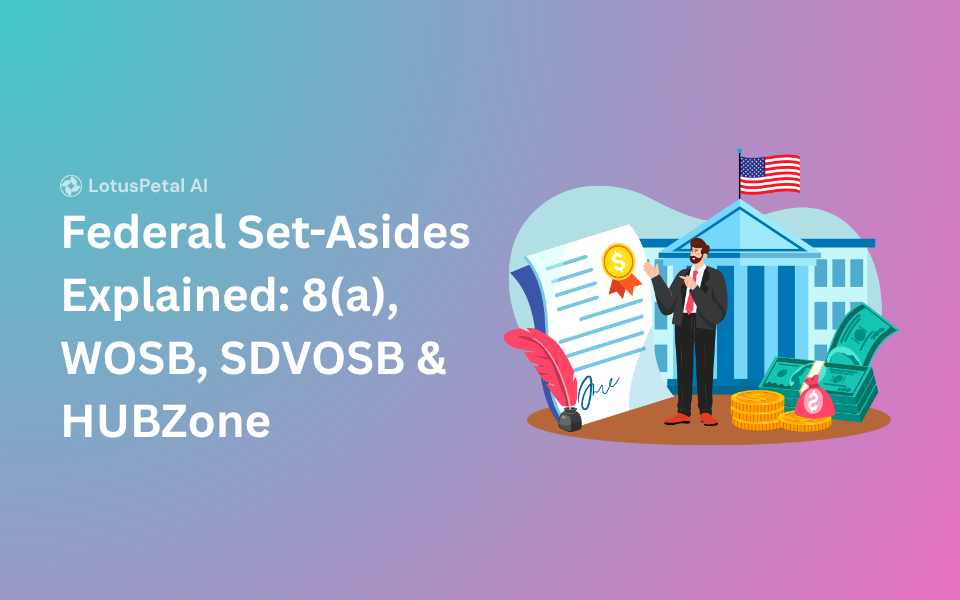
  • Best RFP & Proposal Software of 2026: 6 Tools Compared

    Best RFP & Proposal Software of 2026: 6 Tools Compared


    Table of Contents:


    What is RFP Software?

    RFP software (Request for Proposal software) helps teams manage the end-to-end process of responding to structured procurement solicitations, covering everything from discovering opportunities to submitting compliant proposals. Modern proposal software platforms increasingly use AI to automate compliance extraction, content retrieval, and draft generation. End-to-end RFP software also incorporate capture management and compliance automation, both stages that traditional proposal tools leave unaddressed.


    Most RFP Software Solves the Wrong Problem

    Choosing the right RFP software in 2026 means more than picking a good drafting tool. Ask any proposal team what slows them down, and you’ll hear:

    • “We spend too much time drafting”
    • “Compliance takes forever”
    • “Finding the right opportunities is hard”

    But those aren’t the real bottlenecks. The real issue is this: every stage of the RFP process resets the work that came before it.

    Opportunity research doesn’t carry into capture. The capture strategy doesn’t carry into proposals. Proposal drafts don’t fully reflect the evaluation criteria. So teams aren’t just doing the work. They are rebuilding context at every step. That’s why adding more RFP tools rarely fixes the problem. It often makes it worse.

    What this RFP software comparison actually answers: which platforms preserve context across the entire lifecycle, from identifying the right opportunity to submitting a compliant proposal. For a broader foundation before comparing tools, the AI proposal software complete guide covers how modern platforms are evolving.


    Top RFP & Proposal Platforms in 2026

    Ranked by end-to-end lifecycle coverage, AI capability, and government-market fit, here are the best RFP software tools to evaluate in 2026:

    1. LotusPetal.AI: Best Overall RFP Software for End-to-End Lifecycle

    The only platform connecting opportunity discovery, capture management, AI proposal drafting, compliance automation, and cross-volume orchestration in a single system. Purpose-built for government contractors and enterprise teams.

    2. GovSignals: Best RFP Software for Opportunity Discovery

    Market-leading intelligence and opportunity aggregation for government contracting. Strong early-stage signal, but transitions to manual workflows for capture and proposal execution.

    3. GovEagle: Best RFP Software for Fast Drafting from Past Content

    The platform must leverage past performance, institutional assets, and relevant content to improve efficiency and consistency.

    4. GovDash: Best RFP Software for Partial Lifecycle Consolidation

    Combines discovery and proposal workflows with a broader scope than point solutions. Integration depth between stages varies by implementation.

    5. Loopio: Best RFP Software for Content Library Management

    Mature and widely adopted platform for RFP response management. Excels in template-based workflows and content reuse; capture and compliance require manual processes.

    6. Responsive (formerly RFPIO): Best RFP Software for Enterprise Response Orchestration

    Structured workflows and collaboration features for large enterprise proposal teams. Strong on response management; upstream lifecycle stages handled externally.


    How We Evaluated These Tools

    Each RFP software platform was evaluated across the full RFP lifecycle, not just isolated features. Key evaluation criteria:

    • Opportunity Qualification & Discovery: Does the platform help identify high-fit opportunities or simply aggregate them?
    • Capture Management: Are there structured workflows for qualification, win strategy, and planning?
    • Proposal Generation: Does the platform support context-aware drafting or rely primarily on templates?
    • Compliance & Evaluation Alignment: How well does the system ensure responses meet requirements?
    • Workflow Orchestration: Can teams collaborate efficiently across sections and volumes?
    • Lifecycle Coverage: How well are these stages connected within a single system?

    Disclaimer: Feature descriptions are based on publicly available product positioning and documented platform focus areas.


    What Makes a Great RFP Platform in 2026

    A top-performing RFP software platform does more than help with drafting. The best RFP and Proposal software platforms provide support across every stage of the proposal lifecycle:

    1. Opportunity Discovery & Qualification

    It’s not enough to surface opportunities. The platform must help teams identify which are worth pursuing based on fit, past performance, and probability of win (Pwin).

    2. Structured Capture Workflows

    Capture management is where deals are won or lost. Platforms must support qualification, win strategy, and internal resource planning, not just drafting. Our comprehensive guide to capture management explains why this stage determines win rates more than the proposal itself. 

    3. Knowledge/Content Reuse

    The platform must leverage past performance, institutional assets, and relevant content to improve efficiency and consistency.

    4. Context-Aware Proposal Generation

    AI-assisted drafting must reflect capture strategy, evaluation factors, and past performance, rather than just filling templates. An AI-powered proposal generator should enhance context, not replace it.

    5. Compliance & Evaluation Alignment

    Proposals must meet all client and regulatory requirements automatically. A compliance matrix ensures alignment with Section L and Section M requirements. That’s why compliance automation is no longer optional.

    6. Cross-Volume Consistency & Workflow Orchestration

    Large proposals involve multiple contributors. Structured approvals and cross-volume consistency prevent the misalignments that cost contracts. 


    RFP Software Comparison Table

    This RFP software comparison table summarizes how the six leading proposal software platforms stack up across capture, AI drafting, compliance, and lifecycle coverage:

    Disclaimer note: Feature descriptions are based on publicly available product positioning and documented platform focus areas.

    Which RFP Software Should You Choose?

    The ‘best’ RFP software depends entirely on your team’s priorities. Use this guide to match your primary need:

    If your team needs…Best fitWhy
    Opportunity discovery onlyGovSignalsPurpose-built for early-stage intelligence and bid alerts
    Template-based content libraryLoopioDeep content management with structured reuse
    Enterprise response workflowResponsiveMature workflow orchestration for large procurement teams
    Faster drafting from past contentGovEagleStrong historical content retrieval during response phase
    Partial lifecycle consolidationGovDashCombines discovery and some proposal workflows
    End-to-end AI lifecycle (discovery → compliant submission)LotusPetal.AI Only platform connecting capture, drafting, and compliance in one system

    Best RFP Software by team type:

    Team typeRecommended platforms
    Federal government contractorsLotusPetal.AI, GovSignals
    Enterprise proposal teams (50+ people)LotusPetal.AI, Loopio, Responsive
    Small capture teams (under 10 people)LotusPetal.AI, GovEagle
    Teams prioritizing content reuseLoopio, LotusPetal.AI 
    Teams starting from scratch on AILotusPetal.AI, GovDash

    How Each Platform Handles the RFP Lifecycle

    LotusPetal.AI vs. GovSignals

    Best for: Government contractors who need powerful early-stage opportunity intelligence and bid alerts.
    GovSignals: Key Strengths

    > Market-leading opportunity discovery and aggregation across federal databases

    > Real-time bid alerts and NAICS code filtering 

    > Strong at surfacing relevant opportunities for capture teams 


    GovSignals: Limitations

    > Limited structured support for capture management after discovery

    > Proposal generation typically requires separate tools or manual workflows

    > Lifecycle integration ends at the discovery layer, requiring teams to rebuild context downstream
    When to choose GovSignals

    Your primary need is opportunity intelligence and bid monitoring, and your team already has separate tools for capture and proposal execution.
    When to choose LotusPetal.AI 

    You want discovery insights to flow directly into structured capture workflows and AI proposal drafting, without rebuilding context between tools.

    Key differences

    • Opportunity Discovery: LotusPetal.AI ranks opportunities by fit and past performance; GovSignals excels at aggregation and alerting but doesn’t score opportunities against your win criteria.
    • Proposal Generation: LotusPetal.AI generates AI-assisted drafts aligned with evaluation factors; GovSignals requires transition to external tools for proposal creation.
    •  Lifecycle Integration: LotusPetal.AI connects discovery, capture, drafting, and compliance in one workflow; GovSignals is focused on the early-stage discovery layer.

    LotusPetal.AI vs. GovEagle

    Best for: Teams that need to accelerate proposal drafting using historical content and past performance.
    GovEagle: Key Strengths

    > Fast response generation using past performance data 

    > Strong historical content retrieval for the response phase

    > Reduces time-to-draft for teams with established content libraries


    GovEagle: Limitations

    > Limited structured support for upstream capture planning and win strategy

    > Capture management workflows require supplemental tools or manual coordination 

    > Proposal output may not reflect current capture strategy or evaluation alignment
    When to choose GovEagle

    Your primary bottleneck is drafting speed and you have mature past performance content ready to leverage, with capture handled separately.
    When to choose LotusPetal.AI 

    You need capture management integrated alongside proposal generation, so that strategy and qualification insights carry through to the final response.

    Key differences

    • Capture Management: LotusPetal.AI includes structured workflows for opportunity qualification and win strategy; GovEagle emphasizes drafting with less focus on upstream capture.
    • Proposal Quality: LotusPetal.AI generates proposals aligned with evaluation criteria and capture insights; GovEagle primarily accelerates response creation from existing content.
    • Workflow Continuity: LotusPetal.AI maintains context from discovery through submission; GovEagle may require additional coordination to maintain alignment across tools.

    LotusPetal.AI vs GovDash

    Best for: Teams seeking to consolidate discovery and some proposal workflows into fewer tools.
    GovDash: Key Strengths

    > Broader lifecycle scope than point solutions, covering discovery and some proposal workflows

    > Government-focused feature set relevant to federal contracting teams

    > Useful for teams moving away from fully siloed toolsets


    GovDash: Limitations

    > Depth of integration between stages may vary by implementation and workflow configuration

    > Compliance alignment and cross-volume consistency depend on manual team processes

    > Structured capture management is partial; strategic planning workflows are limited
    When to choose GovDash

    Your team needs to consolidate from multiple disconnected tools and GovDash’s scope covers your primary stages, with some manual coordination acceptable.
    When to choose LotusPetal.AI 

    You need tightly structured transitions between capture, drafting, and compliance, with consistent context maintained automatically rather than by team coordination.

    Key differences

    • Lifecycle Coverage: Both address multiple lifecycle stages, but LotusPetal.AI provides more structured support across discovery, capture, drafting, and compliance.
    • Integration Depth: LotusPetal.AI is designed to maintain consistent context between stages; GovDash’s integration depth can vary based on implementation.
    • Output Consistency: LotusPetal.AI enforces alignment across sections and evaluation matrices; GovDash consistency depends more on team processes.

    LotusPetal.AI vs Loopio

    Best for: Enterprise teams with established content libraries that rely on structured templates and reusable answers.
    Loopio: Key Strengths

    > Deep content library management with structured tagging and search

    > Mature workflow orchestration for large proposal teams

    > Strong adoption in enterprise environments with high RFP volume

    Loopio: Limitations

    > Compliance alignment relies on manual review rather than automated extraction

    > Capture management is handled entirely outside the platform

    > AI drafting is template-driven rather than context-aware from strategy or evaluation criteria
    When to choose Loopio:

    Your team’s primary challenge is content library management and you respond to high volumes of commercial RFPs with structured templates.
    When to choose LotusPetal.AI:
    You need AI-driven contextualization that reflects your capture strategy and compliance requirements, not just template retrieval and assembly.

    Key differences

    • Content Strategy: Both support content reuse; LotusPetal.AI enhances it with AI-driven contextualization aligned to win themes and evaluation criteria.
    • Capture Management: LotusPetal.AI includes built-in capture workflows; Loopio requires capture to be managed entirely externally.
    • Compliance Alignment: LotusPetal.AI automates alignment with requirements and evaluation criteria; Loopio relies on manual review and validation.

    LotusPetal.AI vs Responsive (formerly RFPIO)

    Best for: Large enterprise teams that need structured RFP response workflows and collaboration at scale.
    Responsive (formerly RFPIO): Key Strengths

    > Mature enterprise-grade response management with strong collaboration features

    > Well-established in large procurement organizations with complex approval chains

    > Integrates with common enterprise systems (Salesforce, Slack, etc.)


    Responsive (formerly RFPIO): Limitations

    > Upstream capture management is not part of the platform and must be handled externally

    > AI features focus on response automation rather than lifecycle-wide context

    > Full lifecycle coverage requires significant supplemental tooling or manual coordination
    When to choose Responsive (formerly RFPIO)

    Your organization runs high-volume enterprise RFP programs and your primary need is response workflow management and team collaboration at scale.
    When to choose LotusPetal.AI 

    You need capture planning, AI drafting, and compliance automation connected in one system, particularly for government contracting where lifecycle continuity drives win rates.

    Key differences

    • Workflow Management: Both offer structured workflows; LotusPetal.AI emphasizes deeper automation and orchestration across the full lifecycle including capture.
    • Capture Management: LotusPetal.AI integrates capture planning directly; Responsive focuses on the response phase with capture handled outside the platform.
    • Lifecycle Coverage: LotusPetal.AI supports end-to-end workflows from discovery to compliant submission; Responsive is concentrated on proposal execution.

    The Lifecycle Gap: Why Most Tools Fall Short

    Across all platforms, the same pattern appears: discovery tools don’t support capture, proposal tools don’t incorporate strategy, and legacy systems rely on manual coordination. This creates a lifecycle gap where context is lost between stages.

    The Lifecycle Gap in Practice

    Stage 1 → 2: Opportunity data found in discovery is not scored or qualified for capture, so teams must re-evaluate manually.

    Stage 2 → 3: Win strategy and capture insights developed in planning are not available to the proposal drafting team.

    Stage 3 → 4: Proposal drafts are not automatically checked against evaluation criteria or compliance requirements; review remains a manual step.

    LotusPetal.AI bridges all three gaps in a single connected platform.

    Why End-to-End Platforms Win

    LotusPetal.AI integrates the entire RFP lifecycle, helping teams:

    • Identify high-fit opportunities automatically and score them against your win criteria 
    • Plan and execute capture strategies with structured qualification workflows 
    • Reuse past proposals and institutional knowledge for faster, higher-quality responses 
    • Generate context-aware, compliant proposals aligned with evaluation criteria and Section L and Section M requirements 
    • Maintain consistency across volumes, sections, and evaluation matrices

    Book A Personalized Demo With LotusPetal.AI


    RFP Software Pricing: What to Expect in 2026

    Pricing for RFP and proposal software varies significantly based on platform scope, team size, and market focus. Here is what to factor in when building your business case:

    Pricing factorWhat to consider
    Scope of coveragePoint solutions (discovery only, drafting only) cost less upfront but require additional tools to cover the full lifecycle, adding hidden coordination costs. End-to-end platforms typically cost more per seat but eliminate tool-stacking overhead.
    Seat count & team sizeMost platforms price per user or per seat. Small capture teams (under 10) and enterprise proposal orgs (50+) often have different pricing tiers. Ask vendors about team-size thresholds.
    Proposal volumeHigh-volume teams submitting dozens of responses per month may face volume-based pricing on some platforms. Confirm whether your expected throughput affects cost.
    Security & compliance tierGovernment contractors often require higher security tiers (SOC 2 Type II, FedRAMP authorization). These tiers typically carry higher price points, so confirm this early.
    Implementation & onboardingSome platforms charge separately for onboarding, content migration, and training. Others include it. This can represent 20–50% of year-one cost on complex implementations.
    Contract termsMost enterprise platforms require annual contracts. Multi-year commitments typically unlock discounts. Month-to-month options, where available, carry a premium.

    LotusPetal.AI pricing is tailored to your team’s size, workflow needs, and contract structure.

    Book a personalized demo


    Frequently Asked Questions About RFP Software and Proposal Automation


    What is the best RFP software in 2026?

    Platforms covering the full RFP lifecycle, from discovery to compliant submission, deliver the strongest outcomes.

    LotusPetal.AI provides complete lifecycle coverage with AI-assisted drafting, capture management, and compliance alignment. For teams with narrower needs, GovSignals (discovery), Loopio (content management), and Responsive (enterprise response) are strong point solutions.


    What is the difference between RFP software and proposal management software?

    RFP software typically refers to platforms used by buyers to issue requests. Proposal management software is used by vendors responding to those requests.

    In practice, the terms are often used interchangeably in the vendor market. Modern platforms like LotusPetal.AI go further by covering the full response lifecycle including opportunity discovery, capture planning, proposal drafting, and compliance automation.


    Which RFP tools are best for government contractors?

    Government contractors need platforms with NAICS code filtering, past performance management, and compliance with Section L and Section M evaluation criteria.

    LotusPetal.AI, GovSignals, GovEagle, and GovDash are all purpose-built for GovCon. LotusPetal.AI is the only one offering end-to-end lifecycle coverage from opportunity discovery through compliant submission. 


    Do RFP tools include opportunity discovery?

    Some do. GovSignals and GovDash include discovery, but only LotusPetal.AI carries discovery insights through capture and proposal workflows.

    Most discovery tools hand off to separate platforms once an opportunity is identified. LotusPetal.AI preserves opportunity context (fit scores, strategic notes, competitive intelligence) through every subsequent stage.


    Can AI generate compliant RFP responses?

    Yes. When combined with structured workflows and compliance automation, AI-powered platforms produce context-aware, compliant proposals aligned with evaluation criteria.

    The key is that AI must be grounded in the actual evaluation criteria and capture strategy, not just generic content. LotusPetal.AI extracts compliance requirements automatically and ensures drafts reflect them.


    What is capture management and why does it matter for RFP success?

    Capture management is the structured process of qualifying opportunities, building win strategies, and allocating resources before proposal writing begins.

    Win rates are largely determined in the capture phase, not the proposal phase. Platforms that skip capture and jump straight to drafting miss the strategic foundation that separates compliant proposals from winning ones. 


    How do I choose an RFP platform that supports capture workflows?

    Look for end-to-end lifecycle coverage: structured opportunity qualification, capture strategy tools, requirements management, and workflow orchestration.

    Key questions to ask vendors: Where does your platform start: at discovery or at drafting? How does capture strategy flow into proposal generation? Can teams track qualification decisions and win themes inside the platform?


    What is a compliance matrix and can AI generate one automatically?

    A compliance matrix maps every RFP requirement to the corresponding section of your proposal response, ensuring nothing is missed.

    LotusPetal.AI automatically extracts requirements and generates a compliance matrix as part of its proposal generation workflow. This eliminates the manual effort that typically takes proposal teams days and dramatically reduces the risk of non-compliance. 


    How long does it take to implement RFP software?

    Point solutions (discovery or drafting only) can be live in days. Full lifecycle platforms typically require weeks for configuration and content migration.

    Enterprise response management tools like Responsive can take months in complex environments. LotusPetal.AI is designed for deployment in weeks, with a structured onboarding that includes content library setup and workflow configuration.


    Can small teams benefit from RFP software?

    Yes. Small capture teams often benefit most from AI-assisted platforms because they’re the most resource-constrained.

    For teams under 10 people, platforms like LotusPetal.AI and GovEagle can meaningfully reduce the per-proposal time investment without requiring large content libraries to function well. The ROI is often immediate.


    How does AI prevent hallucination in proposal content?

    The best platforms ground AI generation in specific, verified sources: past proposals, uploaded documents, and explicit capture inputs.

    Hallucination risk increases when AI generates content without constraints. LotusPetal.AI  mitigates this by anchoring drafts to structured inputs (evaluation criteria, past performance records, and capture strategy notes) rather than generating from general training data alone.


    What should I look for when switching from Loopio or Responsive?

    Look for platforms that migrate your existing content library while adding the upstream capabilities (capture and compliance) that your current tool lacks.

    Teams switching from Loopio or Responsive typically do so because they’ve outgrown response-only workflows. Evaluate whether the new platform can import your content library, support capture management, and generate compliance-aligned drafts without requiring your team to rebuild from scratch.


    Take the Next Step with LotusPetal.AI 

    Transform your RFP process into a connected, end-to-end workflow. Stop treating proposals as isolated events and start treating them as the output of a well-structured capture process.

    Book a personalized demo

    Not ready for a demo? Download this comparison as a PDF to help you continue researching.


    Still Researching?

    Dive deeper into related topics:

    Our Core Pillar Guides: